



Quick Summary
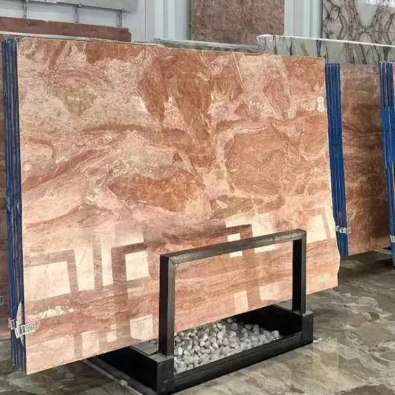
Orange Onyx Slabs are natural decorative carbonate stone slabs distinguished by their warm orange, amber and honey-yellow mineral coloration. The featured 306×204cm and 254×175cm formats can be processed into illuminated wall panels, reception counters, floating vanity tops, decorative tiles and bespoke interior stone components. Their appearance changes considerably under different lighting conditions, making actual slab selection particularly important for backlit architecture. Fabrication and installation decisions should account for natural mineral boundaries, variable translucency, stone thickness and the chemical sensitivity associated with carbonate-based decorative stone.
Orange Onyx Slabs for Backlit Architecture and Custom Interior Stonework
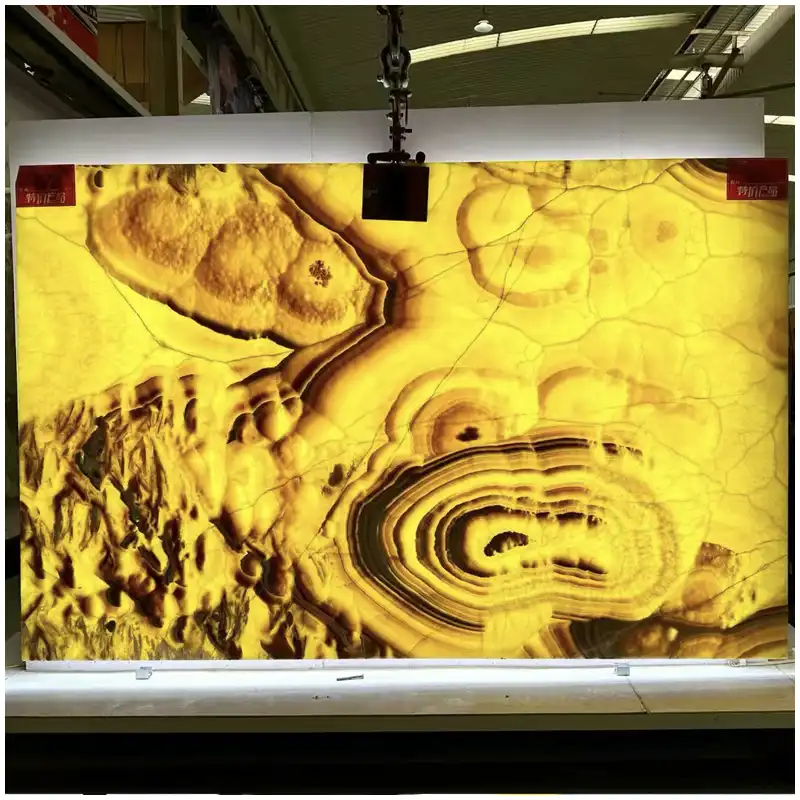
A slab of orange onyx can produce two noticeably different architectural surfaces depending on how it is illuminated. Under ordinary interior lighting, its character comes from the visible mineral coloration, surface finish and distribution of warm tones. When a suitable section is illuminated from behind, differences in mineral density and light transmission become part of the composition.
Orange Onyx Slabs occupy a warmer decorative category than white, blue or pale green onyx. Orange and amber areas can become visually dominant, while yellow and cream-colored regions introduce lighter transitions across the stone face.
In architectural interiors, this color relationship can influence the surrounding material palette. Dark timber, bronze-colored metalwork and neutral wall finishes can frame the stone without competing with its mineral movement. A quieter interior may use onyx as an isolated decorative panel rather than extending its stronger coloration throughout the entire room.
The large slab format is particularly relevant to hotel reception walls, illuminated counter fronts, residential feature panels and customized furniture. Buyers can select the stone before determining exactly where its strongest orange or lighter yellow sections will appear in the finished components.
That freedom also introduces responsibility during fabrication. Natural fissures, repaired areas, mineral boundaries and variations in light transmission can influence the usable cutting area and the suitability of individual sections for different applications.
Orange onyx is primarily a decorative interior material. It should be selected for its particular visual and architectural characteristics rather than treated as a universal substitute for granite, quartzite or other stones intended for more demanding functional environments.
Orange Onyx Slab Sizes and Product Specifications
The featured large slab formats measure 306×204cm and 254×175cm. Both can be considered for decorative architectural fabrication, although the actual cutting arrangement depends on the mineral composition, stone condition and finished component dimensions.
| Product Name | Orange Onyx Slabs |
| Commercial Material | Natural Orange Yellow Onyx |
| Related Sourcing Names | Orange Onyx Marble / Yellow Onyx / Orange Yellow Onyx Marble Slabs |
| Stone Family | Natural Decorative Carbonate Onyx; Exact Mineral Composition by Material Verification |
| Origin | Confirm Quarry and Origin for the Selected Material Lot |
| Color | Orange / Amber / Honey Yellow / Cream-Colored Mineral Transitions |
| Slab Size A | 306×204cm / 3060×2040mm |
| Slab Size B | 254×175cm / 2540×1750mm |
| Thickness | By Selected Slab and Approved Fabrication Specification |
| Surface Finish | Polished Option; Actual Finish Subject to Confirmation |
| Light Transmission | Variable Natural Translucency; Backlit Approval by Actual Sample |
| Backing and Reinforcement | Confirm Existing Treatment and Project-Specific Support Requirements |
| Fabricated Forms | Full Slabs / Wall Panels / Decorative Tiles / Vanity Tops / Counter Fronts / Customized Interior Components |
| Main Applications | Luxury Villas / Hotels / Residential Bathrooms / Reception Areas / Decorative Commercial Interiors |
The slab dimensions represent nominal stone faces. Actual fabrication sizes must account for perimeter trimming, natural fractures, reinforced areas and the required position of the finished component within the original mineral pattern.
Orange Yellow Onyx: Selecting Mineral Color for Different Interior Surfaces
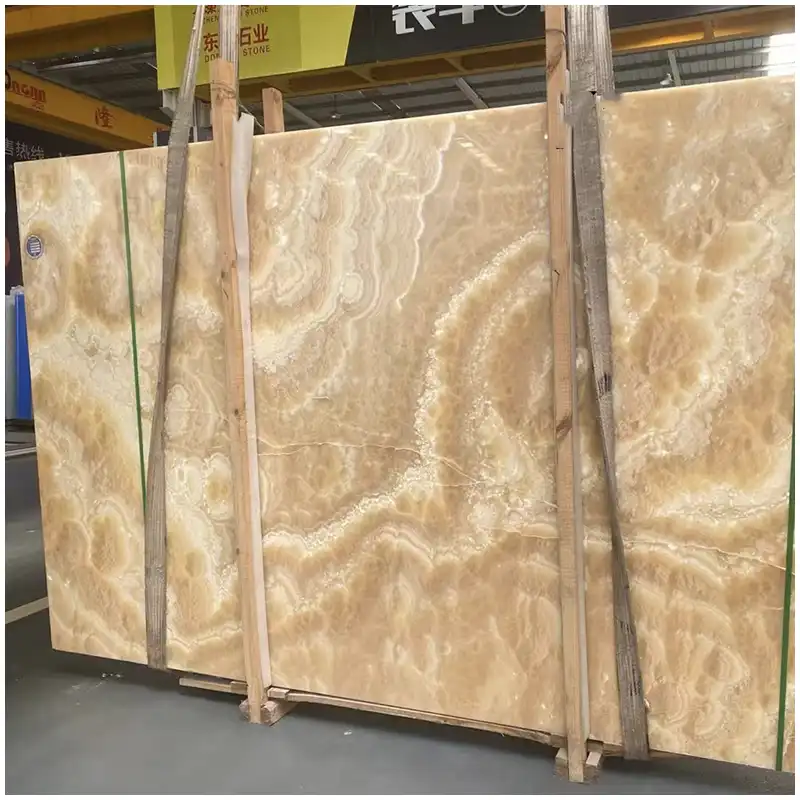
The orange-to-yellow balance of decorative onyx is rarely uniform across a large slab. Some areas may have a deeper amber character, while others contain lighter mineral formations or contrasting boundaries.
This variation allows designers to allocate different parts of the stone to different architectural functions. A prominent reception front may benefit from a concentrated warm mineral composition. A smaller vanity surface might be more visually balanced when selected from a lighter section.
When purchasing Orange Yellow Onyx, it is worth considering how the finished component will be viewed. A vertical panel is normally seen from a distance, making broad color areas more influential. Horizontal surfaces are viewed at closer angles, where smaller mineral details, surface reflections and exposed edges become more noticeable.
A full-slab photograph can help establish the preferred distribution of colors. Nevertheless, photographs taken under different factory lighting conditions may exaggerate or reduce the apparent difference between orange and yellow areas.
Related slabs intended for adjoining surfaces should be photographed under reasonably consistent conditions. A selected slab that appears light yellow in one image may display a stronger amber color when placed beside another stone under the same light source.
For a coordinated architectural package, the approved color range should relate to the intended room lighting and finished component sizes. Matching is more meaningful when assessed at the scale of the final installation.
306×204cm or 254×175cm: Choosing the Right Orange Onyx Slab Format
The difference between the two featured formats is significant for large decorative installations. The 306×204cm slab has approximately 40% more gross surface area than the 254×175cm format, but this does not guarantee a corresponding increase in usable finished stone.
| Slab Format | Gross Area | Potential Fabrication | Cutting Consideration |
|---|---|---|---|
| 306×204cm | 6.24m² | Large decorative wall panels, extended reception fronts and coordinated stone components | Usable face dimensions, panel handling and mineral boundaries |
| 254×175cm | 4.45m² | Vanity tops, decorative furniture, wall inserts and smaller cut-to-size panels | Finished-piece geometry, edge allocation and remaining usable sections |
A feature wall that requires a finished panel approximately 280cm long would normally be evaluated against the larger format. Whether the piece can actually be produced without a joint depends on the selected slab’s clear cutting length and the condition of the required area.
For a group of smaller vanity components, the 254×175cm slab may be more economical if the approved color formations fall conveniently within the cutting outlines. Purchasing a larger slab offers little advantage when its most suitable mineral areas cannot be allocated efficiently.
On illuminated projects, material yield is also influenced by optical appearance. A section may be physically suitable for cutting yet unsuitable for a backlit panel if its light transmission differs substantially from adjacent pieces.
Evaluate gross area, fabrication yield and illuminated appearance as separate purchasing considerations. The largest available slab is not necessarily the best selection for every architectural drawing.
Backlighting Orange Yellow Onyx Marble Slabs
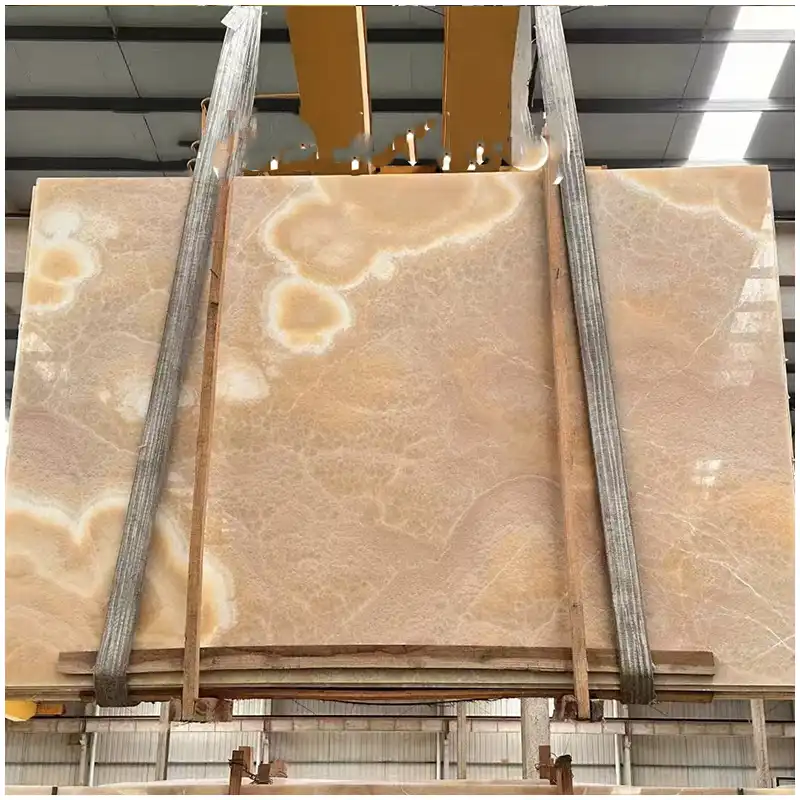
Backlighting reveals characteristics that may not be obvious when an onyx slab is examined under reflected light. Areas that look similar on the unilluminated surface can transmit noticeably different amounts of light.
Orange Yellow Onyx Marble Slabs may contain relatively translucent mineral regions alongside denser or more opaque formations. The resulting contrast is part of the decorative material’s natural identity.
For a large illuminated wall, the objective is not necessarily to eliminate all differences in brightness. The lighting assembly should illuminate the stone evenly enough for its natural mineral variation to remain visible without introducing distracting artificial light patterns.
Light transmission should be examined using the actual stone thickness and proposed backing arrangement. A thin sample may transmit significantly more light than the full-thickness architectural panel.
Existing reinforcement, resin treatment or backing materials can influence illuminated appearance. A backing mesh that is difficult to see on an ordinary polished slab may become more apparent when light passes through the stone.
These conditions should be reviewed before the lightbox, structural support and finished panel thickness are finalized. Removing a backing treatment simply to improve translucency is not appropriate without evaluating its structural purpose.
Backlit approval must follow the selected slab and complete assembly. Natural onyx should not be sold with a guarantee of uniform transparency across every mineral region.
Lighting Color Temperature and Orange Onyx Panel Appearance
The light source can change the perceived color of yellow and orange onyx considerably. A warm LED system may intensify amber and golden coloration, while a more neutral light source can preserve greater distinction between pale mineral areas and deeper orange sections.
The following color-temperature examples are design starting points rather than measured optical properties of the featured slabs.
| Lighting Direction | Possible Visual Effect | Design Review |
|---|---|---|
| 2700K–3000K | Warmer amber appearance with stronger golden-orange emphasis | Check whether pale areas become excessively warm |
| 3500K–4000K | More neutral presentation of yellow, cream and orange mineral regions | Review color balance against adjoining interior materials |
| Dimmable Lighting | Adjustable illuminated presence for different room conditions | Confirm driver compatibility and brightness uniformity |
| Front-Lit Installation | Emphasis on surface finish, reflected light and natural mineral color | Review reflection, glare and viewing position |
Color temperature alone cannot determine the final illuminated appearance. LED spectrum, brightness, diffuser performance and the optical characteristics of the stone also influence the resulting color.
A suitable illuminated mockup should identify potential hotspots, visible LED patterns, dark support shadows and inconsistent brightness near panel joints. There is no universal lightbox depth or LED spacing suitable for every onyx installation.
Permanent illuminated assemblies should also provide suitable heat management and maintenance access. A beautiful stone panel becomes difficult to maintain if a failed driver or light source cannot be reached without dismantling the finished wall.
Natural Onyx Slabs for Hotel Walls, Reception Counters and Interior Furniture
The warmer coloration of orange onyx makes it a particularly distinctive option for interiors that need a concentrated decorative element rather than a neutral stone background.
Different architectural applications require different relationships between the visible stone, the supporting assembly and the expected level of surface contact.
| Application | Architectural Component | Principal Requirement |
|---|---|---|
| Hotel Reception Wall | Large decorative or backlit onyx panels | Panel support, lightbox coordination and access for maintenance |
| Reception Counter Front | Vertical stone facings and illuminated decorative fronts | Impact exposure, return details and concealed lighting structure |
| Villa Feature Wall | Selected full-face or coordinated wall panels | Mineral composition, panel orientation and appropriate fixing |
| Bathroom Vanity | Supported vanity top and decorative apron | Sink openings, water exposure, edge joints and structural support |
| Decorative Furniture | Console surfaces, occasional tables and cabinet inserts | Furniture stability, stone support and protection from abrasion |
| Commercial Display | Display plinth facings, illuminated niches and decorative partitions | Attachment design, maintenance access and protection from accidental impact |
For hospitality spaces, Natural Onyx Slabs are often most useful on decorative vertical surfaces where their mineral character remains visible without continuous contact from beverages, cleaning chemicals or heavy objects.
Functional countertops and furniture surfaces can also be considered, but their service conditions require separate approval. A decorative wall specification cannot simply be transferred to a working countertop.
From Yellow Onyx Marble Slabs to Decorative Tiles and Cut-to-Size Panels
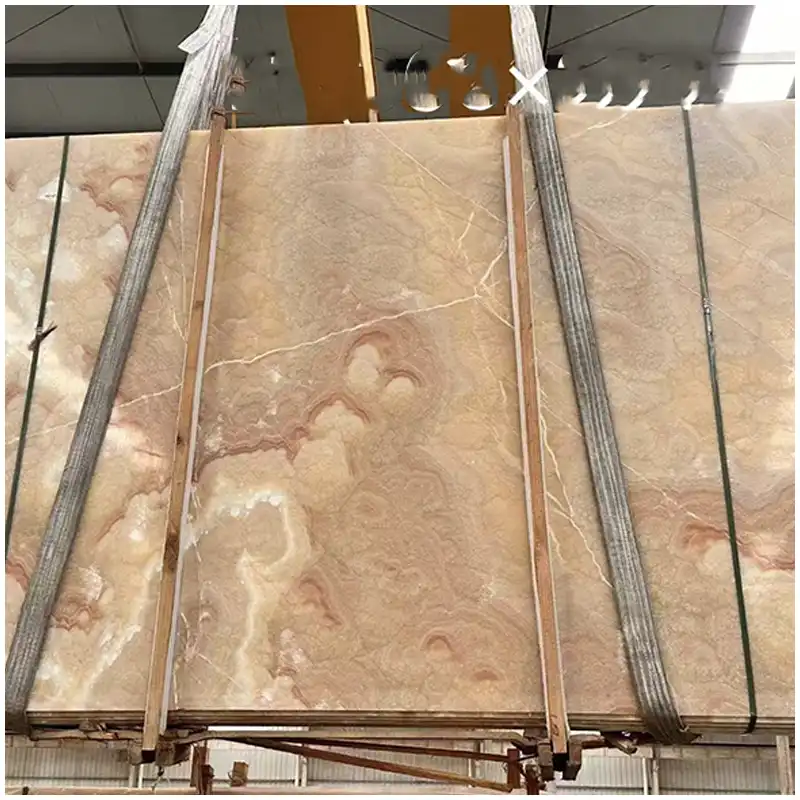
The appearance of yellow onyx changes when a large slab is divided into smaller decorative pieces. A mineral formation occupying only a small portion of the original face may fill nearly the entire surface of an individual tile.
For this reason, the production of Yellow Onyx Tiles requires more than selecting a nominal cutting module. The finished layout should establish how stronger orange areas, lighter yellow pieces and cream-colored regions are distributed.
A sequential arrangement can retain sections of the original slab movement across adjoining tile joints. A blended arrangement creates a different result by distributing the available colors throughout the installation rather than preserving a continuous original pattern.
Both approaches are commercially useful. The correct choice depends on whether the architect wants the finished wall to resemble one continuous mineral composition or a coordinated collection of individual natural stone pieces.
When converting Yellow Onyx Marble Slabs into smaller components, narrow strips and exposed edges need particular attention. A naturally fractured area that remains acceptable within a supported wall panel may not be suitable for a thin decorative trim.
Large panels intended for bookmatching also require appropriate related slab faces. Digital mirroring of a slab photograph does not establish that an equivalent natural stone face exists within the available material.
The cutting schedule should identify finished dimensions, face orientation, edge requirements and the intended arrangement of related pieces. Floor tiles require additional assessment of surface wear and slip performance; the decorative appearance of onyx is not evidence of suitability for high-traffic flooring.
Orange Onyx Floating Vanity Countertops for Luxury Bathrooms
The following application image illustrates a floating vanity countertop using warm orange onyx. It represents a possible interior design direction rather than verification that the pictured assembly was fabricated from the specific slabs described on this page.
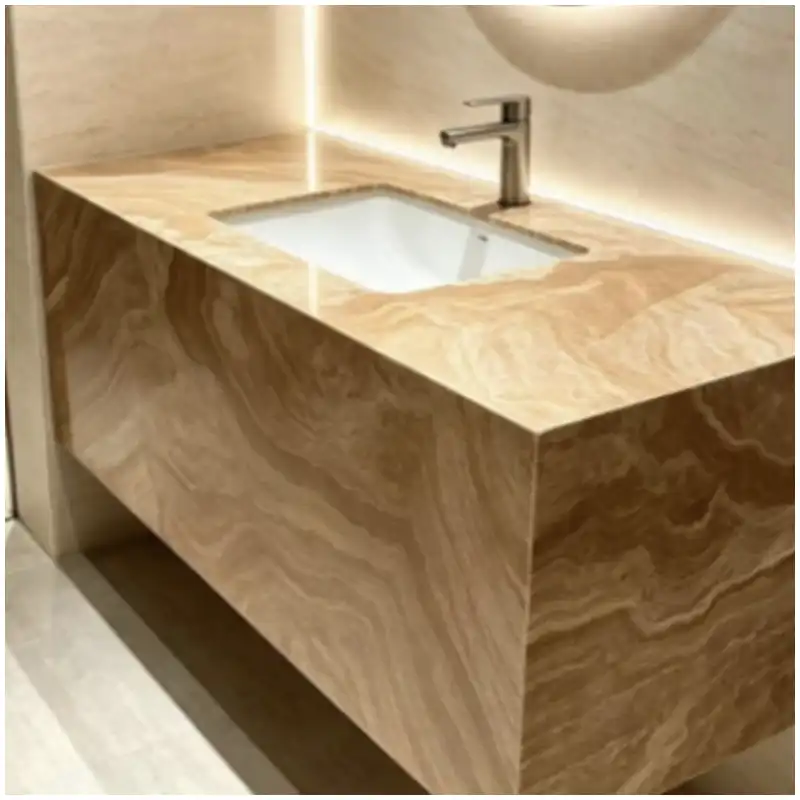
A floating stone vanity creates a visually open bathroom by leaving the space beneath the countertop unobstructed. With orange onyx, the absence of a conventional floor-standing cabinet can place greater visual emphasis on the stone itself.
The suspended appearance, however, must be achieved through a suitable supporting structure. The onyx surface should not be treated as an independently cantilevered structural element. Concealed brackets, framing, wall reinforcement or another engineered assembly must carry the actual loads.
The required support depends on the finished countertop length and depth, the actual stone thickness, basin configuration and the remaining material around openings. These dimensions should be coordinated with the selected wall construction before fabrication.
For an undermount basin, the stone surrounding the cutout requires particular attention. Narrow areas beside a large opening may contain mineral boundaries or repaired sections that need closer evaluation before cutting.
A deep front apron can create the appearance of a substantial stone block while being assembled from individual stone pieces. The mitered joints, internal support and adhesive selection must correspond to that fabricated construction.
The visible orange and yellow areas should also be allocated between the horizontal top and front apron. Exact continuity across a mitered corner may not be possible with every slab. A coordinated transition can be more convincing than forcing an unsuitable mineral section into the edge detail.
Bathroom fabrication should begin with the basin template, faucet specification, countertop drawing and approved structural arrangement. The vanity image establishes the desired appearance; the project drawings establish the actual construction.
Fabrication Requirements for Illuminated and Non-Illuminated Onyx Components
Orange onyx can appear in both conventional stone assemblies and illuminated architectural systems. Although the visible material may originate from the same slab, these finished products have different fabrication priorities.
| Component Type | Fabrication Priority | Approval Point |
|---|---|---|
| Backlit Wall Panel | Suitable thickness, optical appearance and compatible backing | Illuminated mockup and approved panel support |
| Conventional Wall Panel | Face selection, dimensional accuracy and edge preparation | Visible layout, attachment and substrate compatibility |
| Floating Vanity Top | Cutout geometry, exposed edges and coordinated apron joints | Support, basin weight, plumbing access and water exposure |
| Illuminated Counter Front | Optical continuity across front panels and returns | Lighting access, impact protection and assembly details |
| Decorative Furniture | Finished outline, supported spans and edge treatment | Complete furniture stability and intended service conditions |
Where a translucent composite or reinforced stone assembly is requested, its performance depends on the complete construction rather than the decorative stone layer alone. The backing, adhesive, support and lighting components must be compatible with one another.
Any change in slab thickness or reinforcement after illuminated sample approval should trigger another review of the finished assembly. Optical appearance and mechanical suitability may both change.
Yellow Onyx Stone and Onyx Marble Slabs: Understanding the Commercial Material Names
The stone trade uses the word onyx for several decorative materials. Architectural onyx is commonly a carbonate-rich natural stone, often containing calcite or aragonite, whereas gemstone onyx refers to a different silica-based mineral material.
This distinction is important because the performance characteristics of gemstone onyx should not be transferred to architectural Onyx Marble Slabs. Similar commercial names do not establish equivalent hardness, resistance to scratching or chemical behavior.
The term Yellow Onyx Stone describes a broad color category within decorative onyx. Different selections may range from light honey coloration to stronger amber and orange shades. Their geological origin and mineral composition can also differ.
For international stone purchasing, orange onyx and yellow onyx may represent overlapping visual categories. A buyer should identify the intended selection through actual slab faces, approved samples and material documentation rather than relying on a color name alone.
Esta Stone identifies the featured material as Orange Onyx Slabs. This commercial identity establishes the product direction, while the actual quarry source and mineral composition remain subject to confirmation where they are required by the project specification.
Physical Properties and Technical Testing of Natural Orange Onyx
Carbonate-based decorative onyx has different chemical and mechanical characteristics from quartz-rich natural stone. Its behavior can also vary between mineral layers and across naturally occurring discontinuities within the same slab.
Published values for another onyx selection cannot establish the density, absorption, strength or optical performance of the featured Orange Onyx Slabs. Laboratory results must identify the stone tested and its relevance to the proposed finished product.
For formal architectural specifications, the following reference methods and assessment areas may be considered where applicable.
| Property | Reference Method | Project Relevance |
|---|---|---|
| Petrographic Examination | EN 12407 | Mineral composition and natural stone identification |
| Apparent Density and Open Porosity | EN 1936 | Material characterization and preliminary weight assessment |
| Water Absorption | EN 13755 / ASTM C97/C97M | Moisture-related material evaluation |
| Flexural Strength | EN 12372 / ASTM C880/C880M | Mechanical review of panels and fabricated components |
| Compressive Strength | EN 1926 / ASTM C170/C170M | Material characterization where required |
| Abrasion Resistance | EN 14157 | Assessment of relevant wear-exposed surfaces |
| Light Transmission | Project-Specific Optical Assessment | Illuminated appearance at the specified thickness and backing configuration |
The listed methods are reference assessment options, not completed test results for the current material. Test selection, specimen preparation and acceptance criteria should correspond to the stone type and intended use.
Decorative carbonate onyx should not automatically be assigned the material specification limits established for conventional marble. Its commercial association with marble does not demonstrate compliance with a marble dimension-stone specification.
Mechanical test results also do not establish whether a complete floating vanity, illuminated partition or supported wall panel is safe. The finished assembly requires its own construction and engineering review.
Orange Onyx Slab Selection, Fabrication Inspection and Export Packing
Quality control for orange onyx should retain the approved decorative characteristics while identifying material conditions that could affect cutting, handling or installation. Illuminated components introduce additional inspection requirements because some surface and backing features become more visible under transmitted light.
| Slab Identification | Record selected slab faces, actual dimensions, thickness, material lot and required origin documentation. |
| Color Allocation | Assign orange, amber and lighter yellow sections to the approved finished components using actual slab photographs. |
| Material Condition | Inspect natural fissures, repaired regions, mineral boundaries, reinforcement and areas excluded from cutting. |
| Optical Inspection | For illuminated components, review transmitted-light appearance, visible backing features and adjacent panel consistency under approved sample conditions. |
| Finished Dimensions | Measure panel sizes, finished thickness, vanity openings, edge profiles and fabrication tolerances against approved drawings. |
| Dry-Lay Review | Arrange related stone pieces where specified to inspect mineral transitions, seam locations and finished component orientation. |
| Component Numbering | Identify wall panels, apron pieces, counter returns and other related components according to the installation drawings. |
| Export Packing | Select suitable slab bundles or reinforced crates, protective separators, corner protection and transport restraints according to the stone geometry and measured weight. |
Handling arrangements should account for the dimensions and condition of each slab rather than assuming that all decorative onyx can be transported using an identical configuration.
For completed vanity components and illuminated wall panels, packing identification should preserve the approved fabrication groups. Related pieces should remain traceable after crates are unloaded at the project site.
Care and Maintenance of Orange Onyx Walls and Vanity Surfaces
Orange onyx requires maintenance appropriate to a decorative carbonate stone. Acidic substances can react with its mineral surface, leaving visible etching or changes in gloss. Routine cleaning should use a compatible pH-neutral natural stone cleaner and a soft cloth.
Bathroom vanity surfaces may encounter cosmetics, perfumes, toothpaste and cleaning products. Prompt removal of spills reduces unnecessary exposure, while abrasive pads and acidic bathroom descalers should be avoided.
A compatible impregnating sealer may reduce the penetration of certain liquids. However, sealing does not make carbonate-based onyx acid-proof or eliminate its susceptibility to scratches and abrasion.
For illuminated walls, maintenance must also consider the supporting and electrical assemblies. Access panels, lighting drivers and other replaceable components should remain accessible after the decorative stonework is completed.
If a surface treatment is required, test it on representative stone before approving the full installation. Changes in surface color, gloss or translucency can be especially noticeable on warm-colored onyx.
Frequently Asked Questions About Orange Onyx Slabs
What sizes are available for Orange Onyx Slabs?
The featured slab formats measure 306×204cm and 254×175cm, with approximate gross areas of 6.24m² and 4.45m² respectively. Actual thickness, stone condition and usable cutting dimensions must be confirmed before fabrication.
Can Orange Onyx Slabs be used for backlit feature walls?
Suitable translucent slabs can be fabricated into backlit decorative wall panels. Light transmission varies according to mineral distribution, thickness, repairs and backing treatments. An illuminated sample and approved supporting assembly are required before specifying the final installation.
What is the difference between orange onyx and yellow onyx marble?
Orange and yellow onyx are overlapping commercial color descriptions within decorative natural onyx. Orange selections generally emphasize warmer amber or orange coloration, while yellow selections may have lighter honey or golden tones. Actual material identity and color should be confirmed from the selected slab faces.
Can Orange Onyx Slabs be fabricated into floating vanity countertops?
Suitable slabs can be considered for floating vanity surfaces when the complete supporting structure, stone thickness, sink openings, edge joints and plumbing details have been approved. The stone must not be assumed to support itself without an appropriate structural assembly.
Are Yellow Onyx Tiles suitable for floors and bathroom surfaces?
Yellow onyx tiles can be considered for decorative walls and selected interior applications. Flooring requires verified abrasion and slip performance, while wet-area installations require compatible waterproofing, bedding materials and maintenance procedures. Onyx is not automatically suitable for high-traffic floors.
What information is needed for an Orange Onyx Slabs quotation?
Provide the required slab or finished-piece dimensions, thickness, quantity, finish, preferred orange-yellow color balance and delivery destination. Backlit projects should include lighting and backing requirements, while fabricated vanity or furniture orders require component drawings, cutout details and support specifications.
Final Note: Selecting Orange Onyx for Its Finished Architectural Appearance
The value of Orange Onyx Slabs comes from the interaction between natural warm mineral coloration, finished component geometry and the lighting conditions of the installation. A slab chosen for a backlit reception wall may require a different selection process from one intended for a supported bathroom vanity. The 306×204cm and 254×175cm formats offer different fabrication possibilities, but the most suitable material is determined by its usable face, mineral distribution, optical appearance and compatibility with the proposed construction.
Orange Onyx Slabs Compared with Four Colored Decorative Stone Selections
These five decorative stone selections represent different architectural color directions. Orange onyx emphasizes warm amber and yellow mineral coloration, while the related products introduce blue, pink, contrasting striped or green compositions. The actual mineral classification, translucency and fabrication suitability of each selection should be evaluated independently.
| Product | Appearance | Architectural Direction | Buyer Decision |
|---|---|---|---|
| Orange Onyx Slabs | Warm orange, amber and honey-yellow mineral coloration | Illuminated walls, decorative counter fronts and custom vanity components | Warm color balance, actual light transmission and functional-surface suitability |
| Blue Onyx Slabs | Blue mineral coloration with variable contrasting natural movement | Cool-toned decorative walls and architectural accent panels | Blue-tone distribution and illumination response of the selected slab |
| Pink Crystal Onyx | Soft pink crystalline coloration with pale mineral transitions | Residential feature panels and decorative hospitality interiors | Pink shade consistency, crystal boundaries and suitable panel support |
| Zebra Jade Marble Slab | Contrasting striped or banded decorative mineral movement | Directional wall compositions and statement interior stonework | Stripe orientation, adjoining panel alignment and verified material identity |
| Jade Green Marble Slab | Green decorative mineral coloration and natural variation | Green-toned feature walls, decorative furniture and interior accents | Green shade selection, stone classification and component-specific suitability |
Recommended Colored Onyx and Decorative Marble Slabs
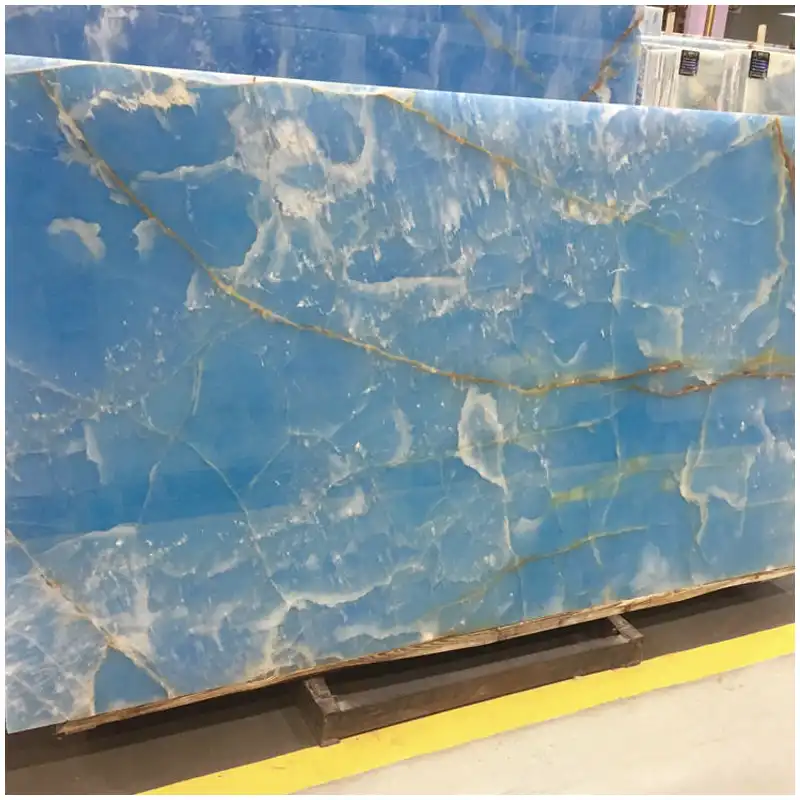
Blue Onyx Slabs
A cooler decorative onyx direction for blue-toned feature walls, illuminated accents and distinctive architectural interiors.
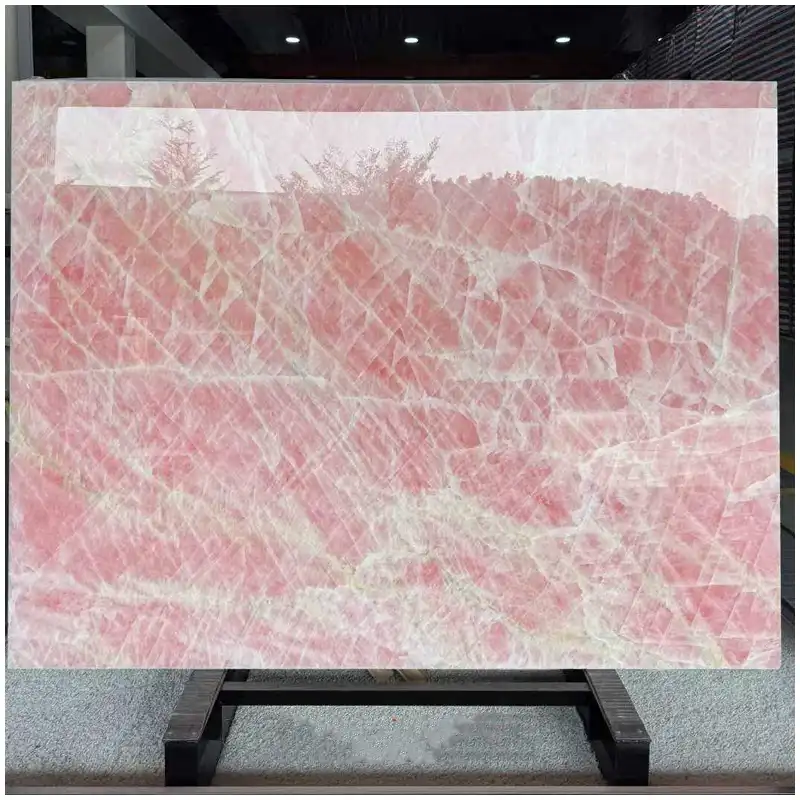
Pink Crystal Onyx
Soft pink mineral coloration for residential feature panels, boutique hospitality spaces and delicate decorative stone compositions.
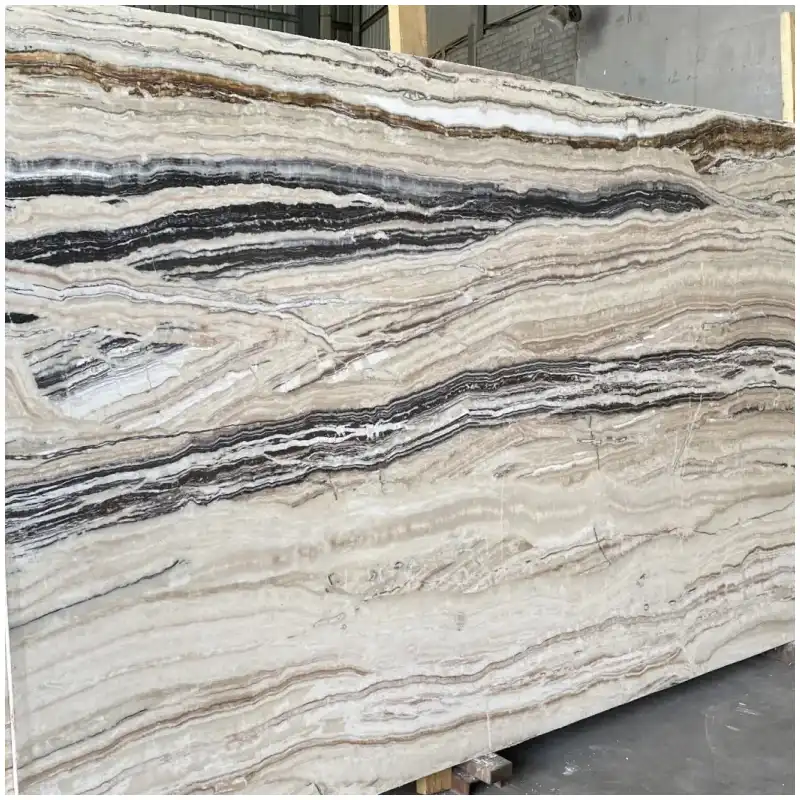
Zebra Jade Marble Slab
A directional decorative stone selection for architectural compositions where contrasting mineral bands define the finished surface.
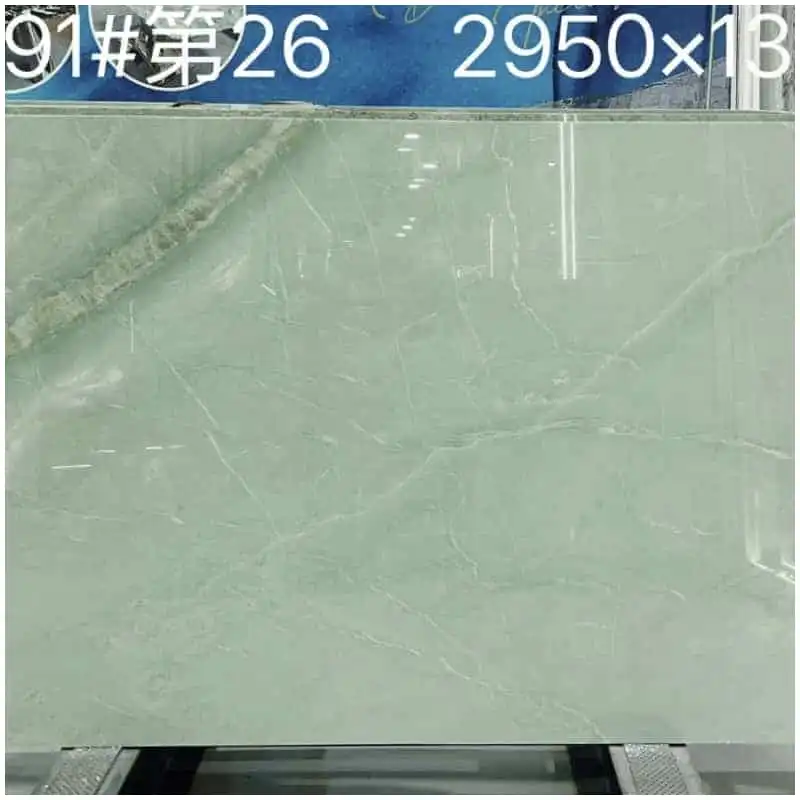
Jade Green Marble Slab
A green decorative stone alternative for custom feature walls, furniture components and coordinated natural stone interiors.
Request Orange Onyx Slabs for Your Interior Floor and Wall Project
For an Orange Onyx Slabs quotation, provide the preferred slab format, required thickness, quantity, surface finish and desired balance of orange, amber and yellow mineral coloration. Include the finished component dimensions, cutting drawings and delivery destination. Backlit wall and counter projects should identify the proposed lighting arrangement, panel support and backing requirements. For floating vanity tops or custom furniture, provide the basin openings, edge details and supporting structure so that the selected stone can be reviewed against the actual fabrication requirements.