

Carrara Marble Mosaic Tile: Herringbone, Hexagon, Basketweave, and Batch Matching
Two Carrara mosaic boxes can carry matching labels and still make a checkerboard on a wall. One run is cooler with tight joints; the other has slightly larger, warmer sheets. Viewed separately, both seem acceptable. Installed together, every sheet edge announces itself.
Sopii carrara marmori mosaiikkilaatta, I open several boxes and place full sheets together before judging color. Then I measure module, joints, alignment, thickness, finish, backing coverage, and any insert. Do not just look at samples. Look for the outline of the sheet.
Pattern changes what the eye notices. Herringbone turns grey lines into movement, hexagon exposes spacing around six sides, and basketweave lets a dark dot dominate a pale field.
Choose Pattern by Surface and Viewing Distance with Carrara marble mosaic tile
At a herringbone vanity wall, I refuse to judge the herringbone rhythm from one flattering crop. I lay several sheets in the actual pattern while the full range is visible. The trouble appears when herringbone magnifies direction changes. Once grout and water enter the picture, the effect of herringbone rhythm becomes easier to judge. The larger field decides; the flattering detail shot does not.

I record backing photographs with box blending sequence. The first locates the slab or piece, while the second preserves the viewing conditions. A darker site result can be compared directly with the recorded condition for basketweave insert color.
Before another process changes the evidence, I examine the production-run identity. I sort warm and cool groups before blending before polishing, sealing, cutting, or cleaning alters what we can prove. The pass-or-reject question is whether herringbone magnifies direction changes. For production-run identity, I step back to read the area, then move close enough to see repairs, edges, pores, joints, and residue.
I keep this detail beside Bianco Carrara Marble Bathrooms because the same white marble must agree across slabs, wet areas, lighting, joints, and maintenance.
Compare Several Sheets before Batch Approval
I pull the herringbone rhythm. I measure the module in both directions before polishing, sealing, cutting, or cleaning alters what we can prove. That view tells me if hexagons expose spacing errors. For herringbone rhythm, I step back to read the area, then move close enough to see repairs, edges, pores, joints, and residue.
When I inspect a hexagon shower floor, I place the hexagon joint network beside the approved reference. I sort warm and cool groups before blending while the full range is visible. A single image can hide the fact that hexagons expose spacing errors. Project light gives the accepted result for hexagon joint network a harsher test than a corrected warehouse image. My approval follows the dry-lay, not the prettiest individual piece.
With Bianco Carrara herringbone marble mosaic, I compare full faces under the project light before accepting tone, veins, finish, and wet-area placement.
Sopii carrara marmori mosaiikkilaatta, choose pattern from the installed surface and viewing distance.
Measure Module, Joint, and Alignment
While viewing a basketweave powder room, I spread out enough material to read the basketweave insert color. I measure the module in both directions while the full range is visible. The installed area may expose that dark inserts overpower the white field. The dry-lay exposes how basketweave insert color behaves when several pieces share one field. A full reading carries more weight than one carefully lit image.
For later comparison, I join lighted range photographs with replacement inventory. Their shared reference lets us compare installed work with the original approval. Those records tell us whether mounted sheet module changed or the viewing conditions did.
The warehouse check then moves to the hexagon joint network. I check joints inside and between sheets before polishing, sealing, cutting, or cleaning alters what we can prove. I am looking for evidence that dark inserts overpower the white field. For hexagon joint network, I step back to read the area, then move close enough to see repairs, edges, pores, joints, and residue.
| Decision point | Evidence to inspect | Release condition |
|---|---|---|
| Kuvio | Direction, insert, viewing distance, use | Rhythm suits the installed area |
| Geometry | Module, chip, internal and edge joints | Sheets align without a grid |
| Backing | Mesh coverage and compatibility | Contact area remains adequate |
| Väri | Several sheets under two lights | Range and blending recorded |
| Grout | Width, color, cure, cleanup | Edges remain clean and balanced |
The Hard-Won Lesson in carrara marble mosaic tile: The sheet outline is the first defect to hunt
A layout can use compatible chips and still reveal every mounted sheet because edge joints are wider than internal joints. The pattern repeats that difference into a grid that random box mixing cannot hide.
The Lesson: Measure and dry-lay sheet-to-sheet joints before batch approval.
Inspect Mesh and Bonding Coverage
From normal viewing distance, I read the basketweave insert color. I inspect backing coverage before polishing, sealing, cutting, or cleaning alters what we can prove. The comparison must settle whether sheet dimensions vary between runs. For basketweave insert color, I step back to read the area, then move close enough to see repairs, edges, pores, joints, and residue.
As I look at several sheets seen from the doorway, I check the individual chip dimensions at the intended viewing distance. I check joints inside and between sheets while the full range is visible. Without the full comparison, the risk is that sheet dimensions vary between runs. The finished setting shows whether individual chip dimensions remains within the approved range. The material passes as a group or returns to the sorting rack.
With carrara marmori mosaiikkilaatta, compare full sheets because tiny pieces still form broad blocks.
Approve Grout with the Actual Marble
During a check of the back before setting, I move the mounted sheet module between warehouse and project light. I inspect backing coverage while the full range is visible. Warm light makes it obvious when mesh reduces bond area. Adjacent stone makes any shift in mounted sheet module more obvious. I need the installed relationship, not a collection of isolated close-ups.
I make the inspection sheet connect reject examples with carton and batch codes. That pair prevents a phone photograph from becoming the only evidence. The site result for sheet-edge alignment has a physical range to answer to.
I keep the lights fixed while checking the individual chip dimensions. I approve a grouted board after curing before polishing, sealing, cutting, or cleaning alters what we can prove. My concern is whether mesh reduces bond area. For individual chip dimensions, I step back to read the area, then move close enough to see repairs, edges, pores, joints, and residue.
I keep White Carrara marble hexagon mosaic beside the approved physical reference so batch drift cannot hide behind a material name.
Blend Boxes without Creating Sheet Blocks
My close inspection focuses on the mounted sheet module. I view under 3000K and 4000K before polishing, sealing, cutting, or cleaning alters what we can prove. The material stays on hold until I know whether one sheet drifts out of square. For mounted sheet module, I step back to read the area, then move close enough to see repairs, edges, pores, joints, and residue.
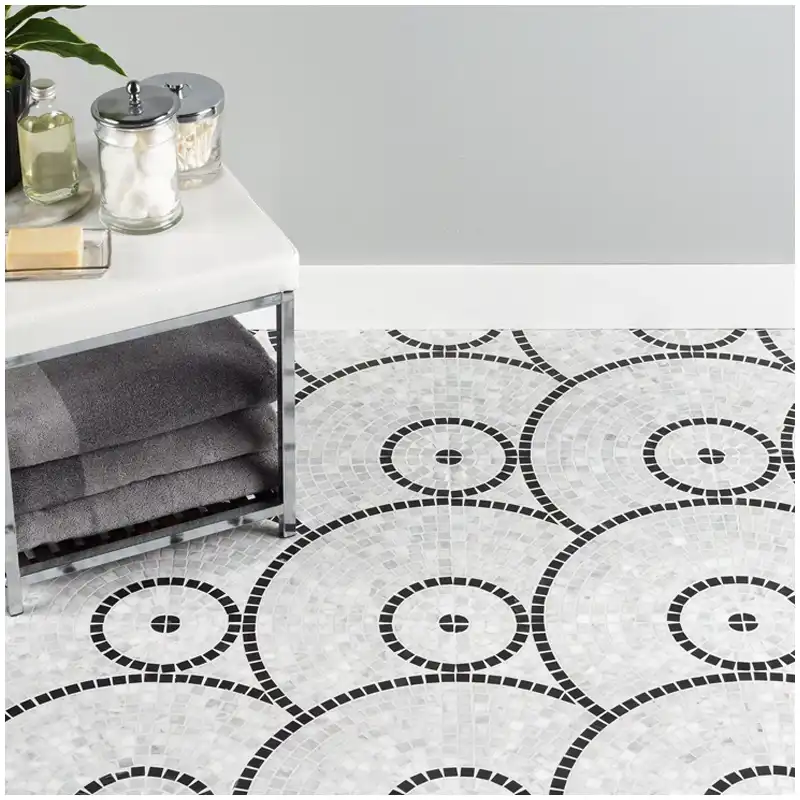
While reviewing a cured grout board, I put the internal joint consistency into the dry-lay before deciding. I approve a grouted board after curing while the full range is visible. Adjacent pieces quickly reveal that one sheet drifts out of square. The complete setting reveals internal joint consistency without the mercy of a cropped photograph. Only the complete arrangement earns a release mark.
Before I accept the batch, I return to Bianco Carrara Marble Bathrooms and check whether this detail still belongs with the complete Carrara bathroom.
When the specification calls for carrara marmori mosaiikkilaatta, measure module, joints, mesh, finish, and grout as one product.
Keep Replacement Sheets with the Installed Batch
Returning to a later repair area, I compare the sheet-edge alignment across several pieces. I view under 3000K and 4000K while the full range is visible. Skip that, and mixed undertones create blocks. Grout, water, light, and neighboring pieces make changes in sheet-edge alignment easier to see. I trust the whole arrangement before I trust a polished close-up.
My warehouse log pairs pattern orientation and location with joint measurements. One identifies the material; the other fixes light, finish, location, and accepted range. If the installation later reads warmer, we can test whether honed versus polished finish caused the shift instead of arguing over screens.
Next I isolate the internal joint consistency. I blend cartons across a defined area before polishing, sealing, cutting, or cleaning alters what we can prove. I want to know whether mixed undertones create blocks. For internal joint consistency, I step back to read the area, then move close enough to see repairs, edges, pores, joints, and residue.
How Small Pieces Create Large Visual Problems
Pattern multiplies direction
Angled layouts make each vein and shade change more active than a straight field.
Mounting quality becomes visible finish
Alignment, squareness, edge spacing, and backing decide whether an even field is possible.
Grout changes the white-to-grey balance
Joint width and color can make the marble feel warmer, busier, or more graphic.
Corners and terminations need a pattern drawing. Herringbone leaves triangular cuts, hexagon can produce uneven halves, and basketweave can lose border rhythm. Show origin, centre line, edge, and transition before adhesive is spread.
Thickness matters where mosaic meets larger tile or slab. Measure the mounted assembly, including backing, and define finished-face alignment so the pale materials meet without a lip or improvised heavy adhesive bed.
Approval must remain tied to the physical reference and the current drawing. For carrara marble mosaic tile, a screen can document position and range, but it cannot settle finish, undertone, touch, or wet response by itself. I keep the signed sample beside the batch record and photograph any approved exception with its piece number, light condition, and intended location.
Under fixed light at a basketweave powder room, I return to the hexagon joint network, and I check joints inside and between sheets. I note sheet and chip dimensions in the warehouse log because dark inserts overpower the white field. A light-dependent shift belongs with sheet and chip dimensions, even when one view looks more saleable.
The final warehouse pass puts the mounted sheet module back beside the reference at several sheets seen from the doorway, and I lay several sheets in the actual pattern. I note lighted range photographs in the warehouse log because wet grout darkens edges temporarily. Both the favorable and unforgiving views remain attached to lighted range photographs.
At the back before setting, I make one more comparison of the mesh coverage, and I blend cartons across a defined area. I note pattern orientation and location in the warehouse log because dark inserts overpower the white field. The actual difference stays in pattern orientation and location rather than being corrected away.
Before applying the release mark, I place the grout after curing in the recorded view at a cured grout board, and I inspect backing coverage. I note backing photographs in the warehouse log because wet grout darkens edges temporarily. I save the condition that exposes the issue with backing photographs, not just the image that minimizes it.
My last close check at a later repair area concerns the hexagon joint network, and I sort warm and cool groups before blending. I note reject examples in the warehouse log because dark inserts overpower the white field. Any change caused by angle or wetness remains visible beside reject examples.
At the recorded viewing distance of a herringbone vanity wall, I reassess the mounted sheet module, and I photograph accepted extremes. I note sheet and chip dimensions in the warehouse log because wet grout darkens edges temporarily. The entry for sheet and chip dimensions tells the next inspector exactly how the material was judged.
Frequently Asked Questions
1. Which Carrara mosaic pattern is easiest to align?
No pattern is automatically trouble-free. Straight modules may be simpler, while herringbone, hexagon, and basketweave demand careful geometry and setting-out.
2. Why do installed mosaic sheets look like squares?
Common causes include edge spacing, size variation, batch tone, mesh distortion, alignment, grout cleanup, or mixed production runs.
3. Should several boxes be blended?
Yes when the approved method calls for it, but incompatible groups must be separated first. Blending does not fix an out-of-range batch.
4. Does grout color affect Carrara?
Yes. It changes contrast and may influence edge darkening during cure. Test the exact grout, width, sealer sequence, and cleaning method.
5. What should happen if one run looks warmer?
Photograph several dry sheets under fixed light, stop mixing that run, and compare carton codes and range evidence before allocation or replacement.
Quick-Reference Checklist for carrara marble mosaic tile
- Lay out several full sheets.
- Measure internal and edge joints.
- Inspect mesh and coverage.
- Compare batches under two lights.
- Approve the cured grout combination.
- Store labelled replacements.
Final Conclusion
Approve mosaics as mounted and grouted fields rather than collections of attractive chips. Pattern, module, backing, range, light, and joints decide whether the surface reads as one material. The final decision on carrara marmori mosaiikkilaatta must stay attached to the evidence that production and site teams can verify.
Lighting lies, so Esta Stone opens more than one box and waits for the grout board to dry before calling a Carrara mosaic approved.
References
- Carraran marmori, Wikipedia.
- Standard Specification for Marble Dimension Stone, ASTM International.
- Natural Stone Institute Technical Bulletins for Wet Areas, Natural Stone Institute.
- ANSI A108 Installation Standards, Tile Council of North America.
- TCNA Handbook for Ceramic, Glass, and Stone Tile Installation, Tile Council of North America.
- Bathroom Planning Guidelines, National Kitchen and Bath Association.
- Search Essentials, Google Search Central.