
Kokemus ja laatu marmori, graniitti, Luxury kvartsiitti, Engineered Quartz Factory Kiinassa
Professional valkoinen marmori laatat ja keinotekoinen marmori valmistaja

Green Marble Vanity

Kategoriat

Ota yhteyttä

Green Marble Vanity
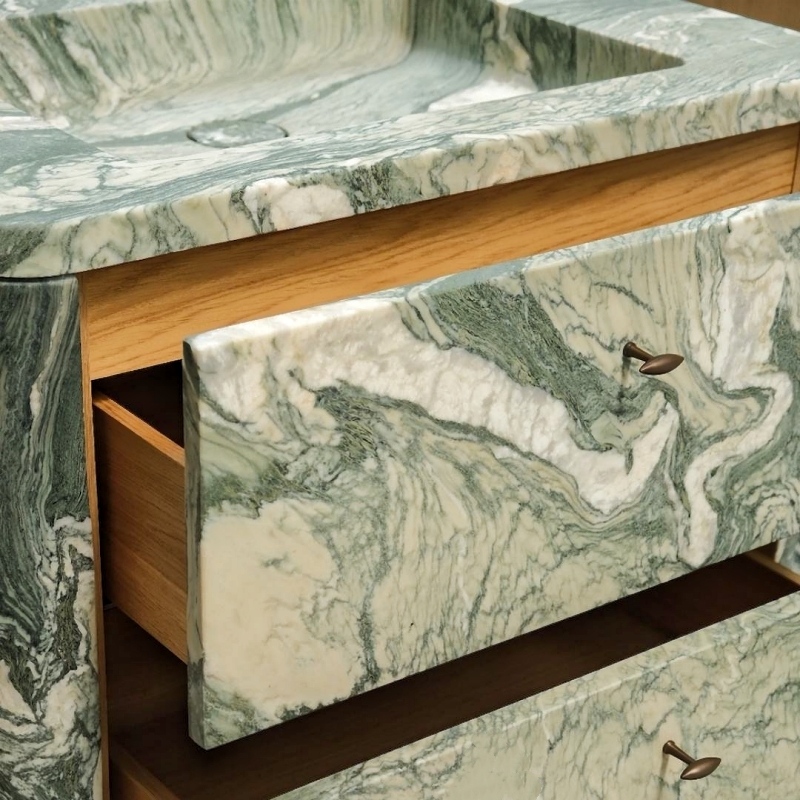
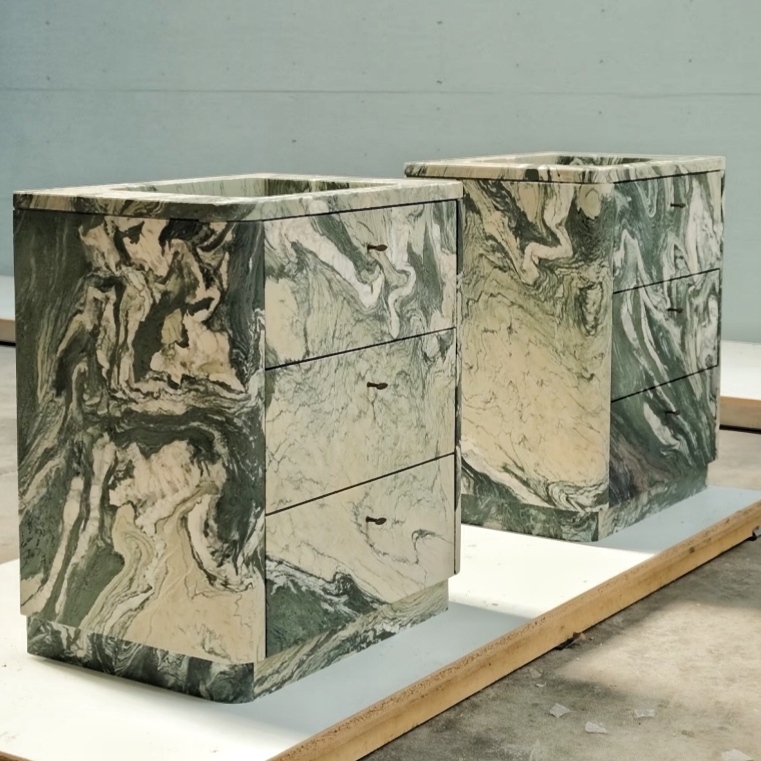
Green Marble Vanity Units are solid stone bathroom furniture pieces built as a thick-walled rectangular box with an integrated basin, finished in a deep green marble crossed by soft grey and ivory swirls. The mitered box form keeps the stone visible on every face, so the vanity reads as a carved block rather than a cabinet with a stone top. The design suits villa bathrooms, boutique hotel suites, powder rooms and cloakroom vanity areas.Because green marble is acid-sensitive and moisture-sensitive, sealing, a waterproofed substrate and low-moisture fixing should be part of every specification.

Kuvaus

Pikaesite

Green Marble Vanity are solid stone bathroom furniture pieces built as a thick-walled rectangular box with an integrated basin. Instead of a stone top resting on a timber cabinet, the vanity is carved from stone: the front, sides and basin surround are all visible marble, mitered at the corners so the block reads as one continuous mass.

The collection covers single and double vanity units, wall-hung and floor-standing versions, with rectangular or softened rectangular basins, optional stone aprons and matching drawer fronts. It suits villa bathrooms, boutique hotel suites, powder rooms, cloakrooms and dressing areas where the vanity is meant to be the object the room is built around.

Green Marble Vanity for Villa Bathrooms, Hotel Suites and Dressing Areas

Green Marble Vanity
Green Marble Vanity
Green marble is chosen for a vanity when the bathroom is meant to feel like a carved interior rather than a fitted one. In a room of travertine, lime plaster and brushed brass, one deep green block gives the space a centre and a colour; in a hotel suite, the same block turns a functional basin into the piece guests photograph.
Esta Stone supplies these units as full stone boxes, cut-to-detail components or complete prefabricated vanities with basin openings, overflow, drawer fronts and stone aprons. Our scope covers block allocation, front-to-side pattern planning, mitered corner fabrication, basin and overflow machining, dry assembly photographs, dimensional inspection and export packing.
The key control point is the corner. A mitered stone box lives or dies on its 45-degree joints: a miter that is slightly open, chipped or filled with visible adhesive destroys the “carved from one block” impression that the design depends on. Every unit should be dry-assembled and photographed at the corners before packing.
The second control point is pattern matching across faces. Because the green ground drifts, the front and the return of the same unit can read as two different stones if they are cut from distant parts of a block. Faces that meet at a corner should ideally come from adjacent cuts, and that allocation has to be planned at slab stage, not at assembly.

Green Marble Vanity for Specification for Single, Double and Wall-Hung Units

The three supplied slab dimensions differ in both length and width. The 320×180cm format is the longest reference, the 300×160cm format maintains a generous width with a shorter length, and the 280×150cm format can be evaluated for narrower components and vanity tops. The appropriate selection depends on the finished cutting plan.

Tuotteen nimi
Green Marble Vanity
Materiaali
Natural green decorative marble
Alternative Trade Names
Green Marble Vanity / Verde Green Marble Vanity / Green Veined Marble Basin Unit
Geological Classification Reference
Green marble of serpentine-bearing type; exact identity by petrographic verification
[VÄRIKUVAUS]
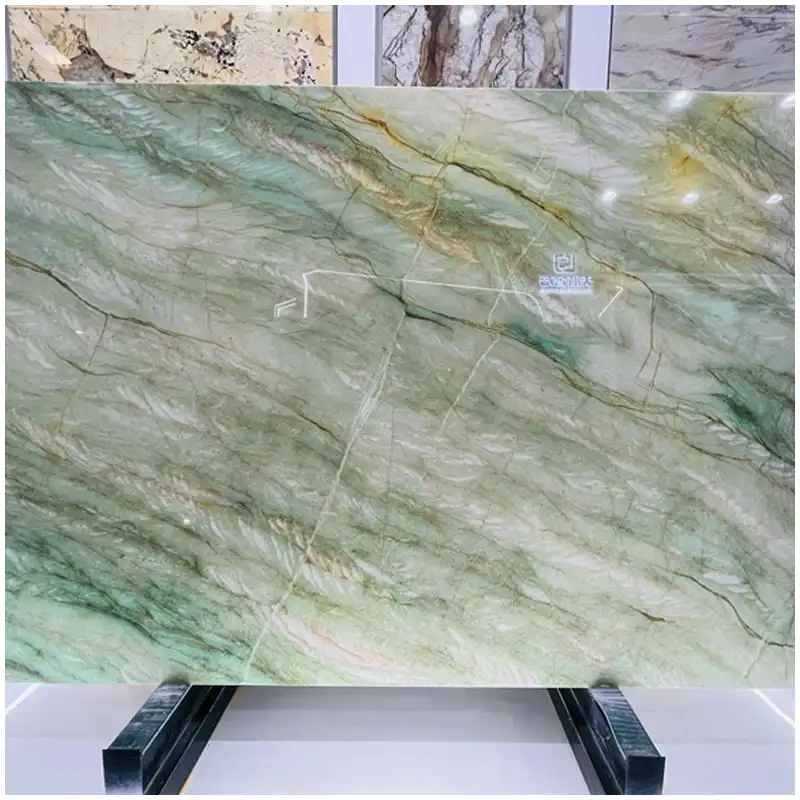
Deep green ground with grey, ivory and white mineral swirls
Unit Forms
Single vanity / double vanity / wall-hung / floor-standing / basin-only block
Basin Type
Integrated rectangular basin with machined overflow
Paksuus Actual Available Thickness by Slab and Order Confirmation
Viimeistely Polished Featured / Honed by Material and Sample Approval
Cut-to-Size Products Bar Tops / Countertops / Wall Panels / Fireplace Surrounds / Vanity Tops
Reunan käsittely
Mitered 45° corners; eased internal basin edges by approval
Panel Matching Sequential Layout / Dry-Lay / Bookmatching if Suitable Related Faces Exist
Pääsovellukset Hotel Bars / Villa Kitchens / Reception Features / Fireplace Cladding

The sizes are nominal slab references, not guaranteed net cutting dimensions. Trimming allowance, kerf, natural fissures, acceptable vein positions and the required finished orientation must be established before calculating the final piece yield.

Layout and Pattern Planning for a Mitered Stone Vanity

Green Marble Vanity
Green Marble Vanity
A mitered box has four visible faces, which makes pattern planning more demanding than for a countertop.
  • Front-to-side allocation: cut the front and the adjacent return from neighbouring slabs so the swirl continues around the corner, or accept a deliberate change of direction at the miter — but decide it, do not discover it.
  • Double units: for a symmetrical double vanity, mirror the two halves around the centre line so the composition reads as one block rather than two cabinets pushed together.
  • Basin placement: centre the basin on the strongest part of the pattern, and check what remains visible in front of and behind it.
  • Wall-hung units: the underside becomes a visible fifth face. Confirm the pattern on the bottom, because on a floating vanity it is seen from a low angle.
  • Drawer fronts and aprons: cut from the same block where possible; a drawer front from a different bundle will read as a replacement part.
  • Mirror and lighting: place the mirror so it does not cut through the most distinctive swirl, and check how the polished face reads under the bathroom lighting rather than showroom light.

Green Marble Vanity vs Other Stone Vanity Forms

The following measurements are published reference results for one natural green marble selection. They support preliminary material comparison but are not the current slab lot’s laboratory certificate. Natural variability and different quarry selections can affect performance.

Fyysinen ominaisuus Test Standard Reference Result
Veden imeytyminen UNE EN 13755 0.09%
Massatiheys UNE EN 1936 2.71 g/cm³
Taivutuslujuus UNE EN 12372 11 MPa
Puristuslujuus UNE EN 1926 157 MPa

These are material-specific reference figures, not confirmed results for the 332×200cm, 299×200cm or 297×157cm slabs offered here. Where a project specifies formal compliance, obtain suitable test documentation for the approved stone, including any required slip, fixing, fire or exposure-related assessment.

How to Select Green Marble for a Vanity

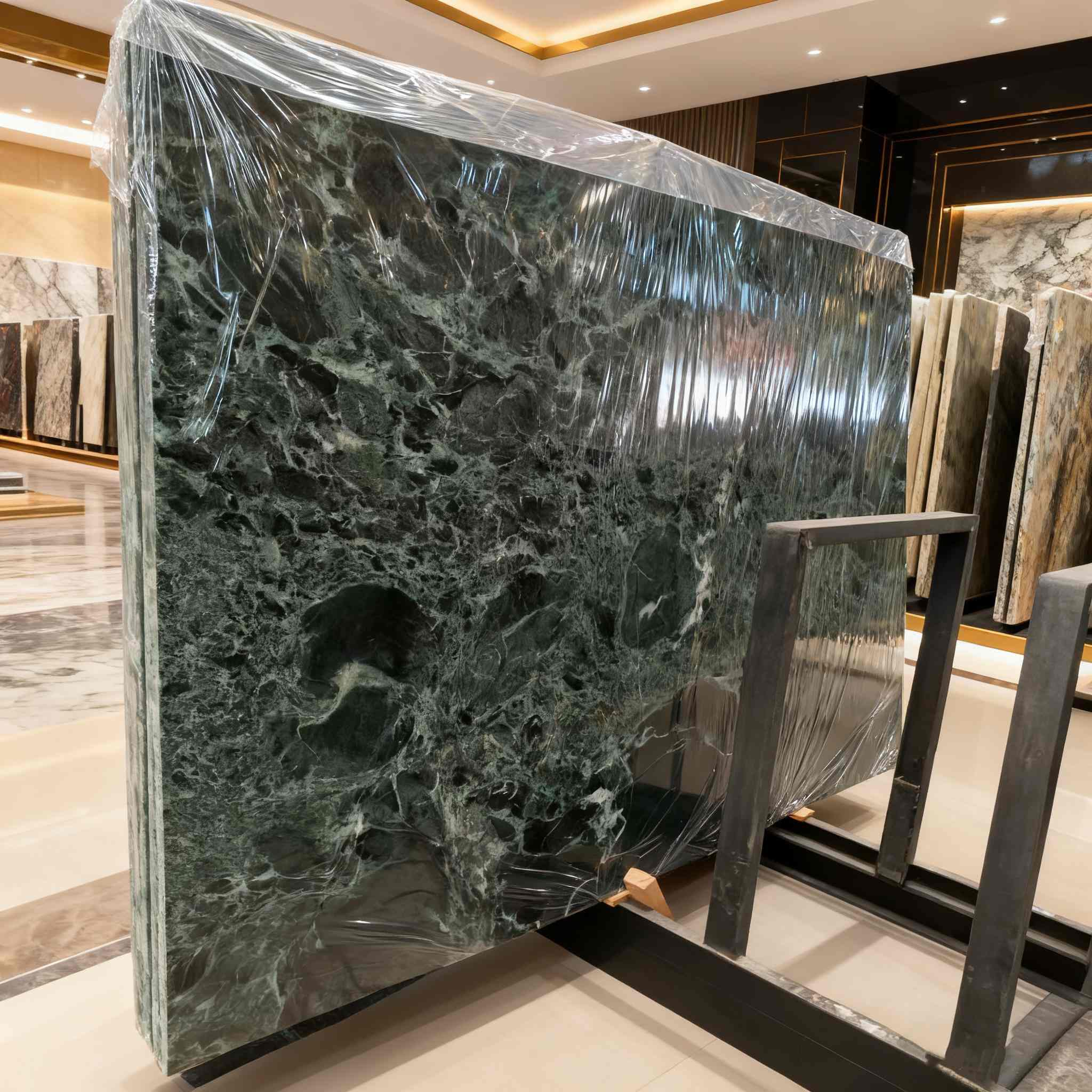
Green marble varies strongly between blocks, and a bathroom is an unforgiving place to discover that. The most useful selection criteria are green depth, swirl density, mineral condition and the intended position of each face.
A darker, more even green with restrained swirls is usually preferred for large double units and hotel projects, where consistency across several bathrooms matters more than individual drama.
Stronger swirls and lighter grey fields are better reserved for single statement vanities, powder rooms and cloakrooms, where one block is seen closely and the pattern can be composed.
Buyers should check whether the green drifts across the block, and whether pale zones sit where a basin or overflow will be machined. A white swirl crossing the basin wall is attractive; the same swirl disappearing into a machined edge is not.
Photographs must be taken under comparable lighting. Dark green stone is particularly prone to misleading contrast when images are brightened or heavily colour-enhanced, and a slab approved from a phone photograph can arrive looking very different.
Fissures must be inspected to distinguish stable mineral veins from open fractures and resin-filled repairs. On a vanity, repairs near the basin edge, the miter and the front face are far more visible than on a wall panel, so grading should be position-based.
Approve the appearance and the usable condition before fabrication begins.

Green Marble Vanity Inspection and Export Packing Requirements

For project procurement, visual approval and dimensional inspection should be related to the same selected slabs. The finished assembly cannot be assessed from material color alone when its value depends on the location and tone of the green veins.

Material Identification Confirm the commercial stone selection, quarry or origin documentation when required, and identification of the approved slab faces.
Visual Approval Review creamy base tone, pink-vein density, grey texture lines, natural fissures and acceptable repairs.
Cutting Schedule Verify usable dimensions, cutting direction, openings, mitered components and numbered project pieces.
Dry-Lay Review Arrange adjoining vanity or wall panels to check major vein transitions and joint positions before final release.
Finished-Piece Inspection Check agreed dimensions, thickness, polish, exposed edges, flatness, joint preparation and fabrication tolerances.
Packing and Identification Protect polished faces and fragile corners, support long or narrow components and label matching pieces by installation position.

Fabrication and Edge Processing for Green Marble Vanities

Processing green marble requires attention to the difference between the dark green ground and the pale mineral veins, which machine and polish differently.
Where a finished edge crosses several mineral boundaries, the fabricator should inspect the surface for localized relief, uneven gloss, small chips and visible filler. On a mitered corner this is the difference between a convincing carved block and an obvious joint.
Basin machining deserves its own check. The internal corners, the overflow slot and the rim thickness should be inspected for chipping, for sealant gaps and for any filler that will be visible once the basin is in use.
Existing resin treatments and mesh backing should be evaluated before cutting. They assist handling but do not establish suitability for structural loading, thin rims or unsupported projections.
Natural discontinuities should be considered when positioning the basin, the overflow and any tap drilling. A vein is acceptable on a front panel and unacceptable at a drilled hole.
For mitered and butt-jointed components, approve decorative continuity and mechanical integrity separately: a joint can look right and still be weak.

Basin Integration, Overflow and Tap Detailing

The basin is where the product succeeds or fails in daily use.
  • Basin geometry: confirm internal dimensions, depth, corner radius and the fall to the waste. A rectangular stone basin with a small radius looks sharper but is harder to machine cleanly and harder to keep clean.
  • Rim thickness: a thin stone rim reads elegant and is more vulnerable; confirm the minimum remaining section around the basin before approving the drawing.
  • Overflow: machined slots must be positioned where the pattern does not run into the cut, and the internal channel must be accessible for cleaning.
  • Tap and waste drilling: confirm centre lines, diameters and clearances against the selected fittings, and drill after the pattern is approved rather than before.
  • Splash behaviour: stone basins tend to splash more than ceramic ones because of the harder, flatter surfaces; confirm the depth and the upstand height with the client.
  • Sealing of the basin: all internal surfaces, the rim and the joint between basin and top should be sealed and re-sealed on a maintenance cycle.

Installation, Moisture and Support for Stone Vanity

A solid stone vanity is heavy, and green serpentine-bearing marble is also moisture-sensitive. Both facts have to be resolved at drawing stage.
Support and fixing. Floor-standing units sit on levelling pads or a stone plinth and must be plumb and evenly supported; a unit resting on three points will crack at the fourth. Wall-hung units require a designed steel frame or a reinforced masonry wall, with the load calculated from the actual stone weight, not estimated.
Substrate and waterproofing. The wall behind the unit, the floor beneath it and the joints around it must be waterproofed as a system. A sealer on the stone is not a substitute for a waterproofed substrate.
Moisture sensitivity. Some green serpentine-bearing stones show dimensional movement when moisture enters one face. Where testing identifies sensitivity, use low-moisture or reactive-resin adhesives and avoid water-retentive bedding; allow the stone to dry evenly during installation.
Joints and sealant. Use a neutral-cure silicone at the wall and floor junctions, not a rigid grout that will crack as the unit moves. Confirm the sealant is compatible with the sealer so the joint does not discolour.
Pre-installation checks. For unfamiliar lots, test a specimen for stability and adhesive compatibility, and dry-fit the unit on site before final fixing.

Packing and International Shipping for Stone Vanities

A stone vanity is a box of thin-walled stone held together by joints, which makes it one of the more fragile items in a stone order.
  • Corners first. Mitered corners are the most vulnerable part; use corner protectors and rigid cradles so the unit cannot rack in transit.
  • Basin protection. Protect the internal basin with a removable insert or padding, and never stack components inside the basin.
  • Component identification. Basin block, front panel, apron, drawer front and hardware should be numbered to the drawing so installation does not require guesswork.
  • Dry packing. Never pack pale or green stone wet; moisture in a sealed crate leaves staining and efflorescence.
  • Shipping. Confirm package dimensions, gross weight, lifting points and unloading method, and ensure wooden packaging meets destination phytosanitary requirements.

Care and Maintenance for Green Marble Vanities

Green marble records what happens in a bathroom, and a vanity receives everything.
Daily cleaning. Soft cloth, clean water and a pH-neutral stone cleaner. No acidic descalers, no vinegar, no abrasive powders — all three dull or etch this stone.
Products to keep off the stone. Toothpaste with whitening agents, hair dye, perfume, nail polish remover and acidic bathroom cleaners can stain or etch within minutes. Rinse and dry promptly.
Water and soap. Wipe the basin and the rim after use; standing water leaves rings, and soap residue builds a film that is harder to remove than the original mark.
Sealing. A penetrating sealer should be applied at installation and renewed according to use, typically more often in a family bathroom than in a guest suite. Test the sealer on an offcut, because it can deepen the green and dull the pale swirls.
Scratches and gloss. Localized re-polishing can create visible gloss variation because the dark ground and the pale veins respond differently. For substantial damage, professional assessment is better than household repair.

Frequently Asked Questions About Green Marble Vanity

Are these vanities made from solid stone?
The featured design uses solid green marble for the box, the basin and the visible faces, assembled with mitered joints. Internal reinforcement, fixing method and any concealed support should be confirmed through the approved construction drawing.
Is green marble suitable for a bathroom?
Yes, with the right detailing. It is a decorative stone that is softer and more acid- and moisture-sensitive than quartzite or granite, so sealing, a waterproofed substrate, low-moisture fixing and pH-neutral cleaning are essential rather than optional.
Can the basin be machined into the stone?
Yes — the basin is cut into the block with a machined overflow and waste. Basin size, depth, corner radius and minimum rim thickness should be confirmed on the drawing before production.
Can a double vanity be book-matched?
Yes, and it should be: the two halves are usually mirrored around the centre so the unit reads as one block. This requires consecutive slabs from the same block, reserved at slab stage.
How is a wall-hung stone vanity supported?
On a designed steel frame or a reinforced wall, with the load calculated from the actual stone weight of the complete unit including the basin. Standard cabinet brackets are not sufficient for solid stone.
Does it need sealing, and how often?
Yes, on all faces including the basin interior. Renew according to use — more frequently in a daily family bathroom, less in a guest suite. Always test the product on an offcut for colour change.
Will the front and the side of the unit match exactly?
Not necessarily, and they should not be presented as identical. The pattern drifts across the block, so faces are matched by tone and swirl direction rather than by continuity. Approve the unit dry-assembled and photographed at the corners before packing.

Recommended Marble Slabs for Countertops and Interior Panels
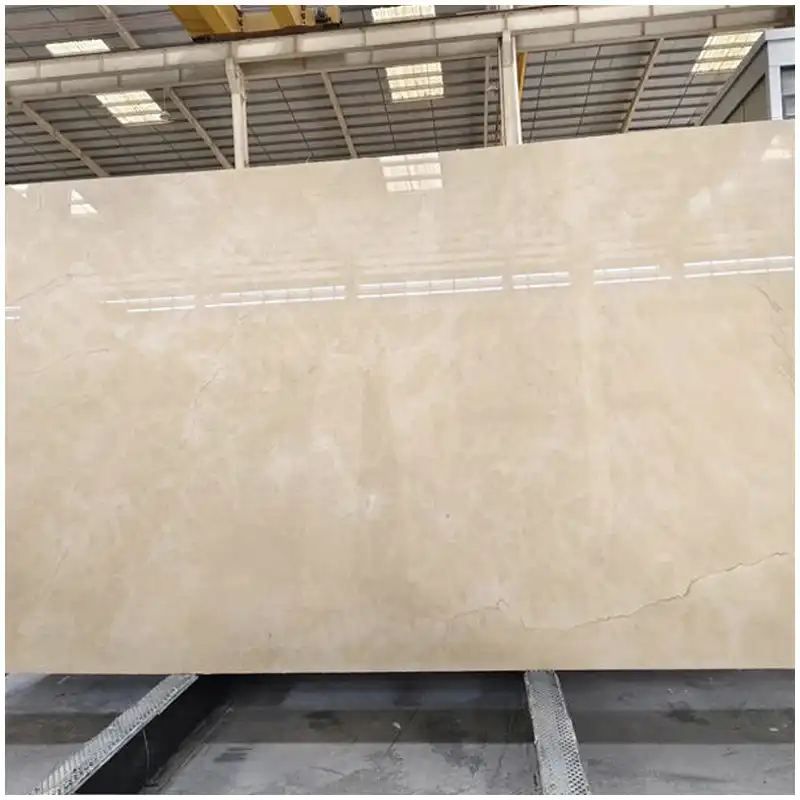
Crema Marfil Marble Slabs showing cream beige Spanish natural stone

Crema Marfil marmorilaatat

Spanish cream-beige marble for coordinated neutral interior wall and floor surfaces.
Katso lisää

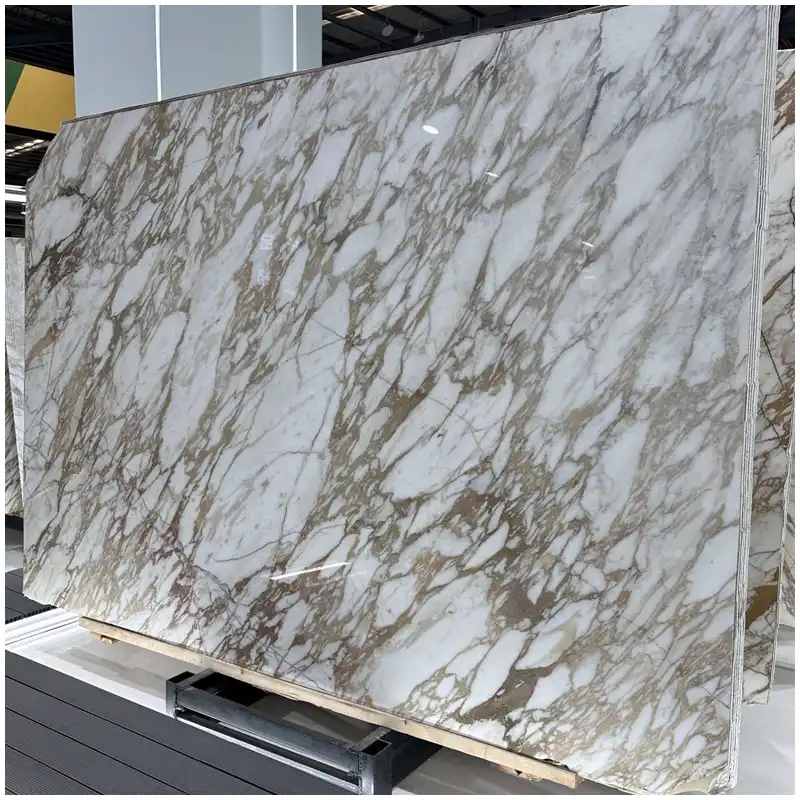
Calacatta Gold Marble Slab with white background and grey golden natural stone veins

Calacatta Gold Marble Slab

White Italian marble selection with grey-gold vein movement for architectural panels.
Katso lisää

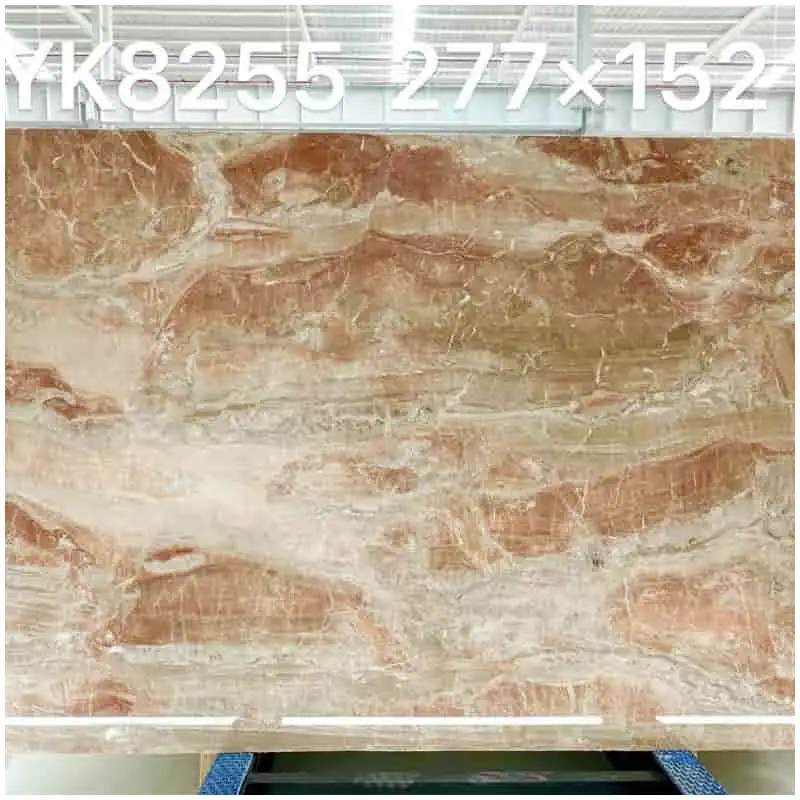
Breccia Damascata Marble Slabs showing contrasting warm breccia natural stone pattern

Breccia Damascata -marmori

Warm breccia-pattern marble for feature panels with more fragmented movement.
Katso lisää

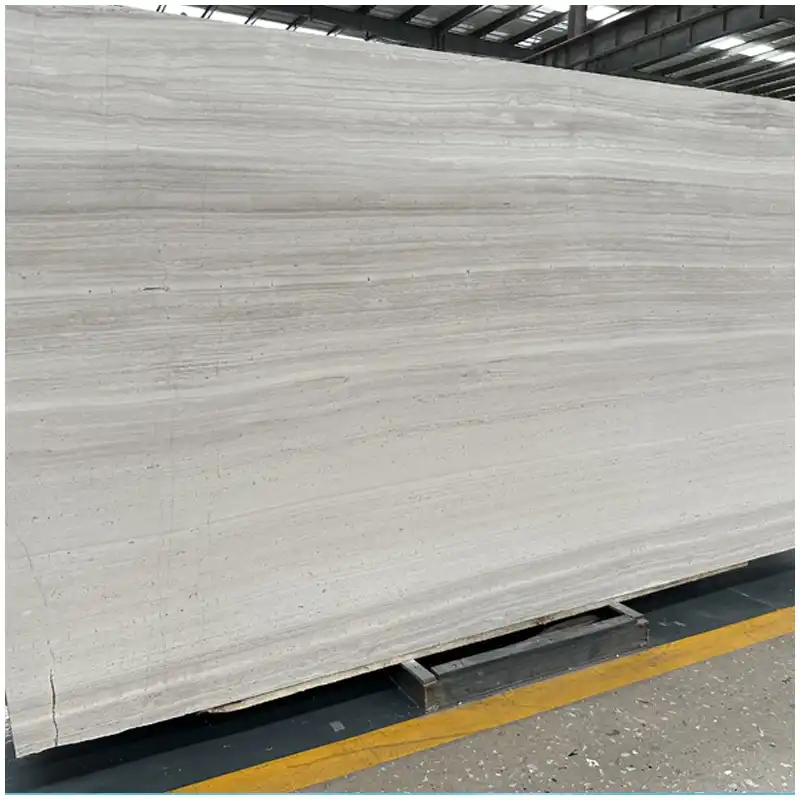
White Wooden Marble Large Slabs with white grey directional stone banding

Valkoinen puinen marmori

Directional white-grey marble for wall panels with continuous linear grain.

Katso lisää

Request Green Marble Vanity Photos and Custom Interior Project Quote

Sopii Green Marble Vanity and single basin blocks, provide the required length, depth, height, stone thickness, basin dimensions, mounting type (floor-standing or wall-hung), finish and quantity with delivery destination. Villa and hotel projects should include the bathroom drawings, basin and tap positions, mirror cabinet layout and the support conditions at the wall and floor, so the unit can be reviewed as one construction rather than a box of components. Where quarry provenance is a project requirement, request the corresponding documentation for the approved block.

Request Green Marble Vanity Quote Katso marmorilevyt

Saatat myös pitää

Lähetä kysely

Tiedustelu