


Bianco Carrara Marble for Bathroom Projects: Slab Range, Light, and Approval
A sound slab can still deserve rejection from an approved bathroom group. A cooler grey background and a busier vein network may fall outside what the sample suggested. Place that face beside warmer, quieter slabs and it reads like material from another decision.
That is the daily reality of Bianco Carrara marble. A small piece can show a pleasant white field and one fine grey vein. It cannot show the slab’s full movement, where grey clouds gather, whether strong lines cross a vanity cutout, or how several bathroom walls will read together.
Don’t just look at samples. Approve the range, assign the slabs, test the finish, check the bathroom light, and review the pieces together before packing. Natural variation is not a defect. Uncontrolled variation is a project failure.
Read the Bianco Carrara Marble Slab Range
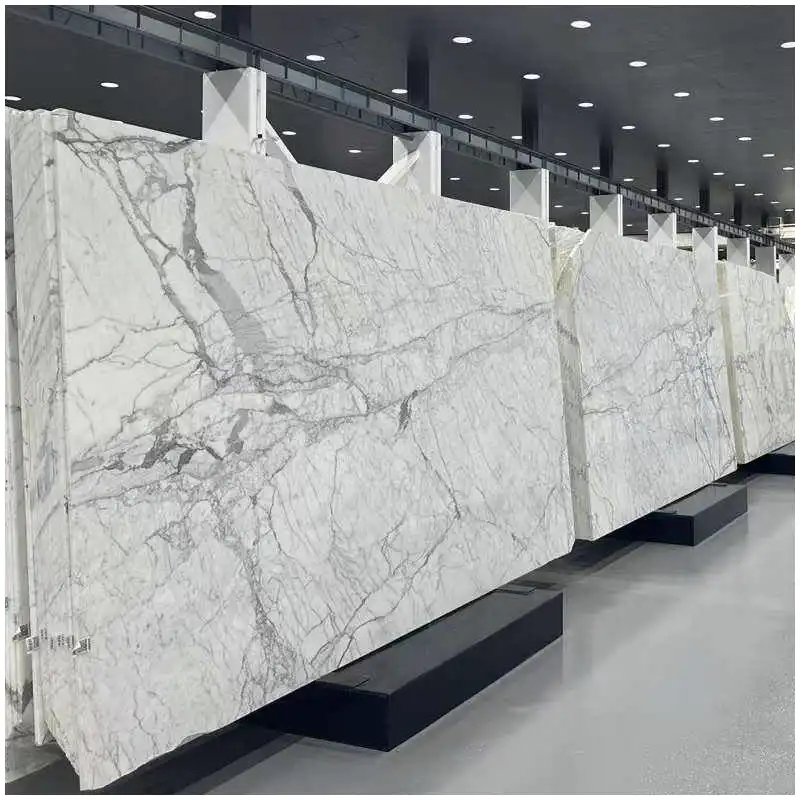
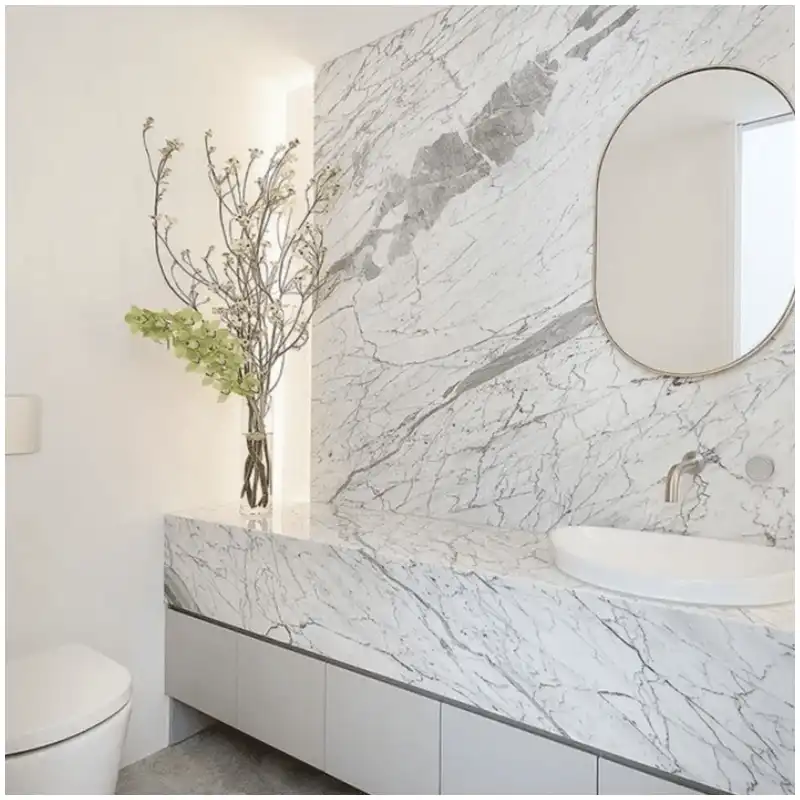
Bianco Carrara marble comes from the Carrara region and contains a light calcite-rich background with grey mineral movement. Commercial selections vary in background brightness, grey cast, vein thickness, clouding, small mineral marks, repair, and slab size. Trade grade names can help sorting, but they do not replace the actual offered slabs.
I want full-face photographs taken square to the slab, with stable exposure, visible labels, and enough resolution to read veins and cloudy zones. Then I want close photographs of open features, fills, resin, chips, repairs, and back treatment. Wet photographs are not enough because water deepens color and hides some surface conditions.
The range board should include the lightest, darkest, quietest, and busiest accepted examples. One unusually clean chip creates an impossible inspection standard. The buyer needs to know what normal approved variation looks like before cutting, not after a wall has been installed.
The Bianco Carrara marble parent decision also needs measured slab sizes and a yield plan. A visually beautiful range that cannot produce long vanity tops, tall shower panels, or matched returns is not the right project set. Sound usable area matters more than the gross square meters on the bundle list.
For current product routes, Marbre Bianco Carrara provides a material starting point, while Dalles de marbre de Carrare can be checked when the project needs different sizes or visual range. We still approve the actual slabs offered for the order.
| Warehouse check | Pass condition | Hold condition | Record |
|---|---|---|---|
| Background tone | Falls inside signed white-to-grey range | Strong warm or dark shift beside connected slabs | Full-slab group photograph |
| Vein density | Suitable for assigned wall, floor, or vanity zone | Busy slab enters a quiet repeated bathroom group | Annotated allocation image |
| Repairs and features | Within agreed size, density, and location limits | Repair crosses cutout, edge, anchor, or focal face | Face/back repair map |
| Finish response | Matches signed benchmark when clean and dry | Haze, gloss drift, filler contrast, or edge mismatch | First-piece photographs |
| Bathroom light | Accepted under intended source and orientation | Tone changes break the approved material relationship | 3000K/4000K comparison set |
Do not let grade labels make the decision
Labels such as C, CD, select, extra, or first choice are not always used identically across suppliers. Ask what the grade means in that offer. Then judge background, vein, clouding, feature limits, slab dimensions, finish, and usable yield against the signed project range.
The separate Carrara Marble Slab Grades: Background Tone, Vein Density, and Batch Range article goes deeper into that problem. The short version is blunt: if the grade name and the full slab disagree, believe the slab.
Compare 3000K and 4000K Bathroom Lighting
Lighting lies. A 3000K source usually warms the scene and can soften cool grey movement. Around 4000K, the same stone can appear cleaner, cooler, and more graphically veined. That does not mean one light is correct. It means the project should approve the marble under the light it plans to use.
Bianco Carrara marble on a horizontal vanity reflects ceiling and mirror light differently from a vertical shower wall. A polished face creates stronger highlights; a honed face spreads reflection and can appear slightly lighter or milkier. Put samples in their installed orientation.
Mirror lighting can make the vanity edge, sink opening, and backsplash joint more visible than the main field. Downlights can exaggerate relief or surface waviness on walls. Daylight may cool one end of the bathroom while warm fixtures control the basin zone.
I compare the stone with the actual or representative ceramic basin, wall tile, grout, sealant, metal finish, and cabinet color. A cool white basin can make Carrara look greyer. Warm paint can make the same slab look cleaner. The relationship matters more than an isolated color reading.
Photographs include the approved sample and state the light condition. Phone white balance can erase or invent a difference. Remote images help selection, but sensitive final approval needs physical references and a working mock-up where possible.
The Hard-Won Lesson: Approve the quiet slab beside the busiest slab
A quiet Carrara slab and a highly clouded slab can each look attractive alone. Place them in one bathroom group and the quiet piece reads almost plain while the other takes over the wall. Different lighting will not repair that visual break. The problem was the range decision, not the installer.
The Lesson: Compare the extremes of the accepted range together before assigning any connected bathroom surfaces.
Assign Carrara to Walls, Floors, Showers, and Vanities
A bathroom is not one visual zone. The vanity is seen close and under direct mirror light. The floor is read as a field. The shower wall is broken by corners, plumbing, niches, glass, and water. Each location needs its own slab or tile selection logic.
For vanity tops, map the sink cutout and faucet holes over the slab. Do not place an open feature or conspicuous repair in a narrow front rail or beside the faucet. Decide where the strongest vein remains after the basin area disappears. Check exposed ends, splashes, and any laminated edge.
A Bianco Carrara marble vanity top can guide the format discussion, but the exact sink drawing must control the project piece. That slab doesn’t belong next to your bathtub if the boldest repaired line lands where water and direct light will emphasize it.
Shower walls need water-management details before stone layout. Substrate, waterproofing, joints, movement accommodation, penetrations, niche slopes, shelves, corners, sealant, setting material, and maintenance affect performance. The responsible project team approves the installation system.
Vein transitions at inside corners should be intentional. Bookmatching can create a formal focal wall, while flow matching can continue movement more quietly. Random cuts may work for smaller modules, but they still need an accepted blend. The strongest vein should not vanish into a niche and reappear without explanation on the return.
Bathroom floors need finish and slip assessment suitable for the service condition and local requirements. Honed surfaces may reduce glare but are not automatically compliant. Module size, joints, drainage, slope, lippage, sealer, cleaning, and wet use all affect the result.
Keep repeated rooms in controlled groups
For hotels and multi-unit work, allocate slabs or tile batches by floor, room type, or connected zone. Pairs and mirrored rooms can use balanced groups. Spare pieces carry the same group code. Random mixing across every crate destroys the work completed during approval.
Dry-lay the areas where transitions matter: feature walls, large floors, vanity pairs, shower sets, and stair-like threshold details. Piece codes and arrows stay visible. Any approved swap updates the packing and installation record.
The existing Comment s’approvisionner en marbre de Carrare à grande échelle pour des projets commerciaux haut de gamme article covers supplier checks. This bathroom guide owns the separate decisions around wet zones, light, sinks, floors, and repeated room groups.
Approve Finish, Cutouts, Dry-Lay, and Installation Interfaces
Bianco Carrara marble changes under polish and hone. Polishing deepens contrast and reflection. Honing softens glare and can make the grey background feel calmer, while showing water or oil differently. Approve the actual finish on representative stone, including veins, fills, and edges.
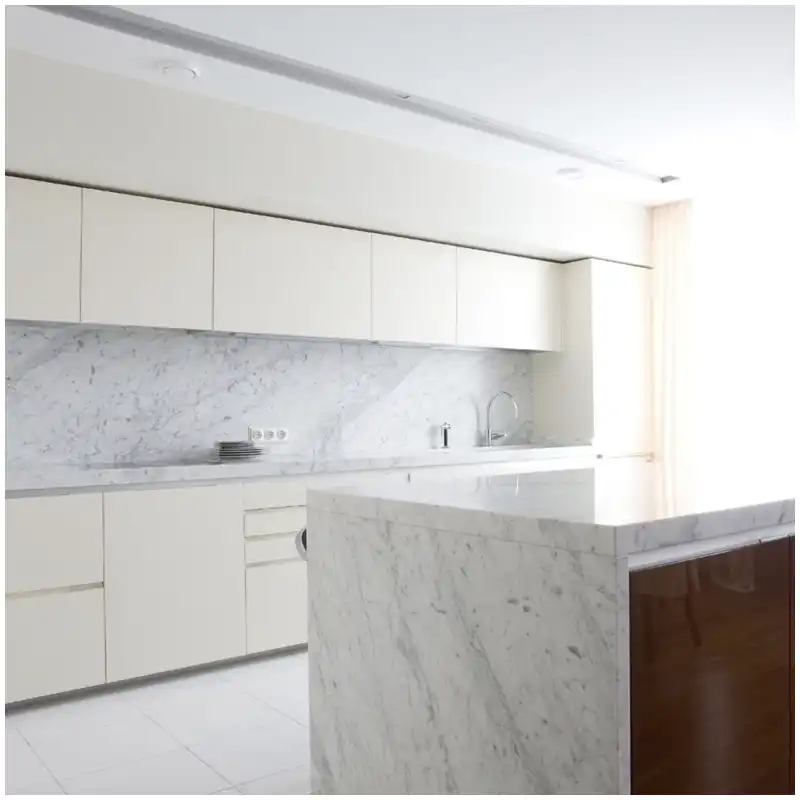
Finish samples should be large enough to show mineral movement and workmanship. Inspect face-on and with raking light. Check scratches, haze, swirl, filler contrast, edge finish, and transitions between factory and hand-polished areas. Clean and dry the sample before judging.
First-piece inspection sets the production benchmark. Verify piece code, drawing revision, length, width, thickness method, squareness, cutouts, holes, edges, face, back, repairs, labels, and orientation. A beauty photograph cannot prove measurements.
Dry-lay under stable light. Do not photograph one group in shadow and another near a bright door. Show the complete layout, then close details of disputed transitions. The buyer’s comments identify exact pieces and actions instead of saying “make it more consistent.”
Installation mock-ups should include substrate, setting material, joint, grout, sealant, finish, edge, and cleaning method. White marble can be sensitive to moisture, adhesive color, curing, staining, and construction contamination. Follow the approved installation specification and manufacturer guidance.
The question Does Carrara Marble Stain Easily? Water, Oils, Grout, and Cleaning deserves its own diagnosis because staining, etching, moisture darkening, picture framing, rust, and residue are different conditions. Do not treat every mark with one chemical.
Hold the work when the evidence changes
Stop cutting if the slab range changes, a replacement slab enters the order, the finish drifts, repairs appear in restricted zones, or the drawing revision moves critical openings. Update allocation and obtain approval before continuing. Silence is not approval.
If a site piece looks wrong, photograph the complete area and close detail under normal light, record piece and room codes, and pause installation. Compare the issue with slab images, dry-lay, finish sample, inspection record, and packing file. Contact the supplier before grinding, harsh cleaning, sealing, or replacing.
Set Wet-Zone Maintenance and Replacement Records
Marble is calcite-based and can react with acids. Etching is surface change, not the same as absorbed staining. Soap residue, hard-water deposits, grout haze, moisture darkening, metal-related discoloration, and organic stains each need different diagnosis.
Use pH-appropriate cleaners recommended for the stone and approved installation system. Test products in an inconspicuous location. Avoid improvised acidic descalers. Keep standing water, toiletries, hair products, and colored oils from remaining on the surface longer than necessary.
Sealer can reduce absorption for some staining agents, but it does not make marble acid-proof, waterproof, or maintenance-free. The sealer selection, application, cure, compatibility, and renewal plan follow the project specification and product instructions.
For Bianco Carrara marble replacements, keep slab or batch IDs, finish, thickness, piece drawings, area groups, dry-lay, installation materials, sealer, cleaning record, and spare inventory. A later slab may not match perfectly. The record helps the team choose where a replacement can be accepted.
Quick-Reference Checklist for Carrara Bathroom Approval
- Compare complete slabs for background, clouding, vein density, repairs, dimensions, and usable yield.
- Place the lightest, darkest, quietest, and busiest accepted slabs together before approval.
- View horizontal and vertical finish samples under the intended 3000K and 4000K conditions.
- Map sinks, faucets, niches, corners, drains, exposed ends, and strong veins before cutting.
- Allocate repeated rooms, connected walls, floors, and spare pieces in traceable visual groups.
- Approve first pieces and dry-lay with stable lighting, piece codes, and exact comments.
- Diagnose site marks before cleaning, refinishing, sealing, or replacing the stone.
What Makes Carrara Approval Reliable
Why the range matters more than the label
The label identifies a commercial material family. The range decides whether the actual backgrounds, veins, repairs, sizes, and finish can form one coherent bathroom package. Buyers need both, but acceptance comes from the slabs.
What the bathroom adds to slab selection
Bathrooms add direct mirror light, water, cutouts, corners, sealant, grout, toiletries, close viewing, and repeated cleaning. Those conditions make placement and finish decisions more visible than a general slab photograph suggests.
When the warehouse should refuse release
Refuse release when the range exceeds approval, a replacement slab is undocumented, yield fails, repairs enter restricted cuts, finish misses the benchmark, dry-lay transitions break, or piece identities no longer match the packing record.
Frequently Asked Questions
1. Is Bianco Carrara marble suitable for bathrooms?
Yes, when the responsible team approves the slab range, finish, wet-zone installation system, slip requirements, sink and niche layouts, lighting, maintenance, and replacement plan. Suitability depends on the application and accepted natural behavior.
2. Why does Carrara look greyer than the sample?
The full slab may contain more grey background or clouding than the small sample, and cooler lighting can emphasize it. Compare the actual slab with the signed range under stable light before cutting, then check it under the intended room light.
3. Is honed or polished Carrara better for a shower?
Neither finish is universally better. Compare appearance, wet use, cleaning, maintenance, slip requirements, and the specified installation system. Approve a representative finish sample and follow applicable project standards.
4. How should Carrara slabs be matched across hotel bathrooms?
Approve a realistic range, group slabs by background and vein intensity, allocate groups by floor or room type, preserve slab-to-piece codes, dry-lay sensitive sets, and keep suitable spares tied to the same visual zone.
5. What should happen if installed pieces look mismatched?
Photograph the complete connected area and piece codes under normal light, pause further installation, and compare with the approved range, allocation, dry-lay, and pre-shipment records. Contact the supplier before aggressive cleaning, refinishing, sealing, or removal.
Final Conclusion
Bianco Carrara marble gives a bathroom quiet depth when full slabs, light, finish, wet-zone layout, dry-lay, maintenance, and replacements are controlled as one record. Don’t just look at samples; I would rather reject one wrong grey slab in the warehouse than explain a broken bathroom range later, and that is the standard Esta Stone keeps before cutting starts.
Références
- Dimension Stone Design Manual, Natural Stone Institute.
- ASTM C503 Standard Specification for Marble Dimension Stone, ASTM International.
- Natural Stone Institute Care and Cleaning Guidance, Natural Stone Institute.
- Natural Stone Flooring Guidance, Stone Federation Great Britain.
- TCNA Handbook for Ceramic, Glass, and Stone Tile Installation, Tile Council of North America.
- Kitchen & Bathroom Planning Guidelines, National Kitchen & Bath Association.
- Marbre de Carrare, Wikipedia, English edition.