Greitas apibendrinimas
Calacatta, Carrara, and Statuario marble for interior projects
White marble is easy to like in a photo and harder to approve in a real project. A sample may look perfect on a desk, but the finished room depends on scale, lighting, grout, cabinet color, wall paint, and the way veins move across the surface. This is why Calacatta, Carrara, and Statuario marble should not be treated as interchangeable names.
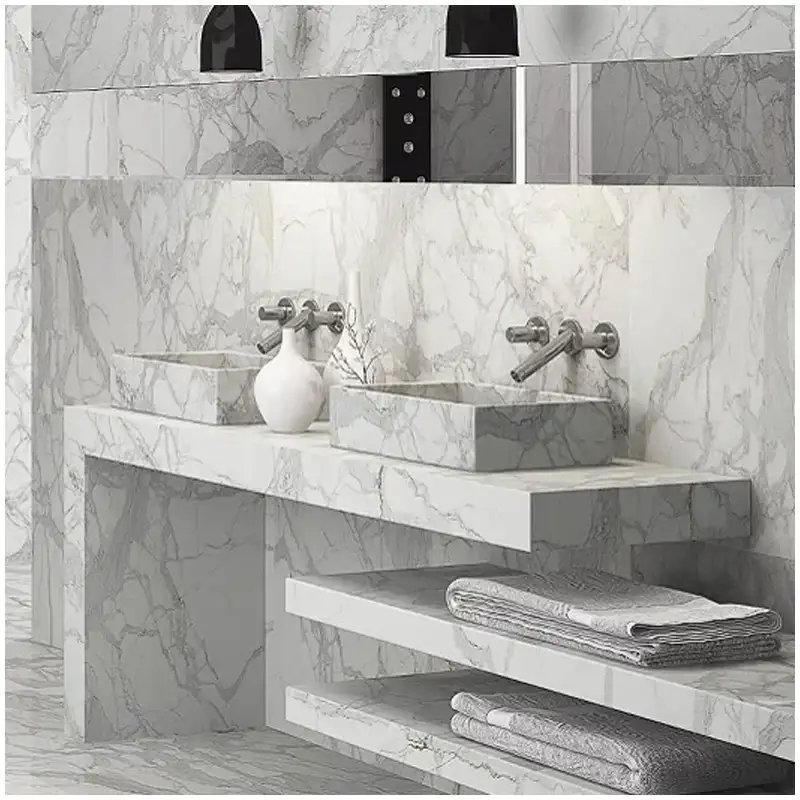
Each of these marble types can work in bathrooms, kitchens, hotel rooms, vanity areas, corridors, floors, and feature walls. The difference is how much visual energy the stone brings into the room. A quiet Carrara tile wall may make a bathroom feel calm. A bookmatched Calacatta slab may turn the same wall into the main feature. A bright Statuario vanity backsplash can look crisp, but it needs careful slab selection so the pattern does not fight the mirror, faucet, or cabinet finish.
This guide is written for interior designers, homeowners planning a renovation, hotel design teams, stone fabricators, and renovation companies comparing marble stone for real rooms. It explains how to choose between marmuro plokštės, marble tiles, and alternative white surfaces without relying only on a stone name.
Why the marble name is only the starting point
Calacatta, Carrara, and Statuario are commonly used in stone discussions, but the name alone does not approve the material. Natural stone varies by block, quarry area, slab, batch, finish, and cutting direction. Even within one familiar marble name, one bundle may have a cleaner white ground while another may show more gray, gold, clouding, or wider veining.
A project should therefore start with the design intention, not only the name. Is the room supposed to feel quiet, bright, dramatic, traditional, or more architectural? Does the stone cover a small vanity splash or a large wall? Will the surface sit beside warm wood, black metal, chrome, painted cabinets, or strong lighting? These questions decide whether a bold stone is helpful or too much.
Size also changes the answer. A stone with strong veins may look balanced on a large wall but too busy when cut into small floor tiles. A gentle marble may look refined on floors and shower walls but may not provide enough contrast for a feature panel. For this reason, full-slab photos and current tile lot photos are more useful than small polished samples.
Esta Stone’s selection process should keep the public product path clear: choose a marble family, check available slabs or tiles, review the application area, and then decide the finish and layout. That order gives the room a better chance of looking intentional after installation.
Calacatta marble: stronger contrast and larger movement
Calacatta marble is often chosen when the project needs a more visible stone pattern. It usually has a lighter background and stronger vein movement than many Carrara selections, though every slab needs review. The veins may be gray, beige, taupe, or gold-toned depending on the material. This makes Calacatta useful for feature walls, vanity backsplashes, fireplace surrounds, kitchen islands, and hotel bathroom accents.
The benefit of Calacatta is presence. A large slab can give a room a clear focal point without using strong paint color or decorative pattern. In a bathroom, it can work behind a freestanding tub or across a vanity wall. In a kitchen, it can create a strong island top or backsplash if the owner understands the care needs of marble. In a hotel suite, it can help the bathroom feel more custom when the rest of the palette is quiet.
The risk is overuse. Strong Calacatta movement on every wall, floor, and surface can make a small room feel busy. It also needs careful layout because the veins are visible. A faucet, mirror, niche, outlet, or seam can cut through the best part of the slab if the design team does not plan the elevation before fabrication.
Calacatta works best when paired with simple surrounding materials. Flat cabinet doors, quiet wall color, plain metal finishes, and restrained lighting allow the stone to lead. If the room already has patterned tile, strong wood grain, or detailed cabinetry, a quieter marble may be the better choice.
Carrara marble: softer pattern and flexible use
Carrara marble is often used when the design needs a softer white-gray surface. Many Carrara selections have finer gray veining and a more even appearance than dramatic Calacatta slabs. This makes Carrara useful for bathroom walls, floors, shower areas, vanity backsplashes, stair details, and interiors where the stone should support the room rather than dominate it.
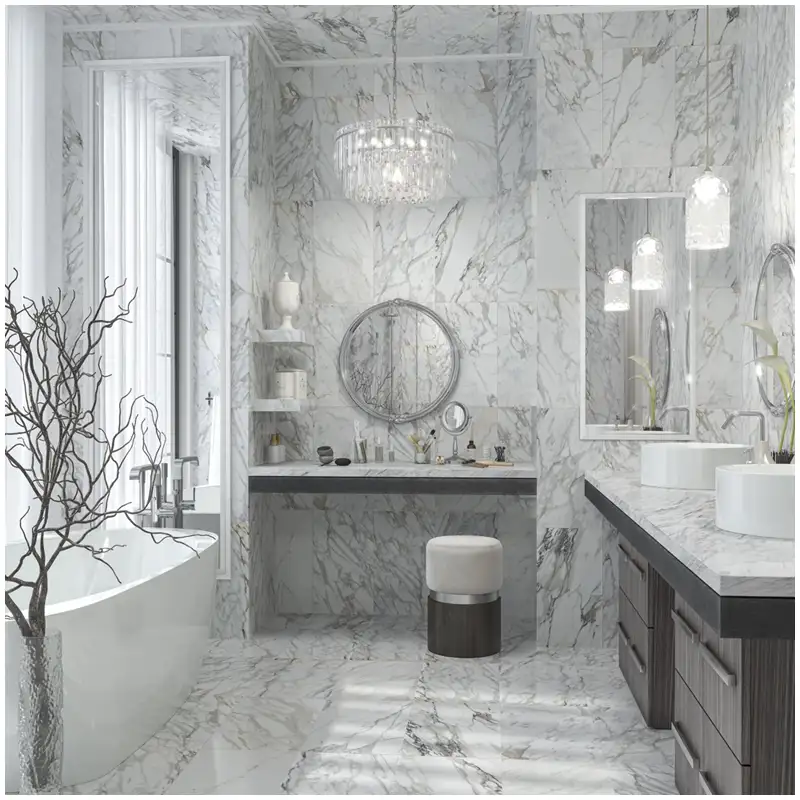
Because the pattern can be more restrained, Carrara often works well as white marble tiles. Tile formats can make the variation easier to distribute across walls or floors. A honed Carrara bathroom wall, for example, can feel clean without becoming plain. A Carrara floor can also pair with painted cabinetry, wood vanities, or chrome fittings when the finish and slip review are handled properly.
The limitation is that Carrara may appear grayer or cooler than expected. In a showroom, it may look white beside dark materials. In a finished room with white paint or bright cabinetry, the gray background can become more obvious. This is not a problem if the design expects it, but it can disappoint someone looking for a very bright white stone.
When choosing Carrara, check the tone beside paint, cabinet, and metal samples. Also check the tile lot or slab bundle for consistency. Some Carrara has tight, fine veining; some has stronger movement or clouding. The right one depends on whether the room should feel quiet or more textured.
Statuario marble: bright ground with clearer veins
Statuario marble is often selected when a project wants a brighter white ground than many Carrara options but does not always want the broad drama of Calacatta. It can provide clearer veining and a clean background, which makes it appealing for bathrooms, vanity walls, slab showers, and refined feature areas.
Statuario can be strong enough for a focal wall but still disciplined enough for a calm interior. It suits projects where the stone needs to look clean and architectural. A Statuario slab behind a vanity can work well with chrome, nickel, black metal, or warm brass if the undertone is checked. It can also work with simple white, gray, or wood cabinetry.
The challenge is selection. Some Statuario slabs are very clean and high contrast; others have more background movement. The stone should be reviewed in full slab form when the project uses large panels. For tile use, check whether the chosen format breaks up the veining in a way that still looks balanced.
Statuario is often a good middle path for interiors that need brightness and definition. It should still be approved like any other natural marble: by actual slab or lot, finish, layout, and application area, not by name alone.
Comparison table for interior use
| Marble type | Typical visual direction | Best interior uses | What to check before approval |
|---|---|---|---|
| Calacatta marble | Stronger veins, higher contrast, more dramatic slabs | Feature walls, vanity backsplashes, fireplaces, kitchen islands, hotel bathroom accents | Full-slab photos, vein direction, bookmatch, seam location, cutouts, and whether the room can handle strong movement. |
| Carrara marmuras | Softer gray veining, more even movement, often cooler tone | Bathroom walls, floors, shower walls, corridors, vanity areas, repeated tile layouts | Tile lot consistency, background gray level, finish, slip review for floors, and cabinet color. |
| Statuario marmuras | Bright white ground with clearer veins, often refined and crisp | Vanity feature walls, slab showers, boutique interiors, refined bathroom and wall panels | Slab brightness, vein balance, lighting response, bookmatch potential, and whether a tile format breaks the pattern too much. |
This table helps narrow the decision, but it cannot replace material review. Marble is a natural stone. The actual slab or tile lot decides the final look. If the project depends on a very exact shade of white, a more controlled material such as quartz stone arba sintered stone should also be compared.
Choosing marble slabs or marble tiles
The slab-versus-tile decision should follow the room size and the visual goal. Slabs are best when the design needs continuous movement. Tiles are often better when the room needs repeated surfaces, easier installation planning, smaller modules, or more control over floors and wet areas.
For feature walls, slabs usually give the strongest result. A Calacatta or Statuario slab behind a bathtub, vanity, or reception desk can show the stone’s full pattern. Bookmatching can add structure when the wall is centered and the seam is part of the design. The drawing must show mirrors, taps, outlets, niches, shelves, and edge conditions before the slab is cut.
For floors and shower walls, tiles often make more practical sense. Carrara and softer white marbles are common in tile format because the pattern can be spread evenly. Smaller formats can follow shower slopes more easily. Larger formats reduce grout lines but need flatter substrates and careful handling.
A room can use both. A bathroom may use a slab on the vanity wall and marble tiles on the side walls or floor. A hotel lobby may use slab panels at the reception wall and tile or cut-to-size pieces on floors. The important point is to make the slab and tile choices look related, not assembled from unrelated white stones.
Finish selection changes both appearance and care
The finish can change the marble almost as much as the name. Polished marble reflects light and makes veining look sharper. It often suits feature walls, vanity backsplashes, fireplace surrounds, and lower-contact vertical surfaces. It can also show etching, water marks, and fine scratches more clearly in daily use.
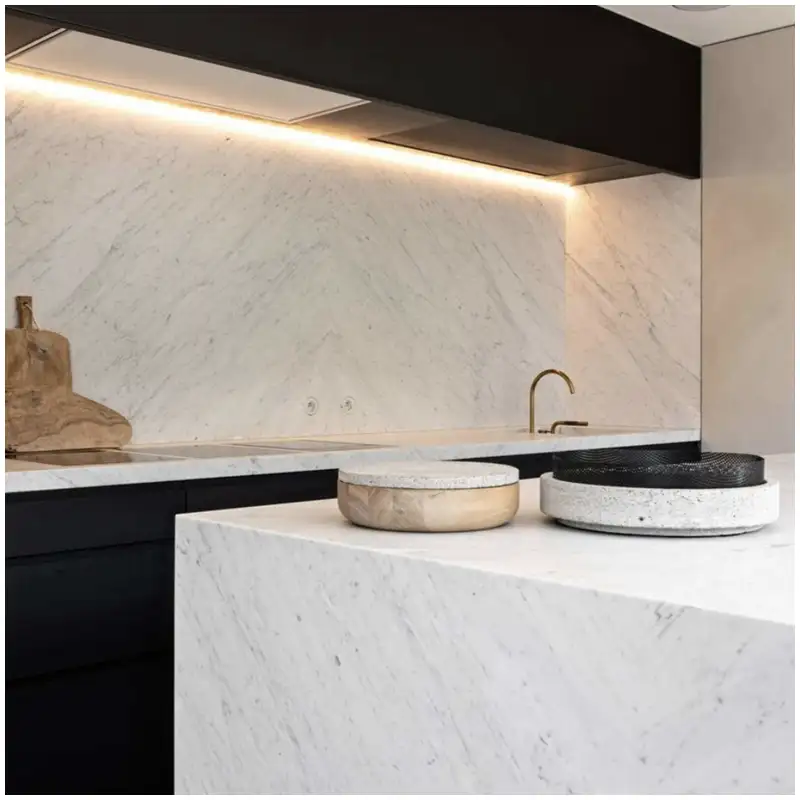
Honed marble is softer and less reflective. It works well in bathrooms, floors, and interiors where the stone should feel calmer. A honed Carrara wall may look more relaxed than a polished one. A honed Statuario vanity wall may reduce glare from mirror lighting. Honed surfaces still need sealing and stone-safe care, but the visual mood is different.
Brushed, leathered, or textured finishes may be considered for floors or areas where a less slippery feel is desired. The exact finish should be reviewed with the supplier and installer because texture changes cleaning and color appearance. A textured white marble can collect more residue if it is used in a wet or high-use area without proper cleaning planning.
Do not approve the finish only from a catalog photo. Ask for close-up photos, angled light photos, and samples where possible. White stone is sensitive to shadows and reflections. A small finish difference can become very visible under bathroom lighting or along a long corridor wall.
Lighting, cabinet color, and metal finishes
White marble should be reviewed under the light of the finished room. Natural daylight, warm LED strips, downlights, and mirror lights can all shift the stone. Calacatta may look warmer if the veins have beige or gold tones. Carrara may look cooler and grayer under bright white light. Statuario may look crisp, but strong side lighting can reveal texture or resin lines.
Cabinet color also changes the stone. White cabinets beside Carrara can make the marble look gray. Warm wood can make Calacatta feel more natural. Black or dark blue cabinetry can make Statuario look sharper and more graphic. Beige paint may work with warm-veined marble but may make cool marble look disconnected.
Metal finishes need the same review. Chrome and polished nickel often suit cooler white marble. Brushed brass can work with warmer Calacatta or Statuario selections. Matte black creates strong contrast, but it can make a small room feel more defined and less soft. The best choice depends on the undertone of the actual slab, not the marble name.
Before approval, place the marble sample or slab photo beside the cabinet, paint, flooring, and metal finish references. If the project uses stone tables, vanity tops, or a nearby countertop, compare those surfaces too. Esta Stone’s stone tables and countertop categories can help when the same interior needs several stone elements to work together.
Care expectations for white marble interiors
Marble is a calcium-based natural stone. It can react to acidic liquids and cleaners, and it can stain if liquids sit on the surface. Sealing can reduce staining risk, but it does not make marble stain proof or etch proof. Any article or sales page that suggests marble has no maintenance is giving the wrong expectation.
For bathrooms and vanities, explain the likely exposure: toothpaste, cosmetics, perfume, soap, standing water, and cleaners. For kitchens, add food acids, oil, hot cookware, and more frequent cleaning. For floors, add grit, shoes, water, and slip review. These conditions do not mean marble cannot be used. They mean the surface should be chosen for the right area and cared for properly.
Use stone-safe cleaners, wipe standing water, avoid acidic products, and follow the sealing recommendation for the specific stone and finish. If the room is a hotel bathroom or commercial interior, the maintenance team should understand which cleaning products are suitable. A beautiful marble can fail as a practical choice if the cleaning routine is wrong.
If lower maintenance is the main priority, compare marble with quartz countertops, sintered stone, or natural quartzite stone. The final material can still look bright and elegant, but it may be better matched to the way the room will be used.
A practical selection checklist
Use this checklist before confirming Calacatta, Carrara, or Statuario marble for an interior project:
- Define the application: wall, floor, vanity, countertop, fireplace, table, stair, or feature panel.
- Decide whether the surface should be quiet, moderately patterned, or dramatic.
- Review current slab photos or tile lot photos, not only a small sample.
- Check undertone beside cabinet, paint, flooring, and metal samples.
- Confirm finish: polished, honed, brushed, textured, or another approved surface.
- Mark vein direction, bookmatch, seam location, and cutouts on drawings.
- Review slip needs for floors and wet areas with the installer or design professional.
- Ask for sealing and care guidance for the exact stone and finish.
- Compare quartz, quartzite, or sintered stone if uniformity or lower maintenance is more important than natural variation.
- Keep spare tiles or documented slab photos for future repair or matching.
This checklist is intentionally practical. It keeps the decision tied to the room, not to a stone name that may mean different things from one bundle to another.
Related white marble guides
Frequently asked questions
1. What is the main difference between Calacatta, Carrara, and Statuario marble?
Calacatta marble often has stronger, wider veins and more contrast, Carrara marble usually has softer gray movement, and Statuario marble often has a brighter white ground with clearer veins. These are general design tendencies. The actual slab or tile lot should be reviewed before approval.
2. Which white marble is best for bathroom walls?
Carrara works well for calmer bathroom walls, while Calacatta or Statuario can be better for a feature wall behind a tub or vanity. The best choice depends on room size, lighting, cabinet color, maintenance expectations, and whether the wall should feel quiet or become the main design surface.
3. Should Calacatta marble be used as tiles or slabs?
Calacatta marble often works best as slabs when the design wants to show large vein movement or bookmatching. Tiles can still work, but small formats may break up the pattern. For feature walls, vanity backsplashes, and fireplaces, full-slab review is usually more useful than a small sample.
4. Is Carrara marble too gray for white interiors?
Carrara marble can look gray beside very white paint or bright white cabinets, especially under cool lighting. That does not make it wrong. It simply needs to be reviewed with the actual room finishes. Carrara is often a good choice when the design wants a softer, less dramatic white marble surface.
5. When should quartz, quartzite, or sintered stone be chosen instead of marble?
Quartz, quartzite, or sintered stone may be better when the project needs more uniform color, lower maintenance, or stronger daily-use performance than marble can provide. Marble remains strong for natural character and feature walls, but alternative surfaces can be more practical for countertops, busy vanities, or commercial interiors.
Final Conclusion
Calacatta, Carrara, and Statuario marble all belong in the white marble conversation, but they solve different design problems. Calacatta brings stronger movement, Carrara gives softer and often cooler patterning, and Statuario can offer a bright, refined middle ground. The right choice depends on the room, not only the stone name.
For interior projects, approve the actual slab or tile lot, check the finish, review the lighting, and place the stone beside cabinets, paint, metal, and flooring before ordering. Esta Stone can help compare marble slabs, marble tiles, white marble tiles, quartzite, quartz, and sintered stone so the final surface matches both the design direction and the way the room will be used.
Ask Esta Stone for white marble matching
For a bathroom, kitchen, vanity wall, hotel suite, villa interior, or feature panel, share the room type, preferred marble look, size range, finish, and maintenance expectation. Esta Stone can help review current slab photos, tile options, and alternative white surfaces for the same design direction.
References
- Dimension Stone Design Manual 2024, Natural Stone Institute Technical Committee, Natural Stone Institute, Natural Stone Institute.
- Standards and Specifications for Natural Stone Products, Natural Stone Institute Technical Committee, Natural Stone Institute, Natural Stone Institute.
- ASTM C503/C503M Standard Specification for Marble Dimension Stone, ASTM Committee C18, ASTM International, ASTM International.
- ASTM C1528/C1528M Standard Guide for Selection of Dimension Stone, ASTM Committee C18, ASTM International, ASTM International.
- ASTM C119 Standard Terminology Relating to Dimension Stone, ASTM Committee C18, ASTM International, ASTM International.
- ASTM C97/C97M Standard Test Methods for Absorption and Bulk Specific Gravity of Dimension Stone, ASTM Committee C18, ASTM International, ASTM International.
- ANSI A326.3 Test Method for Measuring Dynamic Coefficient of Friction of Hard Surface Flooring Materials, Accredited Standards Committee A108, Tile Council of North America, Tile Council of North America.
- 2026 Bath Trends Report, National Kitchen and Bath Association Research Team, National Kitchen and Bath Association, NKBA Research.