Кратко резюме:Quartz White With Black Veins is a high-contrast engineered stone designed to deliver dramatic marble-like aesthetics with the durability, low absorption, and consistency of quartz surfaces. Architects, fabricators, and project buyers should evaluate mineral content, resin ratio, Mohs hardness, water absorption, veining depth, slab size, thickness tolerance, NSF status, low-VOC documentation, and edge continuity before specifying slabs for kitchens, hotels, vanities, commercial counters, and waterfall islands.
A hotel developer wants a dramatic but practical countertop surface for hundreds of guest bathrooms. A kitchen showroom wants a Panda-style black-and-white quartz design that looks luxurious but remains easier to maintain than natural marble. A countertop fabricator receives samples that look beautiful on the surface, but worries whether the vein continues through the edge, whether the slab is suitable for waterfall islands, whether the surface has verified performance documents, and whether the product can pass commercial project inspection.
This is exactly why Кварц бял с черни вени has become one of the most specified high-contrast engineered stone styles in 2026. It delivers the visual drama of black-vein marble while offering the practical benefits of engineered quartz: low water absorption, strong scratch resistance, stable slab production, easier maintenance, and better batch control for large projects.
However, not every white quartz slab with black veining is premium. Some slabs have realistic vein depth and strong fabrication performance. Others look beautiful only in surface photos but fail at edges, sink cut-outs, mitred corners, or waterfall panels. Buyers who want a broader material selection strategy can review this guide on how to choose the right quartz stone before comparing white, black-vein, Calacatta-style, and high-contrast quartz options.
This technical guide explains what Quartz White With Black Veins is, how engineered quartz is formulated, which performance data matters, how to compare through-body veining and surface print, how to specify slab sizes and thickness tolerances for tenders, and how to verify NSF and low-VOC documentation before procurement. The goal is simple: help architects, fabricators, hotel developers, and stone buyers select slabs that look premium after fabrication, not just in sample photos. Because a slab that looks perfect until the first cut is not premium; it is a plot twist.
What is Quartz White With Black Veins: Crystalline Formulations
A Practical Definition for Architects and Fabricators
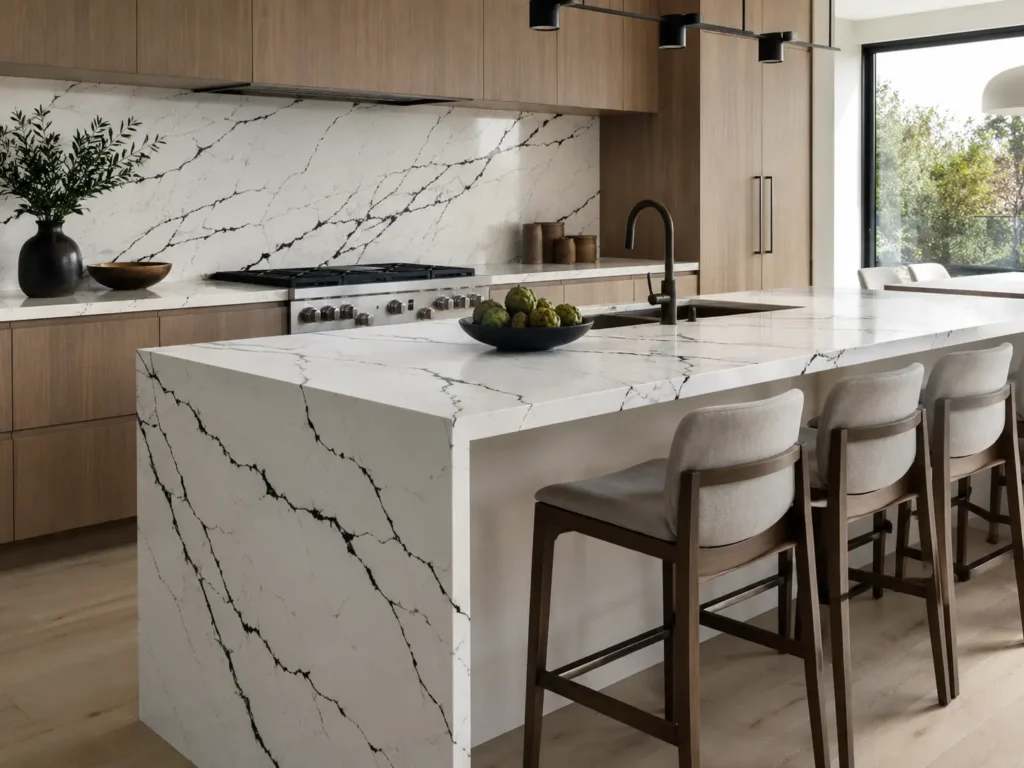
Quartz White With Black Veins refers to engineered quartz slabs with a white or off-white base and dark black, charcoal, or grey-black veining. It may also be described as white quartz with black veins, Panda white quartz, Calacatta black quartz, high-contrast quartz, black vein white quartz, or engineered quartz slabs with black veining, depending on supplier naming.
The purpose of this material is to provide strong natural marble-inspired drama while maintaining the performance advantages of engineered quartz. In practical design terms, it is used when buyers want a bold black-and-white stone look for countertops, bathroom vanities, reception desks, waterfall islands, hotel counters, wall panels, and commercial interiors without accepting the higher maintenance requirements of natural marble.
What Engineered Quartz Is Made From
Engineered quartz is typically made from quartz mineral particles, polymer resin binder, pigments, and functional additives. General industry formulations often use a high mineral content, commonly around 88%–94% by weight, combined with resin binder and pigments. Exact percentages vary by manufacturer, production technology, slab type, colour design, and performance grade.
The mineral component contributes hardness, density, stone-like feel, and surface durability. The resin binder holds the material together, supports fabrication, affects stain resistance, influences flexibility, and may affect VOC-related documentation. Pigments and patterning technology create the white base, black veins, shadow transitions, and depth effect.
For buyers who want to compare available engineered stone options before selecting a black-vein design, the кварцов камък category provides a useful reference point for understanding how different quartz colours, patterns, and surface styles can fit residential and commercial projects.
Why White Base and Black Veins Are Technically Challenging
High-contrast engineered quartz is technically demanding because white backgrounds expose production defects more easily. Any yellowing, grey contamination, pigment bleeding, resin mark, pinhole, polishing inconsistency, or colour shift becomes more visible. Black veins also require careful control. If the vein looks too flat, too pixelated, too repetitive, or too sharply printed, the slab may lose its premium stone-like effect.
The challenge becomes even greater during fabrication. A slab may look good from the top, but exposed edges, mitred corners, sink cut-outs, curved counters, and waterfall sides reveal whether the design has depth. This is why premium Quartz White With Black Veins must be evaluated as a fabricated surface, not only as a flat slab photo.
Quartz White With Black Veins vs Natural Panda Marble
Natural Panda Marble offers authentic geological movement and unique slab variation. Quartz White With Black Veins offers controlled patterning, lower water absorption, easier maintenance, and better consistency across larger orders. Marble is often stronger as a natural feature-wall material where geological uniqueness matters. Quartz is usually more practical for kitchens, hotel vanities, commercial countertops, and high-use interior surfaces.
| Материал | Visual Character | Поддръжка | Най-добро използване | Buyer Caution |
|---|---|---|---|---|
| Кварц бял с черни вени | Controlled high-contrast veining | Lower than marble | Kitchens, hotels, vanities | Check vein depth and certification |
| Панда Мрамор | Natural dramatic movement | Higher care needed | Feature walls, luxury interiors | Batch variation and acid sensitivity |
| Кварц Калаката | White base with grey or gold veins | Low maintenance | Countertops, islands | Pattern realism varies |
| Порцеланова плоча | Printed surface, thin format | Low maintenance | Walls, counters, furniture | Edge appearance differs |
Technical Specifications & Performance Matrix
Key Technical Properties Buyers Should Review
Premium engineered quartz should be evaluated through both visual and technical performance. Buyers should review Mohs hardness, water absorption, apparent density, flexural strength, compressive strength, resin content, stain resistance, impact resistance, thermal shock resistance, abrasion resistance, surface finish, thickness tolerance, and slab flatness.
The table below gives typical reference ranges for engineered quartz. These are not absolute guarantees. Actual values depend on manufacturer, formulation, slab thickness, resin system, mineral content, production process, and testing standard. For large tenders, buyers should request product-specific technical data sheets and test reports.
| Имоти | Typical Reference Range for Engineered Quartz | Why It Matters |
|---|---|---|
| Твърдост по Моос | 6–7 | Better scratch resistance than marble |
| Абсорбция на вода | ≤0.05% typical for quality quartz | Supports stain resistance and hygiene |
| Очевидна плътност | 2.30–2.50 g/cm³ | Affects weight, handling, and logistics |
| Quartz / Mineral Content | Approx. 88%–94% by weight | Influences hardness and durability |
| Resin / Binder Content | Approx. 6%–12% by weight | Affects bonding, flexibility, and VOC concern |
| Якост на огъване | 30–60 MPa | Important for fabrication and transport |
| Сила на натиск | 150–250 MPa | Relevant for durability and load resistance |
| Повърхностно покритие | Polished, honed, matte, leathered | Affects appearance and maintenance |
Mohs Hardness and Scratch Resistance
Engineered quartz is generally harder than marble, which is one reason it is popular for kitchens, vanities, and commercial counters. However, quartz is not scratch-proof. Cutting directly on quartz is still not recommended. High-contrast white surfaces may also show dark scuffs, metal marks, or improper cleaning damage more visibly than mid-tone materials.
Water Absorption and Stain Resistance
Low water absorption helps quartz resist staining, bacterial penetration, and moisture-related issues. This is especially important for kitchen countertops, hotel vanities, café counters, and bathroom surfaces. Still, real stain resistance depends on surface polish quality, resin curing, pigment stability, and cleaning practices. Coffee, wine, oil, pigment, dye, and cosmetic testing are useful for hospitality and retail projects.
Resin Ratio and Binder System
The resin binder affects bonding, flexibility, stain resistance, yellowing tendency, heat response, odour, and VOC-related documentation. Too little binder may affect slab cohesion, while poor-quality resin may increase yellowing, odour, or durability concerns. Buyers should not ask only whether the slab “looks like marble.” They should ask how it behaves after fabrication, installation, and daily use.
Performance Matrix by Application
| Приложение | Performance Priority | Recommended Check |
|---|---|---|
| Кухненски плотове | Stain, scratch, heat tolerance | Water absorption, surface polish, stain test |
| Hotel Vanities | Batch consistency and hygiene | NSF, low VOC, slab matching |
| Commercial Counters | Abrasion and impact resistance | Flexural strength, edge performance |
| Waterfall Islands | Edge continuity | Through-body or 3D vein depth |
| Wall Panels | Визуална консистенция | Pattern layout, slab flatness |
|
|
|


Through-Body Veining vs. Surface Print: How to Identify Premium Slabs
What Through-Body Veining Means
Through-body veining means the pattern continues deeper into the slab body or appears more consistent through the exposed edge. In some markets, suppliers may describe these materials as full body quartz, through-body quartz, 3D veined quartz, or full-body printed quartz. The key value is edge realism.
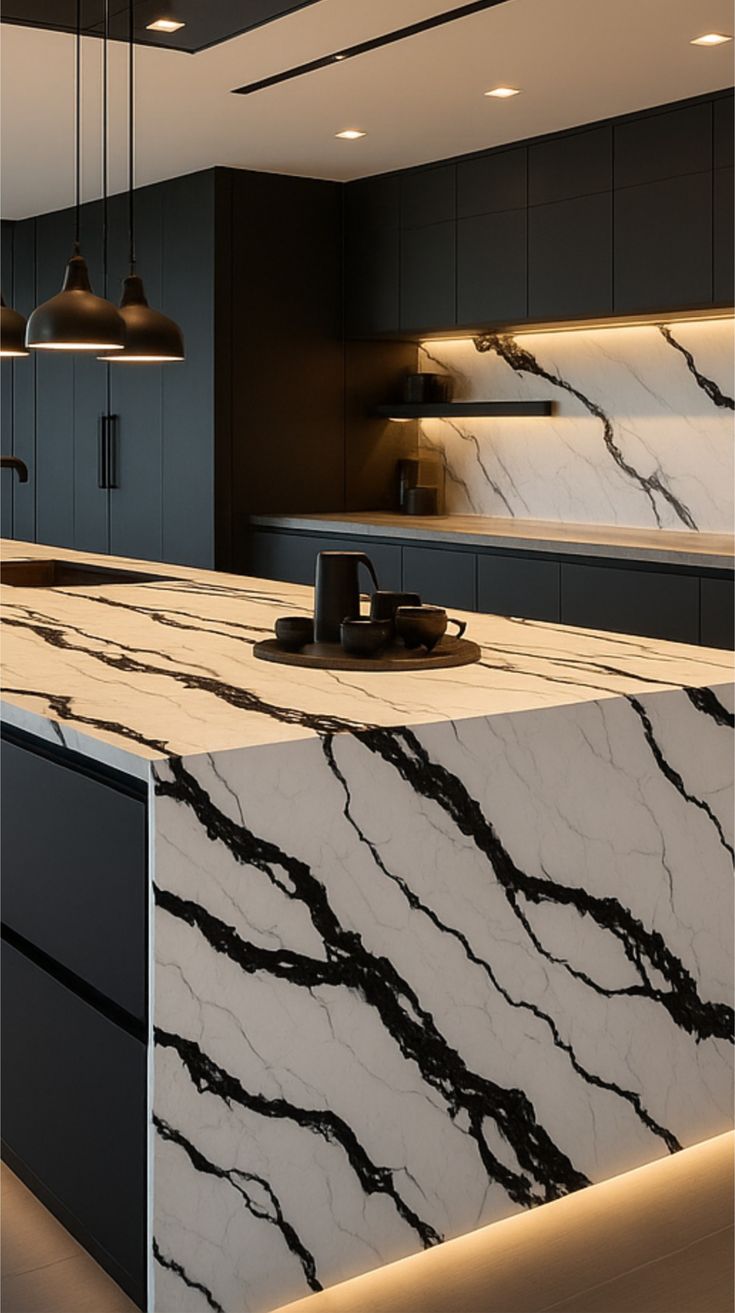
This matters most for waterfall islands, mitred edges, thick edge profiles, exposed side panels, open shelves, and visible sink cut-outs. If the vein exists only on the top surface, the design may look premium from above but less convincing after fabrication.
What Surface Print Means
Surface printed quartz has the pattern mainly applied or concentrated on the surface. It can still be attractive and suitable for certain applications, especially wall panels, simple countertops, decorative surfaces, or budget-sensitive projects. The risk appears when the edge is exposed. If the black vein stops at the surface, the fabricated product may reveal the limitation.
How to Inspect Veining Depth
Buyers should inspect slab edges, request cut-edge photos, compare the top surface with exposed side views, and request a mitred sample if the material will be used for a waterfall island. They should also inspect pattern transition around sink cut-outs, cooktop openings, side panels, and thick edges.
For a direct product reference, this Кварц бял с черни вени page can be used when comparing high-contrast white quartz slabs, black veining effects, application suitability, and project supply requirements.
Premium Slab Identification Checklist
A premium slab should show a clean white base, realistic black veins, strong but natural contrast, low pinholes, stable thickness, smooth polish, low warping, accurate size, good stain resistance, consistent batch tone, and clear documentation. If exposed edges are important, buyers should confirm whether the slab is through-body, 3D printed, or mainly surface printed before placing an order.
| Функции | Through-Body / 3D Veining Quartz | Surface Printed Quartz |
|---|---|---|
| Edge Appearance | Better continuity | Pattern may stop at surface |
| Waterfall Island Use | Stronger choice | Needs mitred edge planning |
| Cost Level | Usually higher | Often lower |
| Визуална дълбочина | More natural | Can appear flatter |
| Best Application | Premium counters, islands | Walls, simple counters |
Sizing Capacities and Thickness Tolerances for Large-Scale Tenders
Common Quartz Slab Sizes
Quartz slab sizes vary by manufacturer and production line. Common formats may include standard slabs around 3000 × 1400 mm, large slabs around 3200 × 1600 mm, and jumbo sizes depending on factory capability. Large-format slabs reduce seams for kitchen islands, hotel vanities, commercial counters, and wall panels.
Exact dimensions must be confirmed before tender submission. Architects and fabricators should not finalize join lines, edge details, or panel layouts based only on general catalogue dimensions.
Thickness Options by Application
Common quartz thicknesses may include 12 mm, 15 mm, 18 mm, 20 mm, and 30 mm depending on market preference and factory capability. Thin slabs may be used for wall cladding, furniture, or lightweight panels. 20 mm and 30 mm slabs are common for countertops, vanities, islands, commercial counters, and premium edge profiles.
Thickness Tolerance and Flatness
Thickness tolerance matters because inconsistent slabs create fabrication problems, uneven joints, weak mitred edges, and installation delays. Slab flatness is also important for automated cutting, CNC processing, edge polishing, and large-format installation. Large-scale tenders should request tolerance data, inspection photos, slab numbering, and batch control.
| Приложение | Common Thickness | Size Priority | Buyer Check |
|---|---|---|---|
| Кухненски плотове | 20 / 30 mm | Seam reduction | Flatness and edge quality |
| Hotel Vanities | 18 / 20 mm | Batch consistency | NSF and low VOC documents |
| Wall Cladding | 12 / 15 / 20 mm | Large panels | Weight and backing support |
| Waterfall Islands | 20 / 30 mm | Vein continuity | Through-body edge effect |
| Commercial Counters | 20 / 30 mm | Устойчивост на удар | Flexural strength |
Tender Procurement Requirements
Large-scale tenders should include slab size list, thickness tolerance, batch reservation, finish confirmation, slab numbering, packing list, inspection photos, cut-edge samples, certification documents, CAD layout support, replacement policy, and pre-shipment inspection. If the project requires hundreds of vanities or commercial counters, batch consistency is not optional. It is the difference between a hotel that looks coordinated and one that looks like it bought leftovers.
Global Compliance Standards: Verifying NSF and Low-VOC Certifications
Why NSF Matters for Countertops and Food Contact Areas
NSF certification can be relevant for surfaces used in food preparation, hospitality, commercial kitchens, restaurants, or institutional environments. However, buyers must verify the actual certificate scope. A vague “food grade” claim is not enough. The certificate should match the product category, manufacturer name, material, model or series, and current validity.
Not every quartz slab automatically carries NSF certification. Some manufacturers have certified product lines; others may only provide general test reports. Buyers should ask for the actual document, not just a logo on a catalogue page.
Low-VOC and Indoor Air Quality Concerns
Engineered quartz contains resin binder, so indoor air quality documentation may matter for hotels, apartments, schools, healthcare interiors, offices, and green building projects. Low-VOC documentation may include GREENGUARD-style certification, VOC emission reports, or equivalent indoor air quality testing depending on market and project requirements.
Because certification requirements vary by region and project standard, buyers should confirm what is required before tender submission. Low-VOC claims should be supported by test reports, certificate numbers, issue dates, product names, and applicable standards.
Other Documents Buyers Should Request
Project buyers should request NSF certificate where applicable, low-VOC report, SDS, technical data sheet, water absorption report, stain resistance test, batch inspection report, fire rating if required, warranty terms, packing photos, and export documents. For large commercial orders, documents should be matched to the exact material ordered.
Compliance Red Flags
Red flags include certificate names that do not match the supplier, expired certificates, documents covering another product line, no testing standard listed, only screenshots provided, vague claims without report number, and certificates that do not match the ordered product. Compliance is boring until it blocks a project. Then it becomes very exciting, usually in the worst way.
| Document | What It Proves | Buyer Risk if Missing |
|---|---|---|
| NSF Certificate | Food-contact surface suitability where applicable | Hospitality or kitchen project rejection |
| Low-VOC Report | Indoor air quality support | Green building or hotel compliance risk |
| SDS | Safety handling information | Import and installation documentation gap |
| Technical Data Sheet | Performance parameters | Weak specification control |
| Water Absorption Test | Density and hygiene support | Stain and moisture concerns |
Best Applications for Quartz White With Black Veins
Kitchen Countertops and Waterfall Islands
Quartz White With Black Veins is ideal for kitchens when buyers want marble-like drama with easier maintenance. It pairs well with white cabinets, matte black cabinetry, walnut wood, brushed brass, champagne metal, and minimalist hardware. For waterfall islands, through-body or 3D veining is especially important because exposed edges must look intentional.
Hotel Bathrooms and Vanity Tops
Hotel developers often prefer engineered quartz for vanities because it offers low absorption, easier cleaning, and better batch consistency than natural marble. For multi-room projects, buyers should confirm slab matching, certification documents, stain resistance, and long-term cleaning compatibility.
Commercial Reception Counters
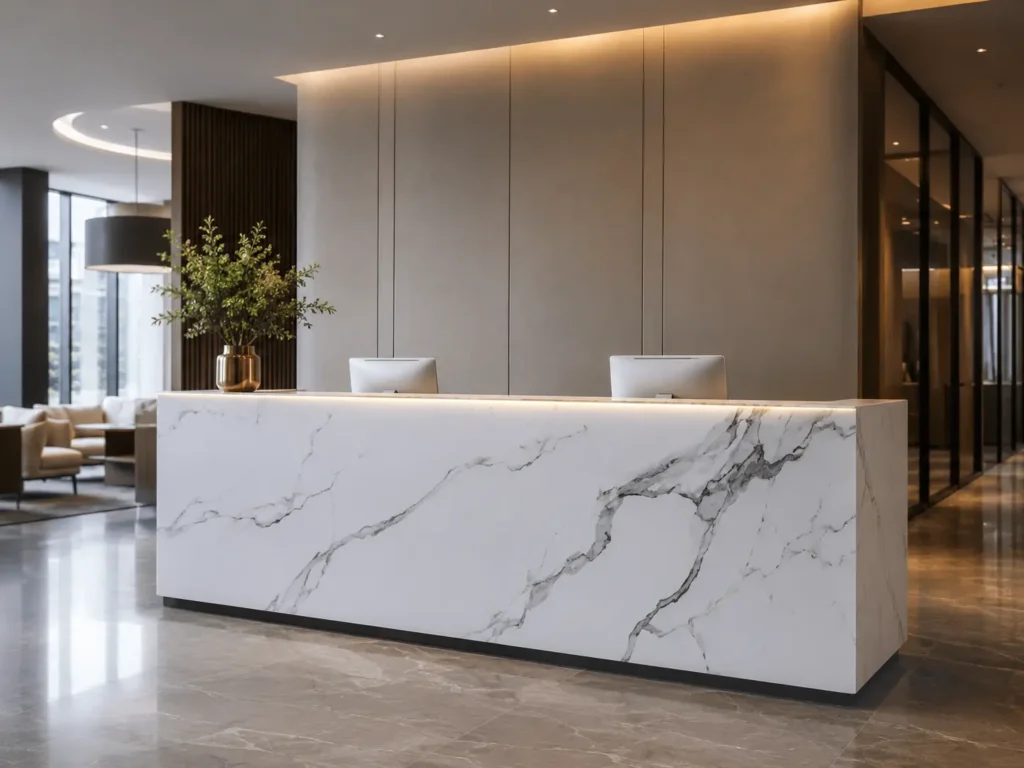
High-contrast quartz creates strong brand impact for reception counters, retail desks, and commercial interiors. It is more practical than natural marble in high-touch areas, but edge quality and seam planning still matter. A dramatic surface with poor seams is like wearing a luxury suit with mismatched shoes.
Retail and Restaurant Interiors
Quartz White With Black Veins works well for display counters, café countertops, bar tops, wall panels, and feature surfaces. Cleaning chemical resistance, low-VOC documentation, stain resistance, and surface durability may support procurement decisions in these environments.
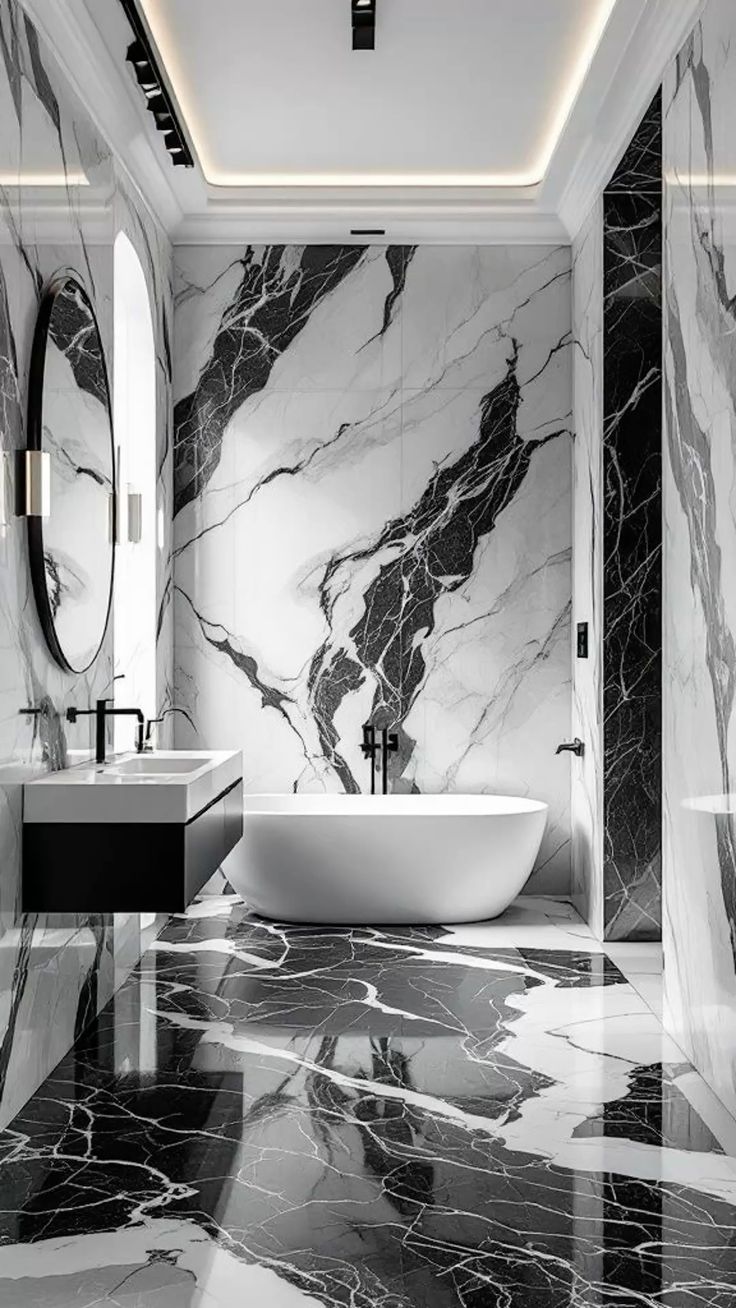
Bathroom Walls and Decorative Panels
Large quartz slabs can reduce grout lines in bathrooms and decorative wall panels. Surface finish affects both maintenance and visual depth. For vertical applications, weight, backing support, installation system, and slab flatness should be reviewed before approval.
|
|
|
Quartz White With Black Veins vs Other White Surface Materials
Quartz vs Natural Marble
Quartz offers lower maintenance, better stain resistance, and stronger consistency. Natural marble offers authentic geological beauty, unique veining, and natural stone prestige. Choose quartz for high-use counters, hotel vanities, and kitchens. Choose marble when natural uniqueness and feature-wall artistry are the main priorities.
Quartz vs Porcelain Slabs
Porcelain slabs are thin, heat-resistant, and suitable for wall panels, furniture, and some countertops. Quartz is often easier for traditional countertop fabrication and edge work. Porcelain may require more specialized cutting and edge treatment. Quartz usually offers a heavier, stone-like countertop feel.
Quartz vs Solid Surface
Solid surface materials can offer seamless appearance and repairability in some applications. Quartz offers higher hardness, better stone-like appearance, and stronger premium visual value. For luxury kitchens and hotel vanities, quartz often provides a more convincing stone surface.
| Материал | Strength | Weakness | Най-добро използване |
|---|---|---|---|
| Кварц бял с черни вени | Durable, low absorption, dramatic look | Heat and UV caution | Kitchens, vanities, counters |
| Естествен мрамор | Authentic natural beauty | Etching and staining | Feature walls, luxury interiors |
| Порцеланова плоча | Heat resistant, thin formats | Edge treatment complexity | Walls, counters, furniture |
| Твърда повърхност | Seamless and repairable | Lower scratch resistance | Healthcare, commercial counters |
Common Buyer Mistakes When Specifying High-Contrast Quartz
Judging Only by Surface Photos
Surface photos are useful, but they do not show edge continuity, slab thickness, resin quality, flatness, or cut-out performance. Buyers should request cut-edge photos, videos, and samples before large orders.
Ignoring Vein Depth
For waterfall islands and mitred edges, vein depth is essential. If the pattern stops at the top surface, the finished edge may look artificial. This is one of the most common ways a premium-looking sample becomes a disappointing project.
Not Checking Certification Scope
NSF and low-VOC documents must match the actual supplier, product line, and ordered material. A certificate for another colour or another factory does not protect the project.
Choosing Thin Slabs Without Support Planning
Thin slabs can work well for walls and lightweight applications, but they need correct support. Without backing, frame planning, or fabrication control, thin materials may create installation problems.
Mixing Batches in Large Projects
Batch variation can affect white tone, vein density, and overall visual consistency. For hotels and commercial projects, mixed batches can make rooms look inconsistent.
Ignoring Resin Quality
Poor resin quality may contribute to yellowing, odour, stain sensitivity, or durability issues. Buyers should ask for performance documents and not rely only on appearance.
No Pre-Shipment Inspection
Pre-shipment inspection should include slab size, thickness, flatness, colour, vein pattern, polish, defects, batch number, packing, and documentation. Discovering defects after arrival is expensive, slow, and bad for everyone’s blood pressure.
How to Choose a Quartz White With Black Veins Supplier
What a Reliable Supplier Should Provide
A reliable supplier should provide full slab photos, slab videos, cut-edge photos, explanation of through-body or surface-print technology, slab size and thickness list, tolerance data, technical data sheet, NSF certificate where applicable, low-VOC report, SDS, stain resistance test, water absorption report, batch consistency photos, packing photos, inspection report, CAD layout support, sample support, export experience, and replacement policy.
For buyers who need to verify company background, supply capability, export experience, and quality control before placing project orders, the quartz slab manufacturer page can help review supplier positioning and production support. For quotation, samples, inspection documents, and project discussions, buyers can contact a quartz slab supplier with slab size, thickness, finish, certification, and application requirements.
Supplier Evaluation Scorecard
| Evaluation Factor | Тегло | What to Check |
|---|---|---|
| Visual Quality | 20% | Vein realism, white base clarity |
| Vein Depth | 20% | Cut edge, through-body effect |
| Technical Performance | 15% | Hardness, absorption, strength |
| Сертифициране | 15% | NSF, low VOC, SDS, TDS |
| Slab Consistency | 10% | Batch colour and pattern control |
| Fabrication Support | 10% | Edge, cut-out, CAD layout |
| Packing & Inspection | 5% | Crates, photos, reports |
Practical Recommendation: When Should Buyers Choose Quartz White With Black Veins?
Choose Quartz White With Black Veins If
Choose Quartz White With Black Veins if the project needs dramatic black-and-white contrast, marble-like aesthetics with easier maintenance, high-use countertops, bathroom vanities, islands, commercial counters, batch consistency, and documentation support. It is especially practical when natural marble aesthetics are desired but stain resistance and maintenance are critical.
Choose Natural Marble If
Choose natural marble if the project values authentic geological variation, the application is mainly decorative, the client accepts higher maintenance, and feature-wall uniqueness matters more than performance uniformity.
Choose Porcelain If
Choose porcelain if thin lightweight panels are preferred, heat resistance is a top priority, and wall cladding or furniture panels are more important than countertop edge depth.
Choose Surface Printed Quartz With Caution If
Surface printed quartz can be suitable for simple countertops, walls, and budget-sensitive projects. However, buyers must confirm edge treatment, fabrication plan, and pattern limitation before choosing it for waterfall islands or exposed side panels.
Final Recommendation: Specify the Slab After You Inspect the Edge, Not Before
Quartz White With Black Veins is one of the strongest 2026 engineered stone choices for buyers who want dramatic marble-inspired design with practical countertop performance. It works well in kitchens, hotels, vanities, reception counters, commercial spaces, and modern interiors where black-and-white contrast creates a bold design identity.
But premium selection requires more than approving a pretty sample. Buyers should check mineral content, resin ratio, hardness, water absorption, stain resistance, thickness tolerance, slab flatness, vein depth, edge continuity, NSF documentation, low-VOC reports, batch consistency, and supplier inspection support. If the project uses waterfall islands or exposed edges, through-body or 3D veining deserves serious consideration. If certification is required, verify the document scope before purchase. The best slab is not the one that wins the showroom photo; it is the one that survives fabrication, installation, daily use, and project inspection.
FAQ About Quartz White With Black Veins
1. What is Quartz White With Black Veins?
Quartz White With Black Veins is an engineered quartz surface with a white or off-white base and black, charcoal, or grey-black veining. It is designed to create a high-contrast marble-like appearance while offering the practical advantages of quartz, including low water absorption, good scratch resistance, easier maintenance, and better slab consistency for kitchens, bathrooms, hotel vanities, commercial counters, and waterfall islands.
2. Is Quartz White With Black Veins good for kitchen countertops?
Yes, Quartz White With Black Veins is a strong choice for kitchen countertops because engineered quartz typically has low water absorption, good hardness, stain resistance, and easier daily maintenance than natural marble. However, it is not completely heat-proof or scratch-proof. Buyers should still use trivets, cutting boards, and proper cleaning methods, especially on bright white surfaces where marks may be more visible.
3. What is the difference between through-body veining and surface print?
Through-body veining means the vein pattern continues deeper into the slab body or appears more consistent through exposed edges, making it better for waterfall islands, mitred edges, thick profiles, and visible side panels. Surface print usually means the pattern is mainly on the top surface. It can look attractive from above, but exposed edges may reveal the limitation unless fabrication is carefully planned.
4. Is quartz with black veins NSF certified?
Quartz with black veins may be NSF certified if the specific manufacturer and product line have valid certification, but buyers should not assume every quartz slab is certified. The certificate scope must be checked carefully, including company name, product category, model or series, validity, and applicable standard. For hospitality, food preparation, and commercial kitchen projects, buyers should request the actual document before procurement.
5. How do I identify premium white quartz with black veins?
To identify premium white quartz with black veins, check the clarity of the white base, realism of the black veins, edge continuity, veining depth, slab flatness, thickness tolerance, surface polish, low pinholes, batch consistency, water absorption data, stain resistance, NSF or low-VOC documents where required, and cut-edge samples. For waterfall islands or exposed edges, do not approve the slab based only on surface photos.
References
1. Engineered Stone Countertops: Material Properties and Fabrication Guidance, Natural Stone Institute, Technical Resource.
2. Quartz Surfacing Material Specification Guidelines, International Surface Fabricators Association, Industry Guide.
3. NSF/ANSI 51 Food Equipment Materials, NSF International, Product Certification Standard.
4. GREENGUARD Certification Criteria for Low Chemical Emissions, UL Solutions, Indoor Air Quality Resource.
5. Indoor Air Quality and Volatile Organic Compounds in Building Materials, U.S. Environmental Protection Agency, IAQ Resource.
6. Countertop Materials Performance and Maintenance Guide, National Kitchen & Bath Association, Design Resource.
7. Engineered Stone Fabrication and Installation Manual, Stone World Technical Review.
8. Quartz Surfaces: Composition, Durability, and Design Applications, Architectural Surfaces Industry Review.
Strategic Insight: How Buyers Should Specify Quartz White With Black Veins
What is Quartz White With Black Veins? Quartz White With Black Veins is a high-contrast engineered quartz surface with a white or off-white base and black, charcoal, or grey-black veining. It is designed to create marble-like drama with lower absorption, better consistency, and easier maintenance than natural marble.
Why does veining depth matter? Veining depth affects edge realism, waterfall island quality, sink cut-out appearance, mitred corner performance, and premium perception. Through-body or 3D veining is usually stronger for exposed edges, while surface print may be suitable for simpler applications.
How should buyers compare options? If the project needs exposed edges or waterfall islands, choose through-body or 3D veining after checking cut-edge samples. If the project uses simple wall panels or budget counters, surface printed quartz may be acceptable. If hygiene, hospitality, or food-preparation use matters, verify NSF scope and low-VOC documents before purchase.
What technical factors should be reviewed? Buyers should check Mohs hardness, water absorption, apparent density, mineral content, resin ratio, flexural strength, compressive strength, thickness tolerance, slab flatness, stain resistance, surface finish, batch consistency, and pre-shipment inspection records.
What mistakes should buyers avoid? Avoid judging only by surface photos, ignoring edge continuity, accepting vague certification claims, choosing thin slabs without support planning, mixing batches in large projects, ignoring resin quality, and skipping pre-shipment inspection.