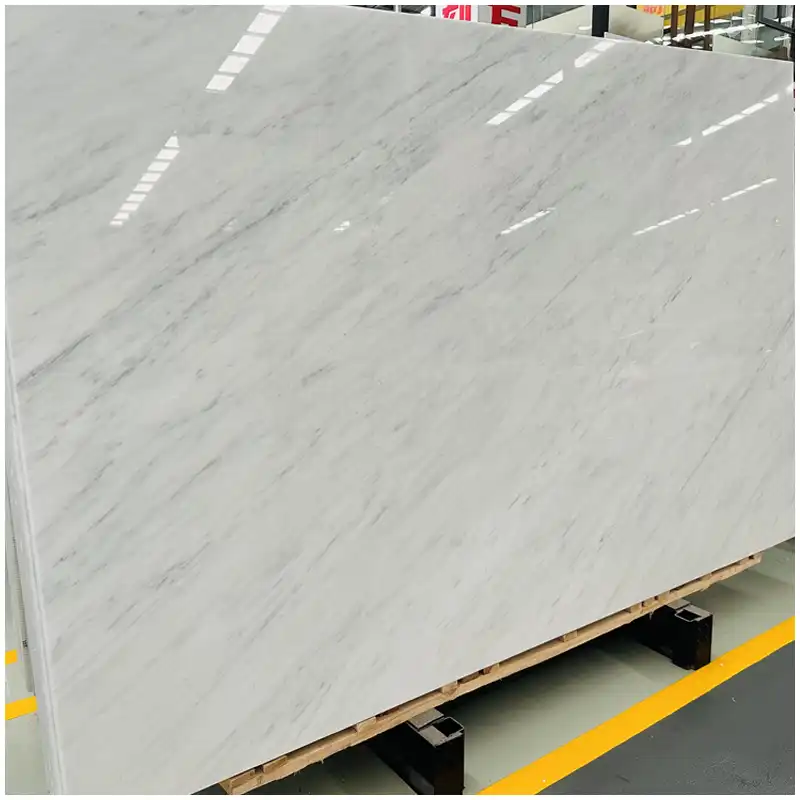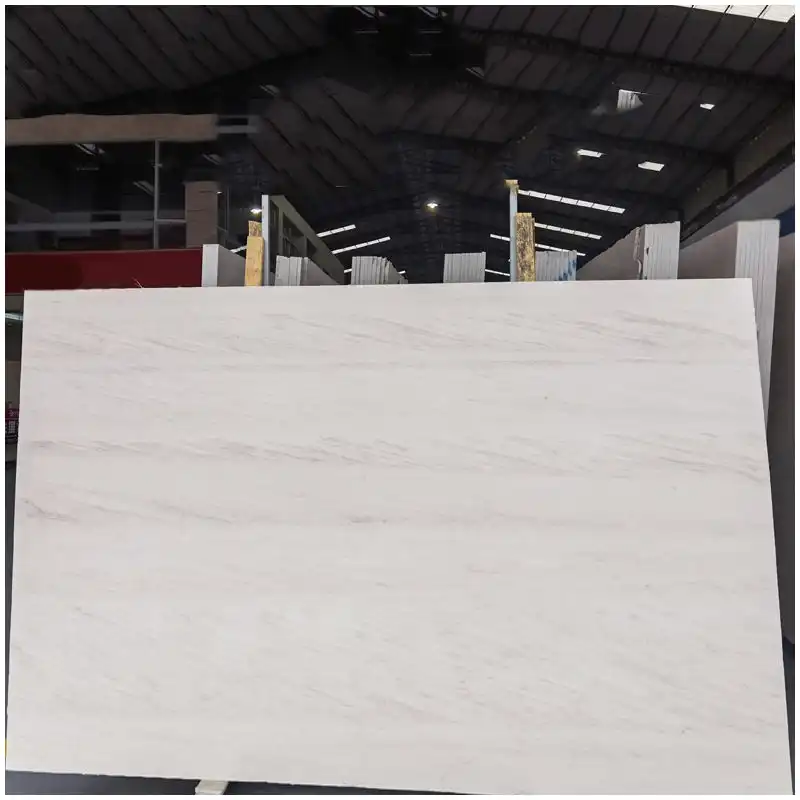




Carrara Marble Slab Grades: Background Tone, Vein Density, and Batch Range
The dispute usually starts with one word: “select.” The buyer expects a clean pale background and restrained veins. The offered bundle includes several cooler grey slabs and two with broad cloudy movement. The supplier still calls the range select because its internal sorting standard allows it.
I do not argue about the label. I line up the slabs. A Carrara marble slab either falls inside the signed background, vein, feature, finish, size, and repair range or it does not. That evidence survives translation, sales language, and changes of supplier.
Don’t just look at samples. A small piece can make a busy slab seem calm and a grey slab seem white. Grade decisions need complete faces, comparable light, current dimensions, and enough slabs to show the real batch.
What a Carrara Marble Slab Grade Can and Cannot Tell You
Commercial terms such as C, CD, select, extra, first choice, and standard can reflect a supplier’s sorting practice. They may consider background, vein amount, shade, visible features, slab dimensions, or market expectations. The problem is that those definitions are not always identical across companies or lots.
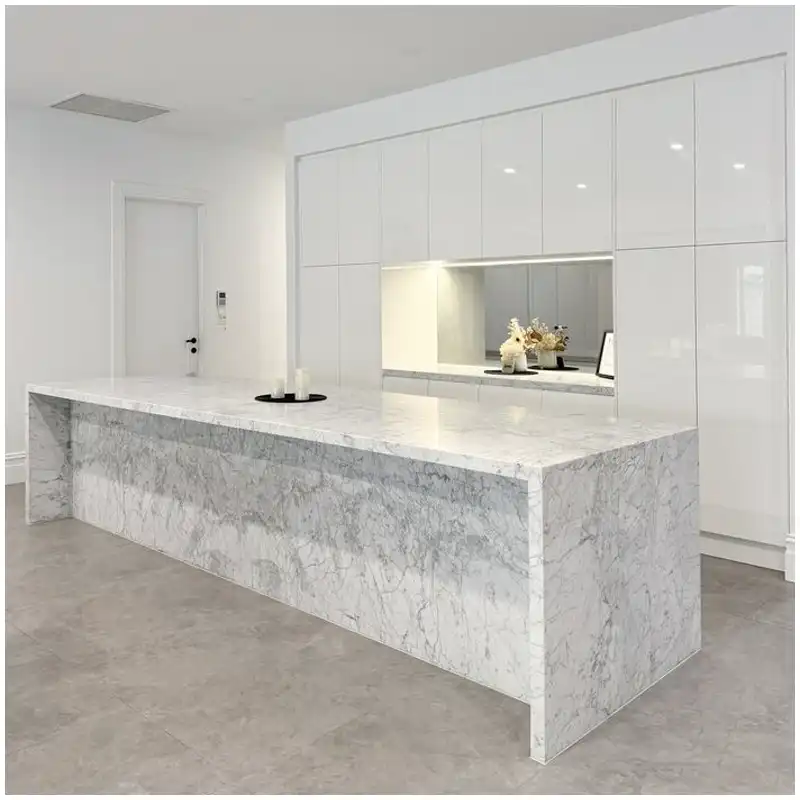
A Carrara marble slab grade can help narrow a warehouse search when both sides share the same definition. It cannot replace the purchase standard. The order needs actual approved slabs or a signed range with measurable and visual limits.
I ask the supplier to write what its grade means for the offered stock. How light is the background? How much grey clouding is usual? Are broad veins allowed? What repairs, pits, resin, or mesh are normal? What slab sizes and thicknesses fall inside the group? Then I compare that description with the material.
Lighting lies. A pale slab photographed near a bright door can look cleaner than a darker slab deep in the rack. Automatic phone exposure can turn grey toward white. Grade photographs should use the same location, orientation, distance, and light, with labels visible.
The material overview in Bianco Carrara Marble for Bathroom Projects: Slab Range, Light, and Approval explains how these differences behave on vanities, walls, floors, and showers. Grade and batch control require a narrower acceptance record.
Use four parts in the grade definition
First, define visual range: background, vein, clouding, marks, and repairs. Second, define physical format: usable dimensions, thickness, flatness method, and edge condition. Third, define processing: finish, treatment, mesh, resin, and benchmark. Fourth, define application: where each range may be installed.
This stops one label from doing too much work. A visually pale slab may be too small for the required wall. A large slab may contain a repaired feature in the exact vanity zone. A quiet slab may polish poorly. Grade, yield, and application must agree.
Current White Carrara Marble Slabs can provide the project with a product reference, while Bianco Carrara Marble supports material comparison. Neither listing cancels full-slab approval.
| Slab attribute | Tighter range | Broader range | Project decision |
|---|---|---|---|
| Background | Paler and more consistent white-grey field | More grey movement or tone variation | Group connected surfaces by accepted tone |
| Vein density | Fine, restrained, evenly distributed movement | Broad, dense, or uneven vein fields | Assign by focal, repeated, or secondary zone |
| Clouding and marks | Limited visible clouding and mineral contrast | More visible grey clouds or local marks | Compare complete slabs, not cropped quiet zones |
| Repair and treatment | Fewer or less visible treated areas | More fills, resin, or mesh within agreed limits | Map restricted edges, holes, anchors, and wet faces |
| Usable size | Large sound fields for long or paired pieces | Smaller usable zones suitable for modules | Nest drawings before accepting quantity |
Score Background, Veins, Clouding, Marks, and Repairs
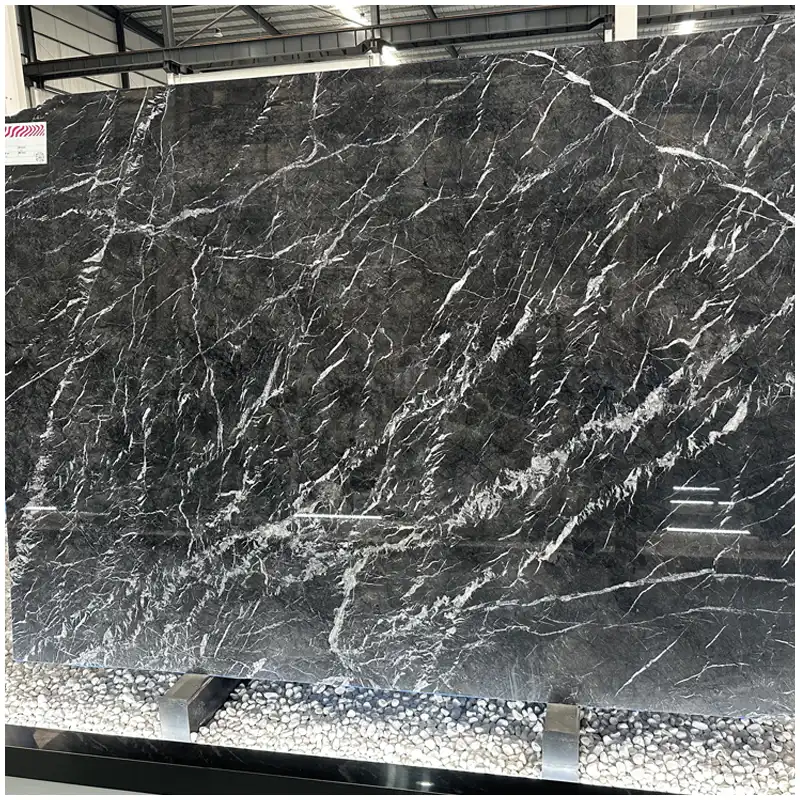
Begin with the whole Carrara marble slab. Stand square to the face. Check whether the background is even, softly clouded, banded, warm, cool, or strongly grey. Then read vein direction and density. Inspect details last. Starting with close photographs can hide the overall composition.
Background needs a signed reference range, not a verbal request for “white.” Put candidate slabs beside the lightest and darkest accepted examples. If one falls outside, decide whether a separate zone can use it or whether it should leave the order.
Vein density should be judged at slab scale. Fine lines may create a quiet field. A few broad veins can dominate a wall. Dense movement can look rich in one feature panel and chaotic across many small vanity pieces. Grade should respond to application, not an abstract preference.
Clouding is not automatically a defect. It can give Carrara its softness. The issue is range and transition. One heavily clouded slab inside a pale group will look accidental. Several coordinated clouded slabs can form a deliberate area.
Mineral marks, pinholes, chips, resin, fills, and mesh receive separate notes. Inspect the face and back. Record size, density, location, and visibility. That slab doesn’t belong next to your bathtub when a pale fill sits under direct light beside the wet edge, even if the same feature would disappear in a high wall panel.
Do not score wet or dirty slabs
Water darkens the field and can reduce the apparent difference between slabs. Dust can make a polished face look honed. Resin residue can create local gloss. Clean and dry the comparison area before grading. If the slab cannot be moved, document the limitation.
Polished and honed stock should not share one visual benchmark without explanation. Finish changes color and reflection. Approve the final finish on representative material and inspect edges and repaired areas as well as the main face.
The Hard-Won Lesson: Grade the usable field, not the prettiest corner
A cropped photograph can show a pale, quiet corner and leave the broad grey cloud outside the frame. Once the complete slab is measured, the required wall panel crosses both zones. The label did not change; the evidence did. Approving the crop would force production to hide information that the installed panel cannot hide.
The Lesson: Every grade approval must include the complete slab face and the actual cut positions.
Include Slab Dimensions, Finish, and Usable Yield
A grade decision without dimensions is incomplete. Record measured length, width, thickness method, irregular edges, cracks, repairs, and restricted zones. Then place the approved drawings on the actual slab. Gross area is not the same as usable yield.
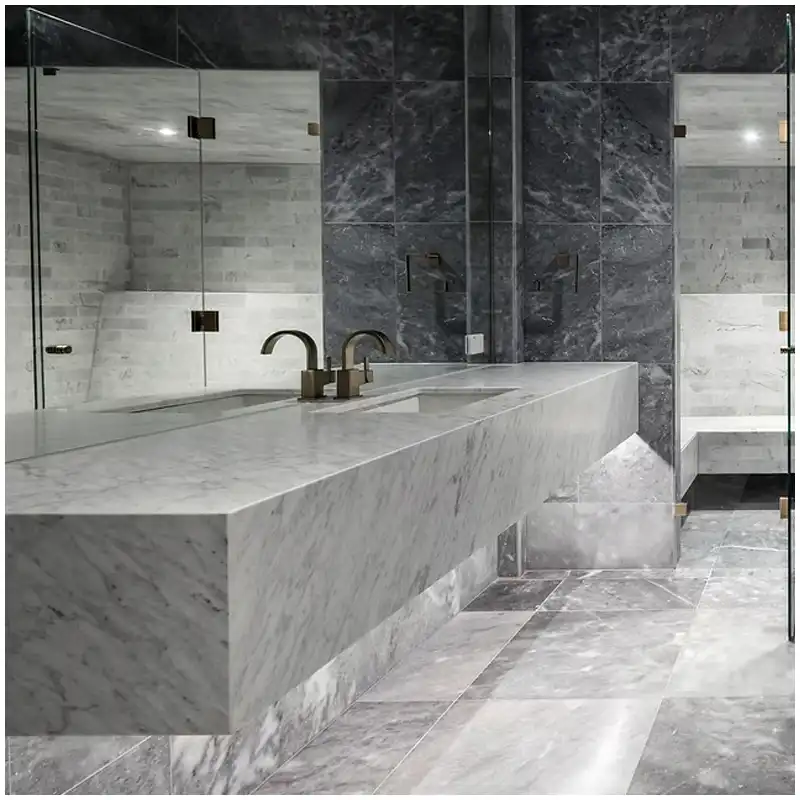
A Carrara marble slab may suit small tiles even when it cannot produce a tall panel. Another may be large enough but carry a strong vein through a sink rail. Grade and yield must be evaluated together. Cheap unusable area is still expensive.
Long vanity tops, stair components, full-height walls, matched pairs, and furniture receive first claim on large sound fields. Small modules, skirtings, and concealed pieces can use remaining approved zones. That allocation belongs in the nesting plan.
Finish affects yield too. A repaired area that looks acceptable sawn may become obvious after polishing. A textured finish may expose an open feature. Produce representative finish tests before final nesting if the response is uncertain.
State which face controls
For many slab applications, the finished face controls appearance. For thin panels, anchors, bonded assemblies, or special fabrications, the back treatment and structure also matter. The project drawing and installation specification state which zones cannot contain mesh, heavy resin, open features, or repairs.
The slab register links front and back images under one ID. If a slab is flipped, re-polished, reinforced, or cut from the back, update the record. Do not let one identity describe two different conditions.
Assign Carrara Grades to Connected Project Zones
Not every area needs the tightest visual range. A formal lobby wall, repeated hotel vanity set, or matched staircase may justify close control. A secondary corridor or modular floor can accept a broader natural blend. The specification should spend tight-range material where people will notice the difference.
The Carrara marble slab allocation map groups material by background and vein intensity. It assigns slabs to connected floors, walls, bathroom types, stairs, or furniture. It also identifies spares. Piece labels carry the area group into dry-lay and packing.
For bathrooms, keep the vanity, backsplash, side return, shower panels, threshold, and floor relationships visible. They do not all need one identical selection, but the differences should be intentional. Direct mirror light can make a vanity group require tighter finish and background control than the floor.
The Bianco Carrara Marble Vanity Tops format is useful when planning sink pieces, while Carrara Marble Tiles supports floor and wall module discussions. Each project still needs its own range, finish, and dry-lay.
Dry-lay the transitions the eye will follow
Dry-lay complete focal walls, visible floor zones, stair flights, matched vanities, and any sequence where background shifts could create a hard line. Show piece codes and arrows. Photograph under consistent light. Approved swaps update the layout and crate list.
A dry-lay is not a pile of pieces photographed from one corner. It should let the reviewer see the intended installation relationship. If space is limited, use staged groups with overlap and a clear map, but disclose the method.
The supplier checklist in How to Source Large-Scale Carrara Marble for High-End Commercial Projects helps confirm access, fabrication, inspection, and packing. Grade control then determines what that supplier may release.
Build the Slab Approval and Replacement Record
The approval file contains the written grade definition, signed range samples, current slab register, complete front and back images, dimensions, treatment notes, finish benchmark, nesting, area allocation, dry-lay, first-piece reports, nonconformance, packing, and final room or area codes.
For each Carrara marble slab, the ID must remain stable after polishing, cutting, dry-lay, and packing. Finished piece codes link back to the source slab and cut position. That chain helps diagnose a mismatch and locate compatible spare material.
Replacement material follows the same approval. If the original block is unavailable, compare the proposed slab with the signed range and the installed area under equivalent light. A grade name alone does not prove the replacement will blend.
If a slab arrives outside the accepted grade, photograph the complete face, label, back, and relevant close details under stable light. Place the signed reference in the comparison where possible. Pause cutting. Contact the supplier with the slab ID and required disposition before regrading, moving, or treating it.
If the issue appears after installation, photograph the full connected area, piece codes, normal light, and close detail. Do not immediately seal, polish, acid-clean, or remove the stone. Compare the site condition with the approval file, then identify whether the problem is grade, light, moisture, residue, finish, or installation.
Quick-Reference Checklist for Carrara Slab Grading
- Ask the supplier to define every grade label used in the quotation.
- Compare complete clean dry slabs under one stable light and visible IDs.
- Approve the lightest, darkest, quietest, and busiest limits of the range.
- Record dimensions, repairs, treatment, finish, and usable cut zones beside appearance.
- Nest critical drawings before accepting quantity or promised yield.
- Allocate slab groups by connected area and preserve codes through dry-lay and packing.
- Use the signed range, not the grade word, when approving replacements.
How to Replace Grade Language with Evidence
Why labels vary
Suppliers sort for different markets, stocks, and commercial expectations. Labels may be internally consistent yet still differ from another supplier’s system. The project avoids that ambiguity by defining observable limits.
What the signed range controls
The range controls background, vein, clouding, marks, repairs, finish, and visible transitions. The slab register adds dimensions, treatment, and identity. The nesting plan adds usable yield. Together they create a real acceptance standard.
When to reject or reallocate
Reject when the slab falls outside required conditions and no suitable zone exists. Reallocate when it remains within an approved secondary range and its dimensions, features, finish, and treatment suit another piece. Record the decision before cutting.
Frequently Asked Questions
1. What is the best Carrara marble slab grade?
There is no universal best grade. The right range depends on desired background, vein character, application, dimensions, finish, treatment limits, usable yield, budget, and matching needs. Approve actual slabs against a written project standard.
2. Are C and CD grades standardized?
They are widely used trade terms, but definitions can vary among suppliers and stocks. Ask for the seller’s written definition, then verify complete slabs for background, veins, clouding, marks, repairs, dimensions, and finish.
3. Does a whiter Carrara slab always cost more?
Price can reflect appearance, availability, slab size, usable yield, treatment, finish, source, demand, and commercial sorting. A paler slab is not automatically better for every design, and price does not replace technical or visual approval.
4. Can several Carrara grades be mixed in one project?
Yes, when the project deliberately assigns ranges to separate zones and controls transitions. Do not randomly mix grades across one connected wall, floor, vanity pair, or stair flight without an approved blend and dry-lay.
5. What should happen when delivered slabs do not match the approved grade?
Photograph complete faces, labels, backs, and disputed details under stable light, place the signed range beside them, and pause cutting. Send the slab IDs and evidence to the supplier before regrading, treating, reallocating, or rejecting the material.
Final Conclusion
A Carrara marble slab deserves approval from its complete background, veins, clouding, marks, repairs, finish, dimensions, and usable yield, not from C, CD, select, or extra alone. Lighting lies, so I would rather put every candidate under one warehouse light than debate grade words later; Esta Stone keeps the signed range and slab evidence as the final authority.
References
- Dimension Stone Design Manual, Natural Stone Institute.
- ASTM C503 Standard Specification for Marble Dimension Stone, ASTM International.
- Natural Stone Institute Care and Cleaning Guidance, Natural Stone Institute.
- Natural Stone Flooring Guidance, Stone Federation Great Britain.
- Slab Handling and Safety Guidance, Natural Stone Institute.
- TCNA Handbook for Ceramic, Glass, and Stone Tile Installation, Tile Council of North America.
- Carrara marble, Wikipedia, English edition.