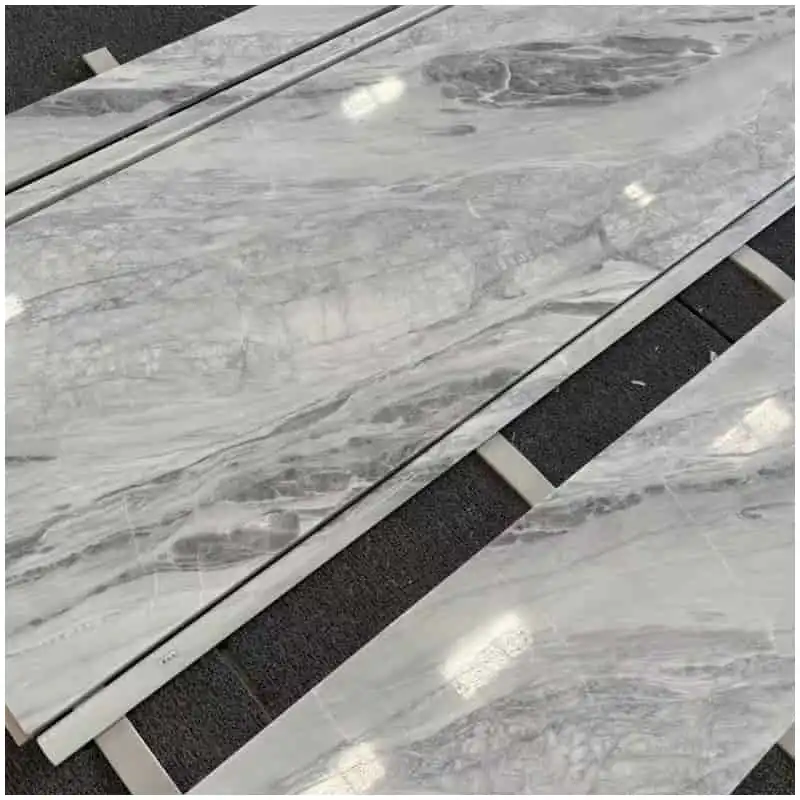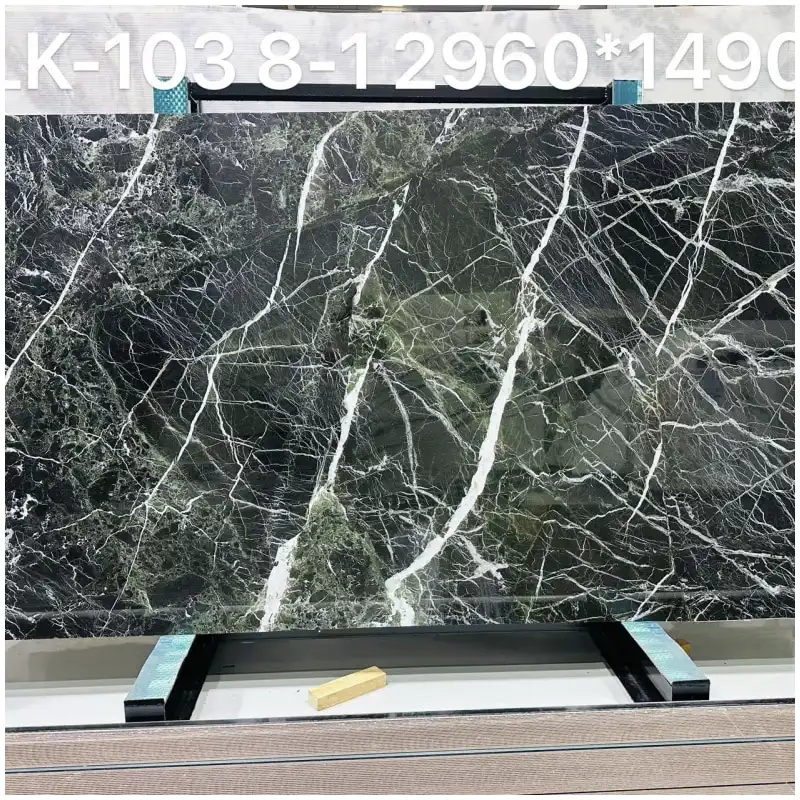



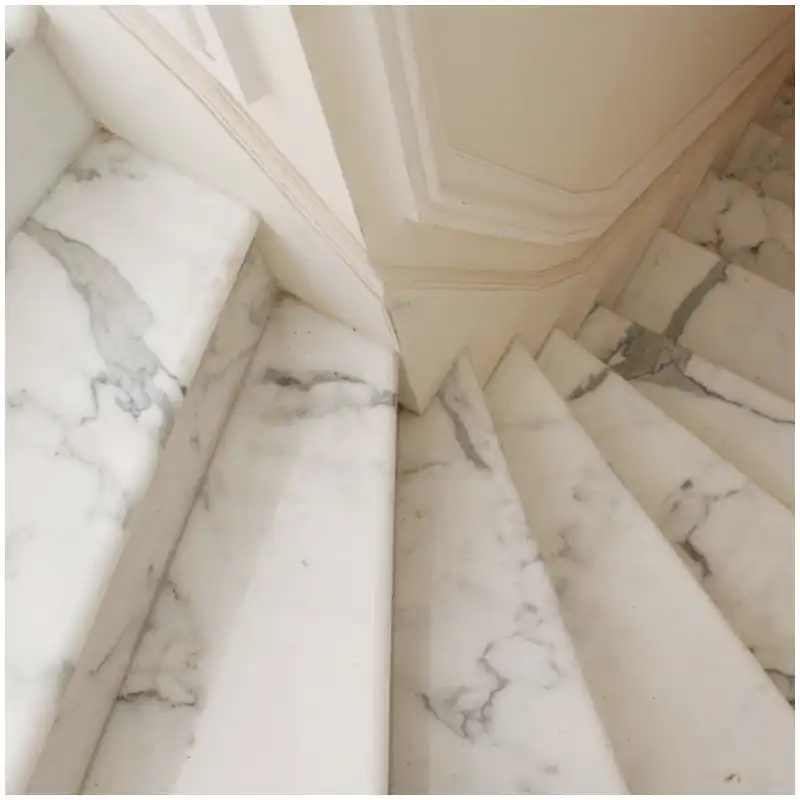
Calacatta Marble Vanity Top Vein Placement around Sinks and Faucet Holes
The drawing arrives after the slab has already received a general approval. Its strongest grey-gold vein crosses the center of the face, and everyone likes it. Then I place the sink template over the photograph. Most of that movement disappears into the bowl, while a darker branch lands beside the faucet hole where the strip of stone is narrowest.
That is the real start of Calacatta marble vanity top vein placement. I do not approve a vanity top by admiring the uncovered slab. I approve the material and the cuts together, at scale, with every opening and exposed edge visible.
The direct rule is blunt: map first, cut second, and keep the revision visible. If the sink, faucet, soap dispenser, overflow route, edge build-up, or backsplash changes, the approved layout changes with it.
Draw Calacatta Marble Vanity Top Vein Placement at Full Scale
Use the final sink model, not a generic oval
Undermount, drop-in, vessel, and integrated arrangements remove or cover different parts of the stone. The cutout file must identify the sink manufacturer and model, bowl outline, flange or rim, fixing zone, sealant area, and required front and rear rails. A brochure dimension is not a fabrication template.

I place the final outline over a square full-slab photograph. The Calacatta Marble slabs chosen for the project may carry broad veins, fine branches, small fills, or pale open fields. The overlay tells me which of those features remain after cutting.
For Calacatta marble vanity top vein placement, the visible perimeter matters as much as the removed center. A vein clipped by the cutout can look accidental. A vein that approaches the bowl and continues toward the backsplash often reads more naturally.
Show every drilled opening
Faucet holes need final center spacing and diameter. Add holes for handles, soap dispensers, pop-up controls, or accessories where they exist. Then show the required clearance from the sink cutout, backsplash, edge profile, cabinet rails, clips, and plumbing below.
A small hole can intersect a natural feature or repair that looked harmless in the full face. Drilling changes local stress. The fabricator determines the safe method and any reinforcement from the actual material, geometry, and equipment. My job is to make the condition visible before work begins.
The published Marble Vanity Countertop: Sink Cutouts, Veins, Light, and Batch Tone covers the broader coordination record. Here I stay with the Calacatta face and the exact way holes interrupt it.
Add edges, returns, and backsplash strips
A mitred apron needs matching material. A laminated edge exposes another strip. A side return can require continuity around a corner. A backsplash may carry the same vein upward or may deliberately use a quieter zone. Put those components on the same map.
I mark exposed and concealed edges separately. The fabricator can then avoid placing a filled cavity on the front arris while accepting a sound natural feature in a concealed rear edge according to the approved criteria.
Der Calacatta Gold Marble vanity top option shows how warm veining can become a focal line around the basin. The website image is not the project approval; numbered slab and cut-map evidence still controls the order.
| Layout item | What Susan checks | Reject or revise when | Approval record |
|---|---|---|---|
| Sink cutout | Final template, rail widths, vein entry and exit | Strong repair or weak feature sits on narrow bridge | Scaled slab overlay |
| Faucet holes | Diameter, centers, clearance, local stone | Hole clips a fill, fissure, edge, or backsplash | Drilling detail and full view |
| Front edge | Vein continuity, fill, profile, apron source | Dark strip or repair frames the top | Edge sample and dry fit |
| Backsplash | Direction, joint, faucet and mirror relationship | Vein breaks sharply at the top junction | Combined elevation |
| Lighting | 3000K and 4000K comparison where relevant | Fill or undertone shifts outside approved range | Dry control photographs |
The table keeps Calacatta marble vanity top vein placement tied to the piece that will exist after cutting. It also stops a close photograph of one hole from replacing the full composition.
Judge Vein Position and Stone Condition Together
A strong vein is not automatically a weak vein
Color does not prove structural condition. Some veins are mineral movement within sound crystalline stone. Others may follow natural fissures, filled openings, resin lines, mesh-supported areas, or repaired breaks. I inspect the front, back, edge, transmitted light where useful, and the supplier’s repair record rather than judging from color alone.
Don’t just look at samples. A hand sample can remove the exact feature that makes the slab interesting and the exact condition that needs fabrication review.
The fabricator decides reinforcement, cutting order, tool path, handling, and support from the actual slab and geometry. If the chosen composition puts a questionable condition beside the sink rail, move the layout or choose another slab before cutting.
Keep the focal vein visible after the basin is installed
A vessel basin can cover a large central area. An undermount bowl removes stone but leaves the surrounding deck. A wide mirror and warm light may pull attention to the rear band. I mock up the final visible zones, not just the cutout boundary.
With Calacatta marble vanity top vein placement, moving the sink by a small amount can preserve a strong branch or improve the balance between left and right decks. That move is only valid if cabinet, plumbing, faucet, accessibility, and design requirements still work.
A double vanity needs a composition across both bowls. Two individually attractive rectangles can create an awkward dead zone at the center. Show the full top as one face, including the gap, faucet sets, backsplashes, and any joint.
Repeat the layout rule without cloning the face
Multi-room work needs consistency, but natural Calacatta cannot repeat one printed pattern. I define a placement rule for each room type: permitted vein strength near the bowl, minimum quiet field around drilled holes, direction across paired basins, exposed-edge limits, and the visual weight allowed at the centerline. Each numbered top then receives its own overlay.
This keeps Calacatta marble vanity top vein placement consistent without pretending every room can look identical. The inspection sheet groups tops by room code and slab range, while photographs prove the actual composition. A replacement top must satisfy the same rule and its neighboring finishes; matching only width and sink model is not enough.
Do not let the cutout consume the best replacement option
Cutting yield matters. If the only compatible spare zone becomes waste inside the first basin opening, the project loses a future repair option. The cutting map should reserve practical matching material where replacement obligations or high-risk pieces justify it.
The broader Calacatta Marble Slabs: Complete Guide to Full-Slab Approval, Vein Layout, Batch Matching, and Project Selection establishes the range and numbered-slab control. The vanity map then assigns that approved material to exact openings and exposed edges.
The Hard-Won Lesson: The sink can erase the reason a slab was chosen
A recurring approval mistake happens when the full slab is signed first and the sink outline is added later. The dominant vein that sold the selection falls almost entirely inside the waste opening. What remains is one dark fragment at the bowl edge and a quiet deck that no longer resembles the approved photograph. Rotating the template after cutting is impossible, and shifting plumbing at site creates a different problem.
The Lesson: Never approve a Calacatta vanity slab until every opening is drawn over the complete face.
Check Undertone and Repair under Bathroom Light
Lighting lies when the comparison conditions change
Warm 3000K lighting can pull beige and gold from Calacatta. Cooler 4000K lighting can make the white field look sharper and grey veins stronger. Mirror lighting also creates frontal reflection that warehouse ceiling light does not reproduce.
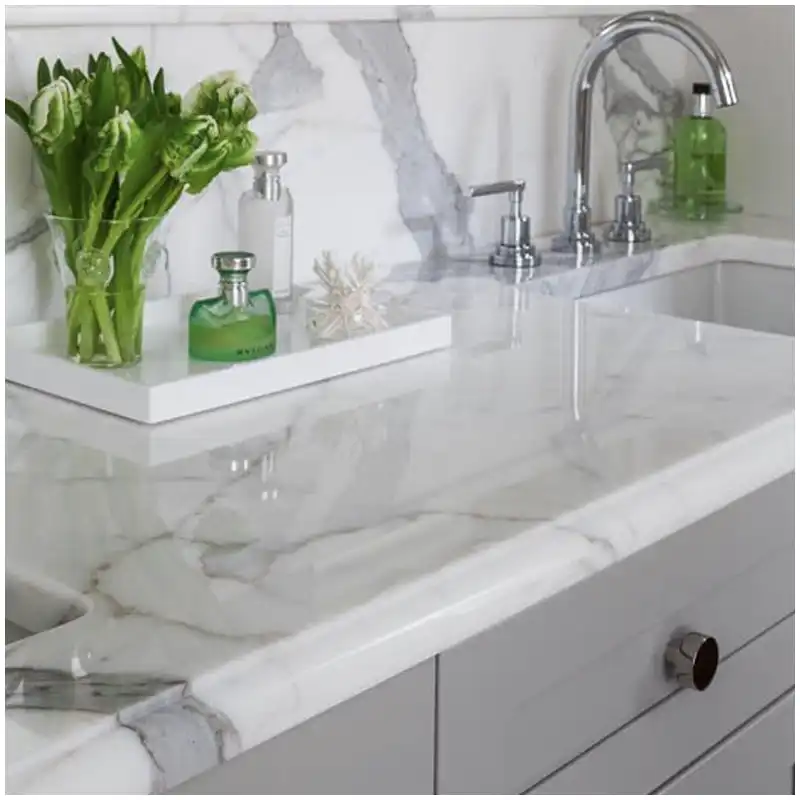
I photograph the dry mapped slab under consistent warehouse light, then inspect the finished control piece under the specified or representative bathroom light when that information is available. The goal is not to make two lights look identical. It is to know which approved features become stronger.
For Calacatta marble vanity top vein placement, a filled line beside the faucet can disappear in one photograph and catch every mirror light in the room. Raking light exposes that surface relationship before installation.
Judge the top dry and clean
Water darkens marble and may linger around cutouts or repairs. Slurry, wax, protective film, and dust can shift the face. Final approval uses a clean, dry piece after the agreed fabrication and treatment process.
If a sealer or treatment is specified, test it on representative material and allow the required cure before judging color. Record the product and sample. Do not use an unrecorded treatment to make one finished piece resemble a wet approval photograph.
Der Calacatta Gold Marble slab for bathroom can show warm movement differently under the room’s lamps. The final numbered slab, finish, and lighting check govern the project, not the product thumbnail.
Carry the Approved Map through Fabrication
Lock orientation and revision
The cut map carries slab ID, photograph revision, scale, piece ID, finished dimensions, openings, orientation, exposed edges, backsplash source, and approved date. A later sink or faucet change creates a new revision and a fresh layout check.
I require a visible orientation mark before the slab leaves the layout station. Once the piece is separated, the full-face context disappears. The identifier must survive cutting, edge work, inspection, dry fit, and packing.
Each Calacatta marble vanity top vein placement approval also identifies which side is the visible face. Back mesh, resin, or reinforcement records stay attached to the piece rather than being separated from the aesthetic map.
Dry-fit sink, faucet template, and edge components
The inspector checks actual cutout dimensions, corner radii, chips, repairs, faucet centers, edge profile, build-up joints, backsplash fit, and vein result. A paper drawing cannot prove that the finished opening and hand-worked edge match the approved face.
For an assembled apron or laminated edge, inspect the glue line dry and under raking light. Confirm that its vein and tone do not create an unintended stripe. If the backsplash continues a feature, place the pieces together with the intended joint.
Keep photographs useful
One image shows the complete top with readable ID. Detail images show each opening, exposed edge, repair, and joint. Include a scale for dimensions, but do not cover the vein being judged. Record whether protective film is present.
The related Bathroom Vanity Top Supplier for White Marble Project Orders connects those piece records to quantity, sink models, finishes, batch tone, packing, and room allocation.
What to Do When the Fabricated Vein Looks Wrong
Compare the piece with the approved overlay
Check slab ID, piece ID, orientation, drawing revision, sink template, and photograph. Decide whether the error is layout, rotation, wrong slab, changed opening, or an appearance shift caused by moisture or lighting.
Stop alteration before evidence disappears
Photograph the complete top and close details, hold installation and further grinding, and contact the supplier with the original slab map and inspection records. Cutting more stone before that comparison can destroy the best correction option.
Review the connected pieces
If the top has an apron, backsplash, side return, or paired vanity, inspect the whole set. Replacing one face may break a relationship that currently works.
Quick-Reference Checklist for Calacatta Vanity Layout
- Use the final sink and faucet templates on a square full-slab image.
- Mark all visible edges, aprons, returns, and backsplash sources.
- Inspect veins, fissures, fills, resin, mesh, and repairs together.
- Preserve the focal movement outside waste cutouts.
- Check the mapped area dry under diffuse and raking light.
- Lock slab, piece, orientation, and drawing revision before cutting.
- Dry-fit every opening and connected edge before packing.
Frequently Asked Questions
1. What does Calacatta marble vanity top vein placement require?
It requires a numbered full-slab photograph with final sink and faucet openings, orientation, exposed edges, backsplashes, repairs, and scale shown before cutting begins.
2. Should a strong vein cross the sink cutout?
It can, but the final visible result and the stone condition around narrow rails must be inspected. Do not let the opening remove the entire focal feature or expose an unsuitable repaired zone.
3. Can the faucet position move to save a vein?
Only when the revised location still works with the approved sink, cabinet, plumbing, backsplash, clearances, accessibility, and fitting requirements. Update every connected drawing before drilling.
4. Why check Calacatta under 3000K and 4000K light?
The two conditions can change how warm undertones, grey veins, filler, and surface repairs read. Use the actual project light where possible and keep the stone dry for comparison.
5. What should happen when the cut piece does not match the approved layout?
Document the full piece and IDs, stop installation and further alteration, and compare it with the slab overlay, drawing revision, fabrication record, and connected pieces before deciding a correction.
Final Conclusion
Calacatta marble vanity top vein placement is complete only when the final sink, holes, edges, backsplash, stone condition, light, and fabrication record agree with the numbered slab. I would rather redraw one cut template than watch the basin remove the reason a slab was chosen, and Esta Stone keeps that map attached to the piece until inspection is finished.
Referenzen
- Dimension Stone Design Manual, Natural Stone Institute.
- ASTM C503 Standard Specification for Marble Dimension Stone, ASTM International.
- ASTM C97 Standard Test Methods for Absorption and Bulk Specific Gravity of Dimension Stone, ASTM International.
- Natural Stone Institute Technical Guidance for Countertop Installation, Natural Stone Institute.
- Bathroom Planning Guidelines, National Kitchen and Bath Association.
- Natural Stone Care and Maintenance Guidance, Natural Stone Institute.
- Marmor, Wikipedia, English edition.