


Thassos Marble Vanity Top: Sink Cutouts, Edge Details, and Warm-Light Approval
A white slab appeared almost still until the sink template was laid over it. The only calm field sat inside the waste opening, leaving the strongest crystal movement directly below the mirror lamps. The full top is kept in view rather than a bright detail, because warm light and water change how the surface reads.
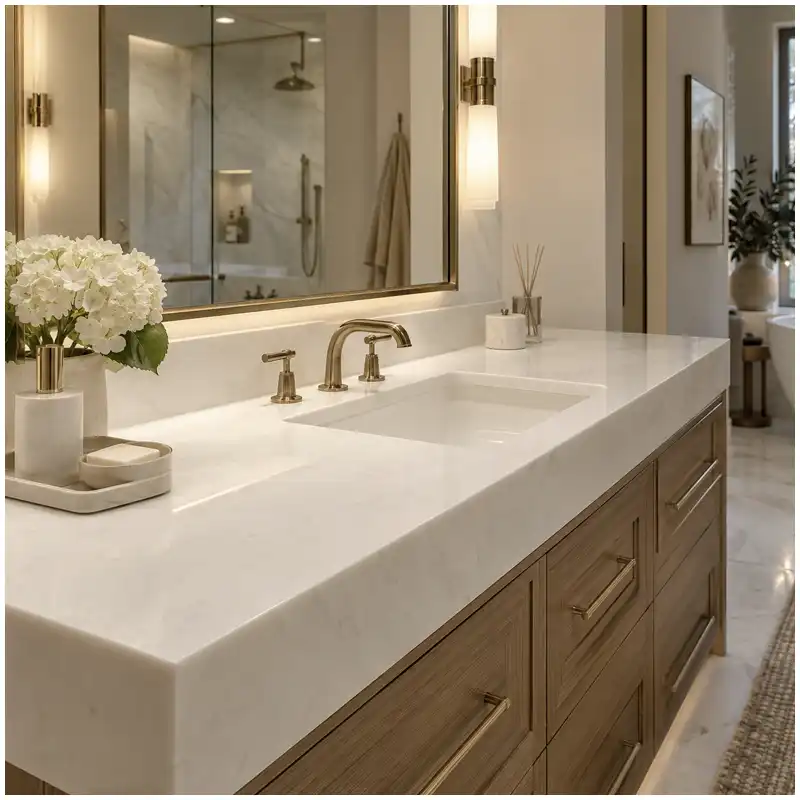
A vanity top is one decision inside the wider Thassos marble bathroom: the slab range and the bathroom lighting are settled first, and the top is approved inside them. This page owns the cutout, the surviving field, the edge profile and the splash relationship rather than the general bathroom selection.
Lighting lies. The full slab and dry-lay tell the truth.
Choose the Full Slab before the Cutout with Thassos Marble Vanity Top
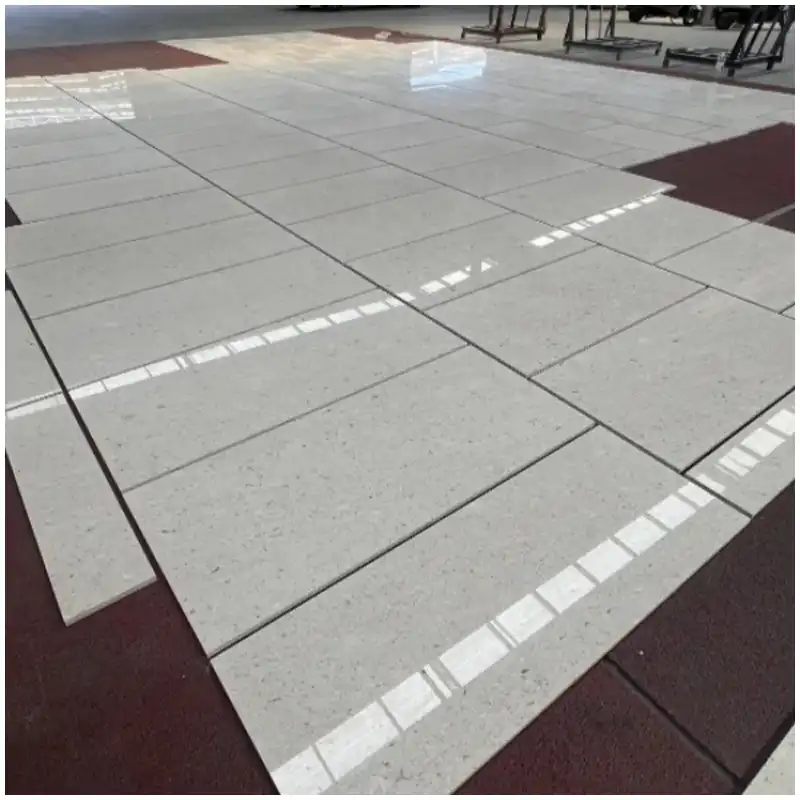
On a white slab, the sink opening decides which part of the field the eye will keep seeing. The template is laid on the full face first, because a cutout that lands on the calm centre leaves the busier crystal around the rim.
Two records go with the top: the approved slab range for the batch, and the two-light comparison taken at approval. The first fixes which white was accepted; the second fixes the conditions it was accepted under.
The sink template is the dominant opening, and it is checked together with the faucet holes before the crop is approved. Its position is compared with the calm zone the slab was selected for.
Place the Sink around the White Field
The edge follows the cutout. An edge detail that reads well on a flat sample can look heavy once the bowl is cut, because the eye now travels from the rim to the edge across a shorter run of stone.
The top has to hold under mirror light, which is the surface it will be judged in every day. The project mirror lighting can differ substantially from the warehouse lighting in spectrum, direction and intensity.
Para Thassos marble vanity top, slab choice, cutout position and edge detail are documented before fabrication. The reference and the delivered pieces are read against the drawing as one condition.
Read the Edge under Mirror Light
A polished edge and a honed edge respond differently to mirror light, so both are compared against the signed reference before the edge is chosen rather than after it is cut.
The dry-lay map and the repair record stay with the top. One locates the piece on the slab; the other records any repair and where it sits relative to the cutout.
On a Thassos marble vanity top, the edge sample is recorded while the surface is still unworked, because polishing or sealing changes what the comparison can show.
| Decision point | Evidence to inspect | Release condition |
|---|---|---|
| Slab crop | Calm and active white zones on full face | Sink and faucet avoid the intended focal field |
| Cutouts | Exact basin and faucet templates | Openings respect edge bridges and visual direction |
| Borde | Profile and finish under mirror light | Vertical edge does not distract from the white field |
| Salpicaduras | Return, wall tone, and joint | Top-to-wall transition remains within accepted range |
| Replacement | Full-face photo and crop drawing | Future work can match the original material logic |
The Hard-Won Lesson in Thassos marble vanity top: The calm field was cut away first
A common failure pattern: A vanity crop was approved from a small photograph. When the full slab arrived, the basin opening removed the quiet central area and left a busier crystal zone exactly where the mirror lights made it strongest. The slab was beautiful. The crop was careless.
The Lesson: Overlay the exact sink and faucet templates on the full slab before approving a white marble vanity crop.
Coordinate Splash and Wall Tone
The relation between the top and the wall behind it is settled early, because a splash in a slightly different tone reads as a break rather than as a shadow.
The chosen edge sample sits with the slab it came from, so a later question about the profile starts from the approved piece rather than from a description of it.
For a Thassos marble vanity top, the slab, the cutout position and the edge detail are recorded while the top is still a whole slab.
Protect the Wet Edge without Altering the Face
Under the mirror lighting, the edge profile and the crystal around the cutout are read together, since that pair is what the user sees at the basin every morning.
The batch register and the room allocation sit together, so the top can be traced to both the batch it came from and the room it was made for.
The splash return is the next check, because it is where the top meets the wall and where a tone difference between the two surfaces becomes visible.
Approve the Top with the Cabinet and Faucet
The faucet holes are positioned against the same calm zone as the bowl, so the two openings are judged as one layout rather than separately.
Where a replacement piece is needed later, it is compared against the accepted range for that top rather than against the top currently installed.
For a Thassos marble vanity top, the decision is recorded while the top is still a whole slab. Delivered material and approved reference are held to the drawing together.
Keep a Replacement Reference
The faucet zone is checked again under the project lighting, because a hole position that clears the field in the warehouse may sit differently once the mirror is lit.
Both records are kept with the top. With them, a later question about a cleaned or repaired area can be answered from what was accepted.
A sealed wet edge is read against the reference with the lighting unchanged, so the sealer’s effect is separated from the effect of the light.
What the Cutout Removes
A rectangular sink opening takes the centre of the slab a viewer would otherwise read as the face. Where the calm zone of a Thassos block sits under the template, the busier crystal is left around the rim, which is the part seen every day at the basin. Laying the actual template on the full slab shows that trade before any cutting starts, and it is one of the checks most likely to change which slab is chosen.
Undermount, inset, and top-mount basins expose different amounts of the stone cutout and use different rim and sealant details. The manufacturer’s template and installation detail therefore belong in the crop decision before fabrication. Each type produces a different relationship between the cut and the visible field, so the bowl type belongs in the decision rather than arriving with the plumbing drawing.
The Rim, the Edge and the Splash as One Reading
From a standing position at the basin, the eye takes in the rim of the cutout, the front edge profile and the line where the top meets the wall splash. These three sit within one field of view, so a change in any one of them is read against the other two. A splash in a marginally different tone, or an edge that is heavier than the one approved on a sample, shows up here rather than in isolation.

This is why the edge is chosen against the template rather than before it. Once the opening is positioned, the amount of stone between the cutout and the profile is fixed, and that distance decides how heavy a profile the composition can carry. Where the chosen slab leaves a narrow band at the front, a simpler profile can keep the reading calmer, while a deep profile in the same place may draw the eye away from the field the slab was selected for.
What the Fabricator Needs before Cutting
The vanity decision is only complete when it can be cut without further interpretation. That means a dimensioned drawing of the top showing the bowl and faucet positions with their centre lines, the finished edge profile and where it stops, the splash height and return, and the overhang relative to the cabinet carcase. Where the slab has been stabilised or repaired, the extent of that work is marked on the same drawing so the cut and the repair can be judged together.
The template matters as much as the drawing. A manufacturer’s paper template reflects the bowl that will actually be installed, while a dimension taken on site reflects the aperture as it currently exists. Where the two disagree, the difference is resolved before cutting rather than at installation, because a cutout cannot be moved once the rim has been finished.
Holding the Approved Reading through Fabrication
A top leaves the decision stage as a whole slab with a marked position, and it arrives as a cut piece with a finished edge. What keeps the two connected is the record: the slab identity, the position the template occupied on the face, the edge sample that was approved, and the light the approval was taken under. With those, a later question about the basin area can be answered from what was accepted instead of from memory of the slab.
That record also covers the practical end of the sequence. A replacement piece has to match an approved area rather than the piece currently installed, and the edge profile has to be reproducible in the same finish. Writing both down while the top is still whole is what makes the later match possible.
Where a White Vanity Top Starts to Look Busy
The basin changes the composition
A sink cutout is not a minor fabrication event. It decides which part of the white field remains visible every day.
Edges live in different light
A vertical polished edge catches mirror lighting differently from the horizontal face and needs a real comparison.
The bathroom is the approval setting
Cabinet reveal, wall tone, splash, faucet, and warm light complete the stone decision.
Tone, vein movement, finish and the wet-area relationship are all judged on the full face under the project light, not on a detail photograph.
How to Identify Premium Thassos White Marble carries the wider version of this check, since the white has to agree across the whole assembly.
Losa de mármol blanco de Tasos sits beside its signed reference so a different batch cannot pass on the name alone.
Before acceptance it goes back to Thassos and Bianco Sivec Marble and to the bathroom the top serves.
At the distance the top is actually used from, the cutout, the edge and the splash are read as one composition rather than as three separate details.
Release happens against the full-face record and the cutout overlay together, so the approved top can be traced back to the slab position it was cut from.
Frequently Asked Questions
1. How should a Thassos marble vanity top be selected?
Review the full slab, overlay the exact sink and faucet templates, compare edge samples under project light, and approve the top with its cabinet and splash context.
2. Can a sink cutout change the look of white marble?
Yes. It removes part of the selected face and can leave a different crystal or vein zone in the main visible area.
3. Should a Thassos vanity edge be polished?
Compare polished and honed edge samples under the actual mirror lighting and selected finish requirements before deciding.
4. Why does white marble look different beside a backsplash?
Wall tone, joint color, splash return, lighting, slab range, finish, and moisture can all change the visible relationship.
5. What should happen if the finished crop differs from the approved slab photo?
Photograph the top under comparable light, stop related fabrication, compare it with the full-face and cutout record, then resolve the crop or allocation before repeating it.
Quick-Reference Checklist for Thassos marble vanity top
- Approve the full slab before committing the vanity crop.
- Overlay exact sink and faucet templates on the selected face.
- Test edge profiles below the actual mirror light.
- Check splash and wall tone beside the finished top.
- Save a full-face photograph and crop drawing for replacement work.
Where the Cutout Sits in the Crystal Field
A sink cutout removes the part of the slab the eye was reading. The decision is not only where the bowl physically fits but which crystal zone survives around it, because the surround is what will actually be seen under mirror light. Marking the template on the full face makes the trade visible before the saw runs.
Two further details belong on the same drawing. The first is the splash-to-wall relationship: the top is judged against the wall behind it, so a splash in a slightly different tone reads as a break rather than a shadow. The second is the edge profile relative to the cutout, since an eased edge around a heavily patterned zone gives the eye less to follow than a square edge does.
Final Conclusion
A white vanity top stays quiet when the calmest part of the slab survives the openings, edges, light, and wall transition. The final decision on Thassos marble vanity top must stay attached to the evidence that production and site teams can verify.
Don’t just look at samples. Esta Stone reads the whole slab before a sink cutout decides the bathroom for us.
References
- Mármol de Tasos, Wikipedia.
- Dimension Stone Design Manual, Natural Stone Institute.
- Natural Stone Institute Technical Bulletins for Wet Areas.
- TCNA Handbook for Ceramic, Glass, and Stone Tile Installation.
- Stone Federation Great Britain Technical Guidance for Natural Stone.
- Search Essentials, Google Search Central.