Résumé rapide : Calacatta Marble vs Carrara Marble is one of the most important comparisons for luxury kitchen buyers because both stones are beautiful white marbles, but they create very different design results. Calacatta Marble is usually bolder and more dramatic for statement islands and backsplashes, while Carrara Marble is softer, more timeless, and easier to use across classic kitchen countertops.
A homeowner wants a dramatic white marble island that becomes the visual center of an open-plan kitchen. A designer wants a softer, timeless stone for a calm family kitchen. A contractor needs consistent marble slabs for multiple luxury apartments. A wholesaler wants to stock the right white marble for countertop projects. In all of these cases, the buying decision often becomes one question: Calacatta Marble vs Carrara Marble — which one is better for the kitchen?
The honest answer is not “one is better.” The better choice depends on the kitchen design goal, slab layout, lighting, maintenance expectation, project size, and buyer tolerance for natural variation. Calacatta Marble is often selected when the kitchen needs drama, bold veining, waterfall islands, full-height backsplashes, or a luxury showpiece. Carrara Marble is often selected when the kitchen needs soft elegance, subtle grey veining, timeless countertops, and easier visual balance across larger surfaces.
For buyers comparing premium white marble options, a dedicated Calacatta Marble slab page is a practical starting point because it helps show the bold veining, bright background, and statement potential that make Calacatta popular in high-end kitchen islands and luxury interiors.
Calacatta Marble vs Carrara Marble: Quick Comparison
The Short Answer for Kitchen Buyers
Choose Calacatta Marble if the kitchen needs a bold focal point, dramatic island, bookmatched backsplash, or high-end visual statement. Choose Carrara Marble if the kitchen needs a softer, more classic, more understated surface that can work across countertops, backsplashes, walls, and traditional-modern interiors.
Both materials are natural marble. Both can be used in kitchens. Both need sealing, careful cleaning, and realistic maintenance expectations. Neither should be treated like quartz. Marble is beautiful, but it is not a superhero countertop wearing a cape. It can stain, etch, and develop patina if used heavily without proper care.
| Facteur | Marbre Calacatta | Marbre de Carrare | Buyer Recommendation |
|---|---|---|---|
| Background Color | Brighter white or warmer white | Softer white to light grey | Calacatta for brighter luxury, Carrara for subtle elegance |
| Veines | Bold, dramatic, wider veins | Softer, finer grey veins | Calacatta for statement islands, Carrara for calm kitchens |
| Impact visuel | Élevée | Medium to soft | Choose based on design intensity |
| Meilleure utilisation | Islands, backsplashes, feature counters | Countertops, walls, classic kitchens | Match to space size and lighting |
| Entretien | Needs sealing and careful use | Needs sealing and careful use | Both require marble care |
What Is Calacatta Marble?
Caractéristiques visuelles
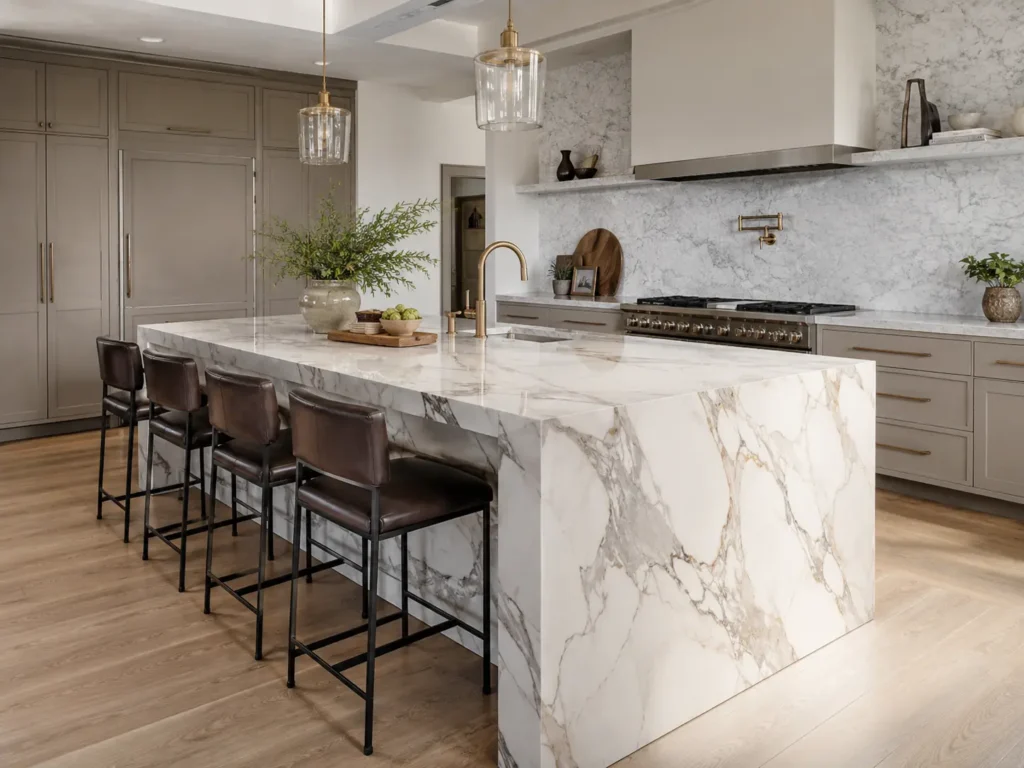
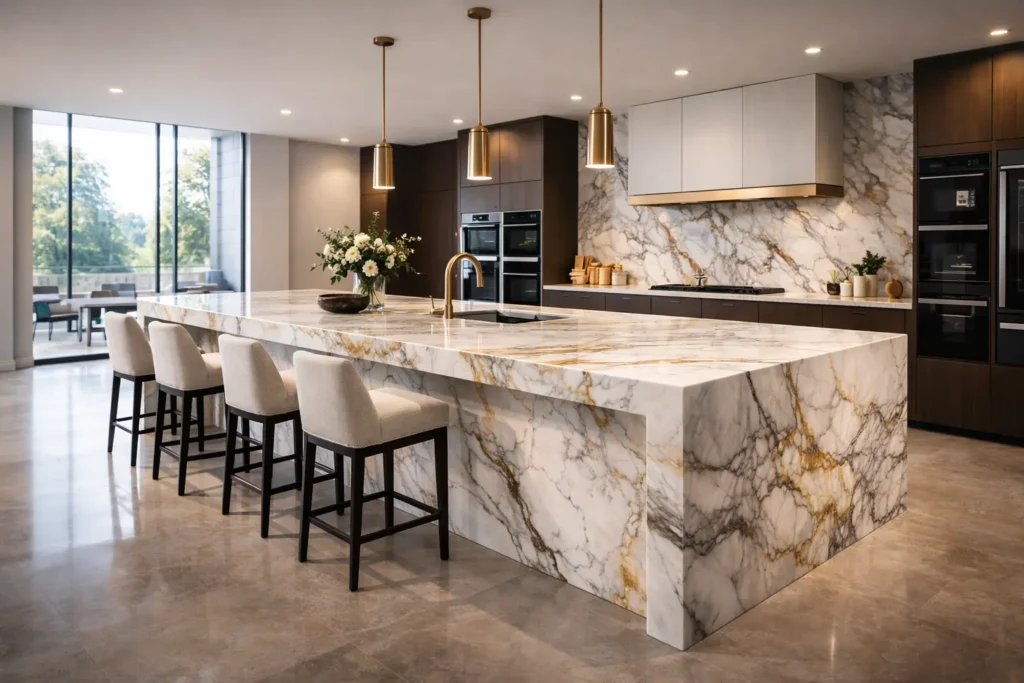
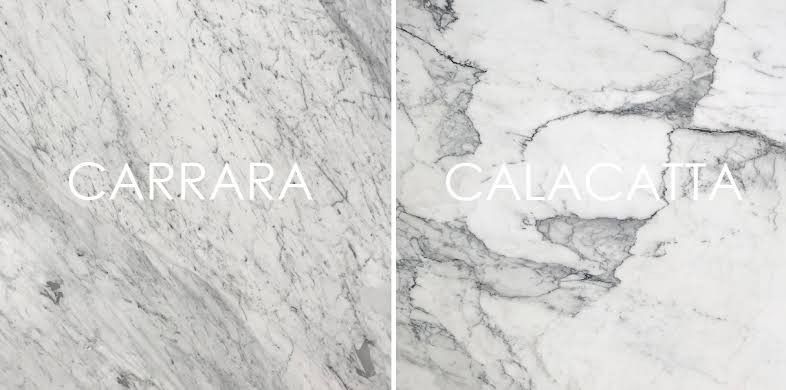
Calacatta Marble is known for a bright white or warm white background with bold, expressive veining. Depending on the variety, the veins may be grey, gold, beige, taupe, or dramatic charcoal. Compared with Carrara, Calacatta usually creates stronger contrast and a more luxurious visual statement.
This makes it especially suitable for large kitchen islands, waterfall countertops, full-height backsplashes, bookmatched walls, bar counters, and high-end open-plan kitchens. When the design goal is to make the stone the star of the kitchen, Calacatta Marble is often the stronger choice.
Buyers who want to understand the origin, visual identity, and material positioning of Calacatta can review this detailed guide on natural Calacatta Marble, which is useful for understanding why the material is so often associated with premium interior design and luxury kitchen surfaces.
Best Kitchen Uses for Calacatta Marble
Calacatta Marble works best when the kitchen has enough space and lighting to let the stone breathe. A large island allows the veins to run naturally across the surface. A waterfall edge can continue the pattern downward and create a sculptural effect. A full-height backsplash can turn the cooking wall into a natural artwork.
However, strong veining requires planning. Buyers should not approve Calacatta from a tiny sample alone. Full slab photos, videos, dry lay, vein direction, seam placement, and fabrication planning are essential. A poorly placed seam through a dramatic vein can make a luxury kitchen look accidental rather than intentional.
What Is Carrara Marble?
Caractéristiques visuelles
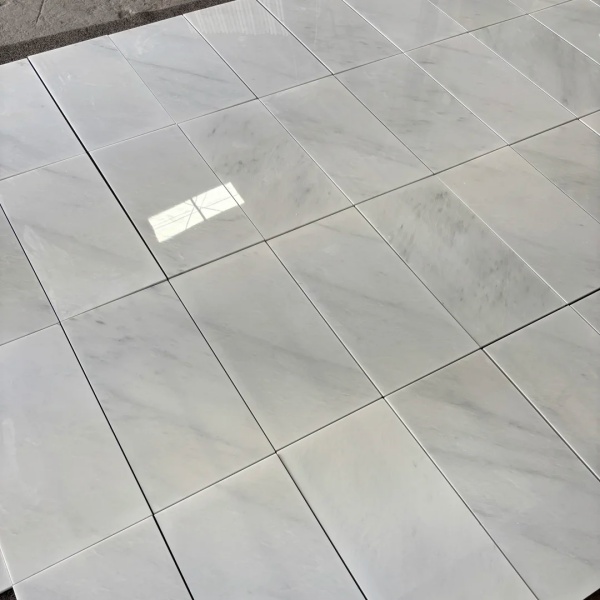
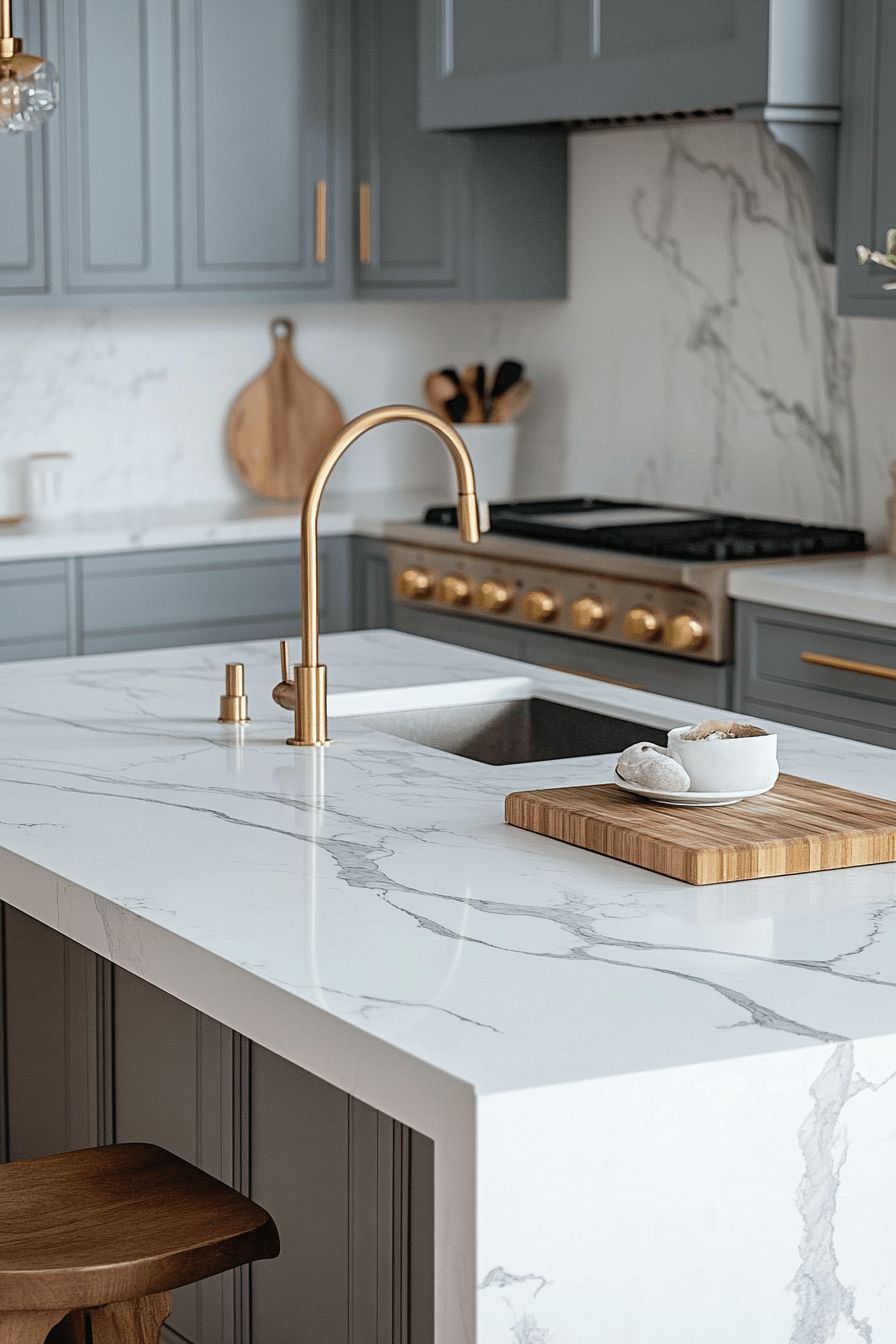
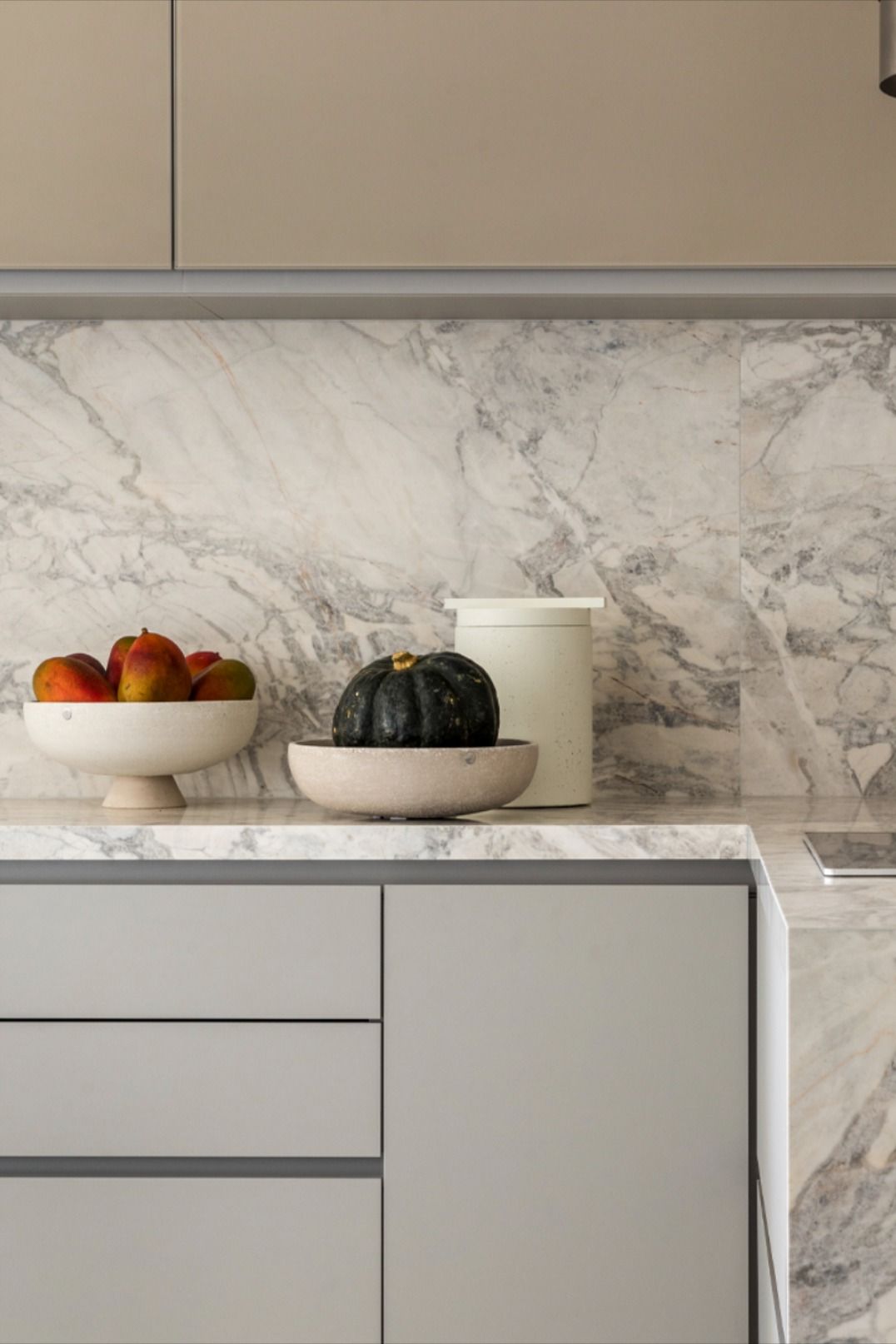
Carrara Marble usually has a softer white to grey-white background with finer grey veining. The overall look is calmer, more classic, and more understated than Calacatta. It is often easier to use across larger surfaces because it does not dominate the room as aggressively.
For kitchen buyers, Carrara Marble is a strong option when the design calls for timeless elegance rather than dramatic contrast. It pairs well with white shaker cabinets, soft grey cabinetry, cream walls, light oak, brushed nickel, chrome, and traditional or transitional kitchen styles.
For projects that need tile-based applications or coordinated kitchen and bathroom surfaces, Carrara Marble tiles can be useful for backsplashes, wall cladding, bathroom coordination, and softer interior layouts where full slabs may not be required.
Best Kitchen Uses for Carrara Marble
Carrara Marble is ideal for kitchen countertops, backsplash tiles, soft white kitchen islands, classic cabinet combinations, apartment kitchens, hotel apartment projects, and subtle luxury kitchens. It works particularly well when the space should feel elegant but not overly dramatic.
Buyer warning: softer does not mean maintenance-free. Carrara Marble is still natural marble. It can stain, etch, and show wear if used without sealing and proper care. Some batches may appear greyer or cloudier than expected, so full slab approval is still important.
Appearance Difference: Veining, Color, and Visual Impact
Veining Pattern
The most obvious difference between Calacatta Marble and Carrara Marble is veining. Calacatta usually has larger, wider, more dramatic veins. Carrara usually has finer, softer, more feathery grey veins. Calacatta often works like artwork. Carrara works more like a refined background.
If a kitchen has minimalist cabinets and a large open island, Calacatta can create a powerful focal point. If the kitchen has many cabinets, shelves, appliances, and visual details, Carrara may feel more balanced. This is why design context matters more than simply saying one marble is “better.”
Tonalité de fond
Calacatta often appears brighter or warmer white, depending on the slab. Carrara often appears softer, cooler, or greyer. Lighting can change both materials. Warm lighting can soften Calacatta and make it feel warmer. Cool lighting can make Carrara look more grey and sometimes more subdued.
For buyers comparing multiple white marble options beyond these two famous names, a broader marbre de qualité supérieure category can help identify alternative tones, veining patterns, and project-appropriate materials for kitchens, bathrooms, and commercial interiors.
Which Marble Looks Better in Luxury Kitchens?
Choose Calacatta Marble for a Statement Kitchen
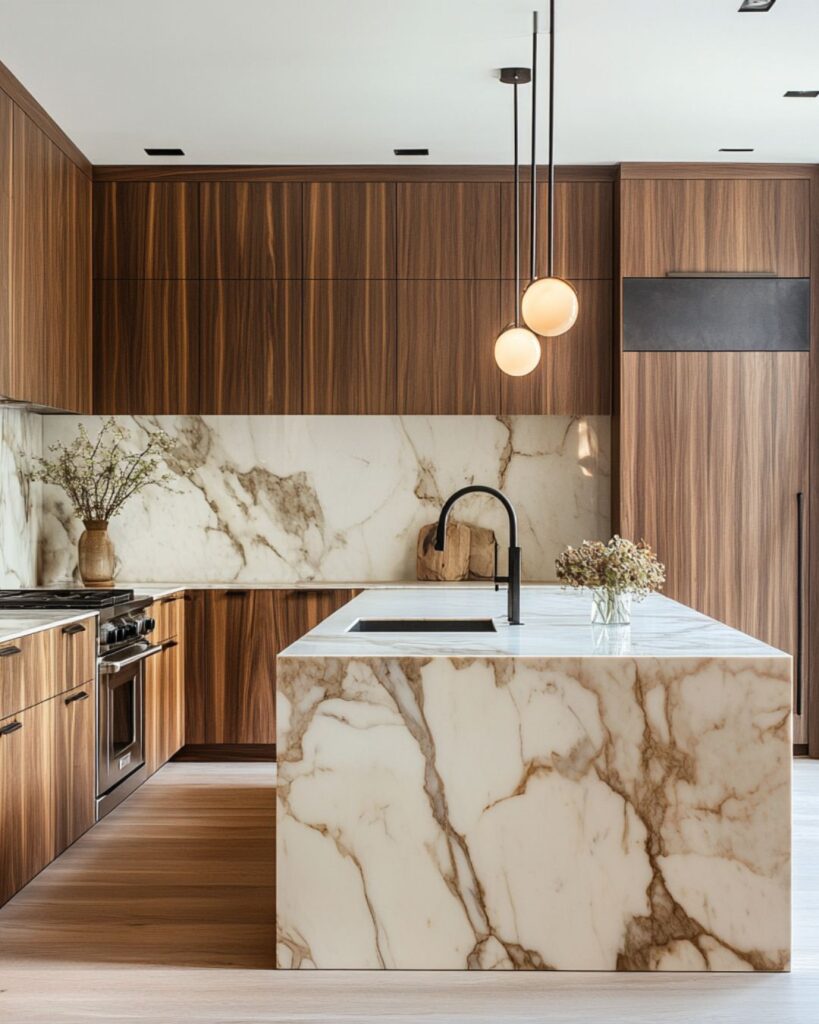
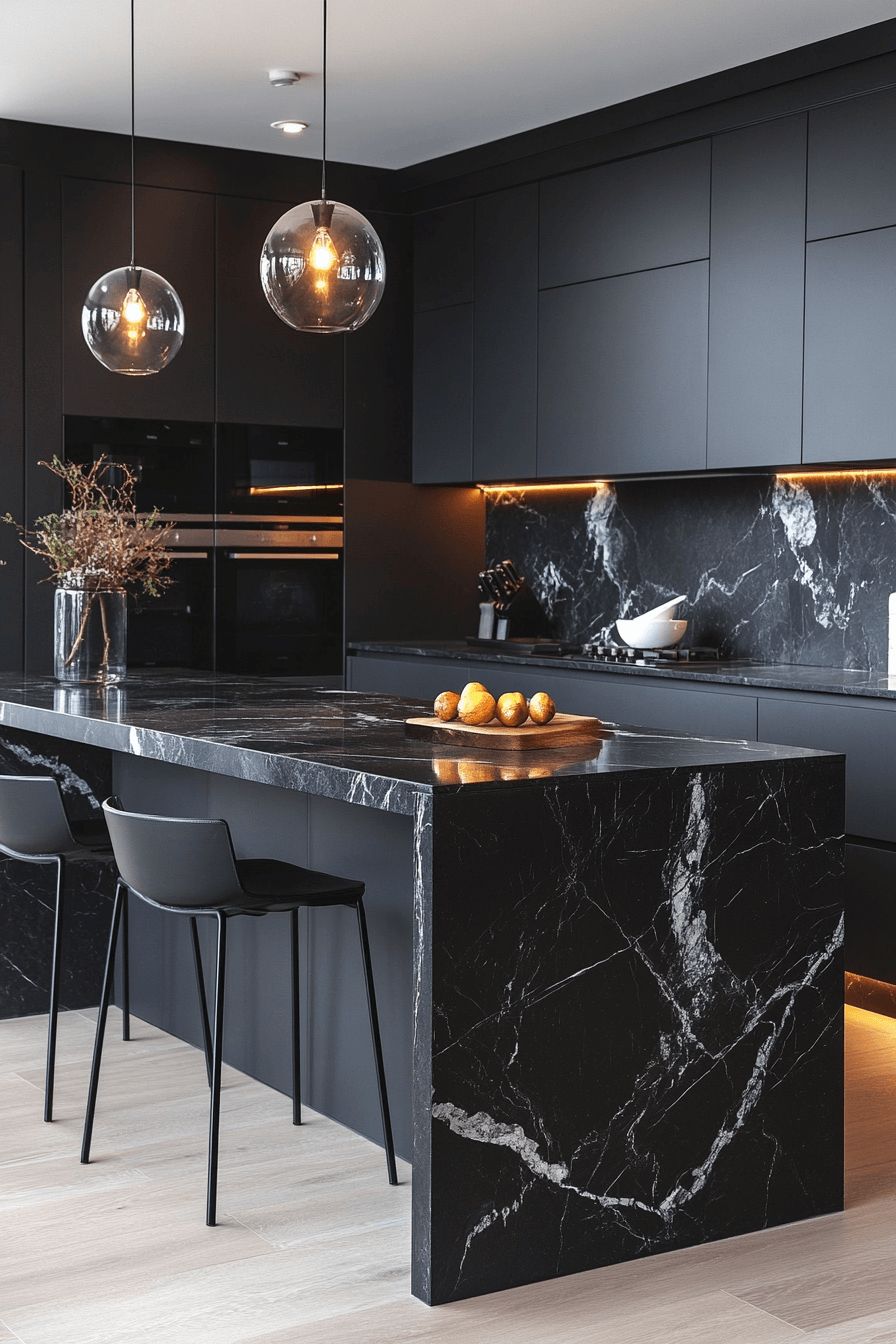
Calacatta Marble is best when the island is the focal point, the kitchen is large and well-lit, the cabinet design is minimal, and the buyer wants a memorable high-end look. It pairs beautifully with white cabinets, black cabinets, walnut, brass, bronze, and warm lighting.
For design-led homeowners and luxury developers, Calacatta can create the “wow” moment that defines the kitchen. It is especially strong for waterfall islands, bookmatched backsplashes, and open-plan kitchens where the countertop is visible from living or dining areas.
Designers looking for broader inspiration can explore Calacatta Marble design ideas to see how this material can be used in modern interiors beyond the kitchen, including walls, bathrooms, feature panels, and luxury furniture details.
Choose Carrara Marble for a Softer Timeless Kitchen
Carrara Marble is best when the kitchen needs calm elegance, classic styling, and a softer visual rhythm. It works well with white, grey, cream, and light wood cabinets. It is also easier to use in smaller kitchens because its veining is less visually dominant.
If the buyer wants a timeless European kitchen look without making the countertop shout across the room, Carrara is a strong choice. It is not “less beautiful”; it is simply less dramatic. Sometimes the quiet one wins the room. Carrara knows this trick very well.
|
|
|
Kitchen Countertops: Performance and Maintenance Comparison
Are Both Suitable for Kitchen Countertops?
Yes, both Calacatta Marble and Carrara Marble can be used for kitchen countertops. But buyers must understand how marble behaves. Marble is calcium carbonate-based and can react to acids. Lemon juice, vinegar, wine, tomato sauce, citrus, and harsh cleaners may cause etching. Sealing helps reduce staining risk, but it does not completely prevent acid etching.
Cutting boards, trivets, coasters, soft cloths, pH-neutral cleaners, and regular sealing are practical maintenance steps. For show kitchens, luxury villas, residential kitchens, and design-led spaces, marble can be a beautiful choice. For heavy-use commercial food preparation areas, buyers should compare marble with quartzite, porcelain, or engineered stone.
| Kitchen Condition | Better Choice | Reason |
|---|---|---|
| Show kitchen / luxury villa | Marbre Calacatta | Stronger visual statement |
| Family kitchen with moderate use | Marbre de Carrare | Softer appearance, less visually demanding |
| Heavy cooking with acidic foods | Use caution for both | Marble needs maintenance |
| Large island centerpiece | Marbre Calacatta | Bold veining becomes focal point |
| Small kitchen | Marbre de Carrare | Softer veining feels less overwhelming |
Calacatta Marble vs Carrara Marble for Kitchen Islands
Calacatta Marble Island
A Calacatta Marble island is ideal for large open kitchens, luxury villas, high-end apartments, and hospitality residences. It works beautifully with waterfall edges, bookmatched slab planning, and dramatic lighting. The key is vein layout. The strongest vein should be intentionally placed, not accidentally cut across the sink or seam.
For island projects, buyers should approve full slab photos, review vein direction, plan seam placement, check slab thickness, and confirm support for overhangs. Sink and cooktop cutouts should be planned carefully to avoid weakening the slab or interrupting the main vein flow.
Carrara Marble Island
A Carrara Marble island creates a softer and more relaxed look. It works well in smaller kitchens, classic interiors, and projects where the stone should support the overall design instead of dominating it. Carrara pairs naturally with shaker cabinets, light wood, soft grey, cream, chrome, and brushed nickel.
For hotel apartments or multi-unit kitchen projects, Carrara Marble can also be easier to coordinate visually across many kitchens because the veining is usually less aggressive than Calacatta.
Cabinet and Metal Pairing Ideas
Best Pairings for Calacatta Marble
Calacatta Marble works beautifully with white cabinets for a gallery-like luxury kitchen. With black cabinets, it creates dramatic modern contrast. With walnut cabinets, it becomes warmer and more residential. Brass or gold hardware can enhance the luxury feeling, while bronze fixtures can soften the look.
Best Pairings for Carrara Marble
Carrara Marble pairs well with white shaker cabinets, soft grey cabinets, cream cabinets, light oak, brushed nickel, chrome, and matte black hardware. It creates a calm and timeless kitchen mood, especially when paired with balanced lighting and simple cabinet lines.
| Marble Type | Cabinet Color | Metal Accent | Design Mood |
|---|---|---|---|
| Marbre Calacatta | Blanc | Brass | Bright luxury |
| Marbre Calacatta | Noir | Or | Dramatic modern |
| Marbre Calacatta | Walnut | Bronze | Warm high-end |
| Marbre de Carrare | Blanc | Chrome | Classic clean |
| Marbre de Carrare | Gris | Brushed nickel | Soft modern |
Slab Selection: What Buyers Must Check Before Ordering
Full Slab Photos Are Essential
Marble varies naturally. Small samples cannot show full veining, background tone, resin repair, cracks, layout potential, or seam planning. Full slab photos and videos help buyers evaluate pattern movement, polish reflection, color tone, and fabrication possibilities.
Calacatta usually needs more careful vein layout because bold veins become part of the kitchen design. Carrara may be softer, but multi-slab projects still require batch consistency and tone control.
Bookmatching and Dry Lay
Dry lay is highly recommended for large islands, backsplashes, and multi-slab kitchens. It helps confirm slab sequence, seam placement, vein direction, and visual balance before cutting. For Calacatta, dry lay can protect the entire luxury effect. For Carrara, it can help keep the tone consistent across countertops and backsplashes.
For procurement teams comparing both options at scale, this Calacatta Marble vs Carrara Marble procurement strategy provides useful sourcing logic for buyers who need to balance visual effect, stock planning, and project suitability.
Technical Parameters Buyers Should Confirm
Thickness, Finish, and Physical Checks
Kitchen marble slabs are often selected in thicknesses such as 18mm, 20mm, or 30mm depending on fabrication requirements, supplier availability, and project design. Polished finishes provide a glossy luxury look but may show etching more visibly. Honed finishes create a softer surface and may hide etching better, though they can respond differently to staining and maintenance.
Buyers should check water absorption, compressive strength, flexural strength, abrasion resistance, acid sensitivity, flatness, resin repair, mesh backing, sealing requirement, packing quality, and slab condition before fabrication.
| Paramètre | Why It Matters | Buyer Check |
|---|---|---|
| Épaisseur | Countertop strength and edge design | Match fabrication requirement |
| Finition | Appearance and maintenance | Polished vs honed |
| Absorption de l'eau | Stain risk | Ask for data if needed |
| Flexural Strength | Breakage resistance | Important for large islands |
| Flatness | Fabrication quality | Inspect before cutting |
| Scellement | Stain protection | Confirm sealer plan |
Cost factors
Why Calacatta Is Often Positioned Higher
Calacatta Marble is often positioned higher in luxury kitchen projects because of its bolder veining, brighter background, stronger design demand, and more selective slab layout requirements. It may also involve more waste if the buyer needs vein matching, bookmatching, or precise island layout.
Why Carrara Is Often More Flexible
Carrara Marble is often more flexible for broader kitchen use because of its softer veining, wider familiarity, classic demand, and easier visual balance. It is especially useful for countertops, tiles, backsplashes, apartments, and projects where the stone should feel elegant but not overpower the room.
For buyers planning larger commercial or hospitality projects, this guide to sourcing large-scale Carrara Marble is useful because batch consistency, slab approval, logistics, and supplier coordination become more important when one project needs many matching surfaces.
Common Mistakes When Choosing Between Calacatta and Carrara
Choosing From Small Samples Only
Small samples do not show slab movement. This is especially risky with Calacatta because the large veins define the entire design.
Ignoring Lighting
Lighting can change white marble tone dramatically. Carrara may look cooler under blue-white lighting. Calacatta may look warmer or sharper depending on light temperature.
Expecting Marble to Behave Like Quartz
Marble is natural, porous to varying degrees, and acid-sensitive. Buyers should accept patina or maintain the surface carefully.
Not Planning Seam Placement
Kitchen islands, backsplashes, and waterfall edges require seam planning. Poor seam placement can interrupt the stone’s natural rhythm.
Choosing the Wrong Marble for the Design Goal
Calacatta and Carrara create different moods. Calacatta is for drama. Carrara is for softness. Choosing the wrong one can make the kitchen feel either too loud or too plain.
How to Choose a Marble Slab Supplier for Kitchen Projects
What a Reliable Supplier Should Provide
A reliable supplier should provide full slab photos, slab videos, material origin information, thickness options, finish options, dry lay support, bookmatching support, color matching, cut-to-size processing, countertop fabrication support, packing photos, export documents, project communication, and replacement support.
Before choosing a marble slab supplier, buyers should review the supplier’s material selection capability, export experience, fabrication knowledge, packing control, and project communication. In luxury kitchen projects, supplier support can be the difference between a beautiful installation and a very expensive headache.
For project discussion, slab availability, sample requests, or kitchen countertop support, buyers can contact a marble slab manufacturer to confirm Calacatta and Carrara options, dry-lay service, packing method, and custom processing before final order approval.
| Evaluation Factor | Poids | What to Check |
|---|---|---|
| Slab Selection | 20% | Full slab photos, batch quality |
| Vein Layout Support | 20% | Dry lay, bookmatching, seam planning |
| Processing Ability | 15% | Cut-to-size, edge, sink cutout |
| Packing Quality | 15% | Wooden crate, countertop protection |
| Soutien au projet | 15% | Drawings, communication, scheduling |
| Expérience en exportation | 10% | Documents and shipping control |
Practical Recommendation: Which One Should You Choose?
Choose Calacatta Marble If
Choose Calacatta Marble if you want a dramatic luxury kitchen, the island is the focal point, bold veining is desired, bookmatched slabs are part of the design, the kitchen has strong lighting, and the buyer accepts natural variation and maintenance.
Choose Carrara Marble If
Choose Carrara Marble if you want soft classic elegance, the kitchen is smaller, the countertop should feel calm, grey veining is preferred, the design needs a timeless look, and the project uses white, grey, cream, or light wood cabinets.
For buyers evaluating long-term architectural demand, this article on why Carrara Marble remains a primary investment for 2026 interiors helps explain why Carrara continues to perform well in classic, soft-modern, and high-end commercial design despite changing trends.
Consider Other Materials If
Consider quartzite, porcelain, or engineered stone if the kitchen is very heavy-use, the buyer wants low maintenance, acid exposure is frequent, strict uniformity is required, or stain resistance is more important than natural variation.
Final Buying Insight: Pick the Marble That Matches the Kitchen’s Personality
The Calacatta Marble vs Carrara Marble decision is not only about luxury level. It is about design personality. Calacatta is bold, bright, and expressive. Carrara is soft, classic, and calm. Calacatta creates the hero island. Carrara creates the timeless kitchen. Both can be beautiful. Both need care. Both require proper slab selection.
The safest buying path is simple: define the kitchen’s visual goal, review full slabs, confirm lighting, plan seams, choose the right finish, understand maintenance, and work with a supplier who can support layout and fabrication. Do that, and the marble choice becomes much easier. Skip those steps, and even the most expensive stone can look like it lost an argument with the installer.
FAQ
1. What is the main difference between Calacatta Marble and Carrara Marble?
The main difference between Calacatta Marble and Carrara Marble is their visual appearance. Calacatta Marble usually has a brighter white or warmer white background with bold, dramatic veins. Carrara Marble usually has a softer white to light grey background with finer, more subtle grey veining. Calacatta is often chosen for statement kitchen islands and luxury backsplashes, while Carrara is often chosen for timeless countertops and classic kitchens.
2. Which is better for kitchen countertops, Calacatta or Carrara?
Calacatta Marble is better if the kitchen needs a bold focal point, dramatic veining, waterfall island, or luxury showpiece. Carrara Marble is better if the kitchen needs a softer, calmer, and more timeless countertop surface. Both materials can be used for kitchen countertops, but both require sealing, careful cleaning, and realistic maintenance expectations because marble can stain or etch when exposed to acids and harsh cleaners.
3. Is Calacatta Marble more luxurious than Carrara Marble?
Calacatta Marble is often perceived as more luxurious because of its brighter background, bolder veining, and stronger visual impact. It is commonly used in high-end kitchen islands, full-height backsplashes, and statement interiors. Carrara Marble is more subtle and timeless, with softer grey veining and a calmer appearance. The better choice depends on whether the project needs dramatic luxury or quiet classic elegance.
4. Does Carrara Marble stain easily?
Carrara Marble can stain if it is not properly sealed or if spills are left on the surface for too long. Like other natural marbles, it can also etch when exposed to acidic substances such as lemon juice, vinegar, wine, tomato sauce, or harsh cleaners. Sealing helps reduce staining risk, but good daily habits are still important. Buyers should use pH-neutral cleaners, cutting boards, coasters, and regular maintenance routines.
5. How do I choose marble slabs for a kitchen island?
To choose marble slabs for a kitchen island, review full slab photos, videos, vein direction, background color, thickness, finish, resin repair, and slab size. For Calacatta Marble, vein layout and seam placement are especially important because bold veins can define the entire island design. For Carrara Marble, batch consistency and tone control are important for a calm, uniform look. Dry lay, edge profile planning, overhang support, sink cutout position, and supplier fabrication support should all be confirmed before cutting.
Références
1. Dimension Stone Design Manual, Natural Stone Institute, Natural Stone Technical Reference.
2. Natural Stone Maintenance Guide, Natural Stone Institute, Stone Care and Maintenance Publication.
3. ASTM C503 Standard Specification for Marble Dimension Stone, ASTM International, Stone Material Standard.
4. Stone in Architecture: Properties, Durability, Fourth Edition, Siegfried Siegesmund and Rolf Snethlage, Springer.
5. Interior Design Materials and Specifications, Lisa Godsey, Fairchild Books.
6. Architectural Graphic Standards, American Institute of Architects, Wiley.
7. Time-Saver Standards for Interior Design and Space Planning, Joseph DeChiara, Julius Panero, and Martin Zelnik, McGraw-Hill.
8. Natural Stone and World Trade: Quarrying, Processing, and Logistics, Stone World Magazine, Industry Feature.
Strategic Insight: How Buyers Should Choose Between Calacatta and Carrara Marble
What is the core difference?
Calacatta Marble usually has a brighter background and bolder veining, making it ideal for statement kitchen islands and luxury backsplashes. Carrara Marble usually has a softer grey-white background and finer veining, making it ideal for timeless countertops and classic kitchens.
Why does slab selection matter?
Natural marble varies from slab to slab. Buyers should review full slab photos, videos, vein direction, finish, thickness, resin repair, and seam layout before approving material for kitchen fabrication.
How should maintenance affect the decision?
Both Calacatta and Carrara are natural marble and require sealing, pH-neutral cleaning, protection from acids, and realistic expectations about etching and patina. Sealing helps reduce staining but does not fully prevent acid etching.
Which option is best for different kitchens?
Choose Calacatta for dramatic luxury kitchens, waterfall islands, and bold backsplashes. Choose Carrara for softer classic kitchens, smaller spaces, and calm countertop surfaces. Consider quartzite or engineered stone for heavy-use kitchens that require lower maintenance.
Buyer consideration: The best supplier should provide full slab selection, dry lay, bookmatching support, color matching, cut-to-size processing, packing photos, export documents, and project communication. In luxury kitchen marble sourcing, beauty starts with the slab, but success depends on planning.