

Quick Summary
Grey Random Rubble Slate Tiles are natural irregular stone pieces with rugged split faces, charcoal and silver-grey backgrounds, and occasional earthy brown mineral coloration. Their varied polygonal shapes reproduce the visual character of traditional rubble stonework without the repetitive geometry of rectangular wall tiles. The material is intended primarily for architectural cladding, villa exterior walls, garden enclosures, landscape features and decorative interior surfaces. Project specification requires an approved range of stone sizes, surface relief, color distribution, thickness and installation details, with exterior suitability assessed against actual material properties and local building requirements.
Grey Random Rubble Slate Tiles for Architectural Walls and Natural Stone Cladding
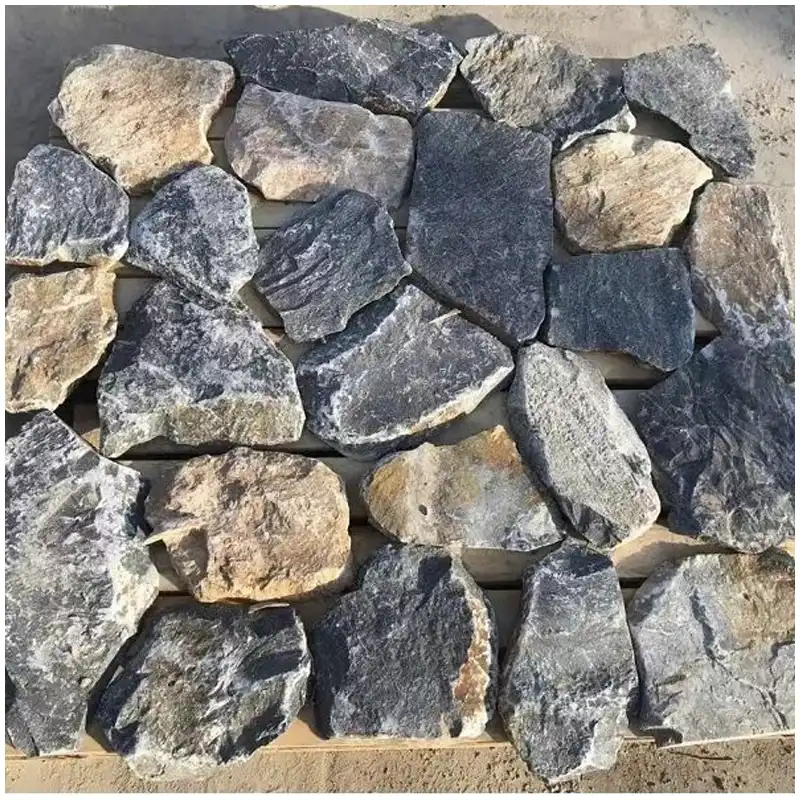
Traditional rubble stonework derives its appearance from the individual shapes of the stones rather than a predetermined tile grid. Large polygonal faces, smaller infill pieces and irregular boundaries create a wall surface that changes continuously across the elevation. Grey slate introduces an additional layer of character through its natural cleavage, mineral coloration and uneven exposed texture.
Grey Random Rubble Slate Tiles are supplied for projects seeking this type of natural stone composition. The featured selection contains dark grey, medium grey and silver-toned pieces, interspersed with warmer brown and ochre-colored areas. Some stones have broad, comparatively flat faces; others display more pronounced surface relief and irregular edge profiles.
This combination distinguishes the product from conventional calibrated rectangular tiles. It also differs from standard ledgestone cladding, where narrow rectangular strips are arranged into recognizable horizontal courses.
An irregular rubble wall has no obligatory repeating module. Its visual quality depends on the relationship between adjacent pieces, the distribution of differently sized stones and the treatment of joints throughout the finished surface.
For architects, the material is a way to introduce substantial natural texture into contemporary construction. It can soften the appearance of concrete, steel and glass elevations or create continuity between a building and its surrounding landscape.
The product is specified as decorative stone cladding. Its resemblance to traditional load-bearing masonry does not establish that the supplied pieces can function as structural wall units. The supporting wall and attachment system must be designed for the actual installation.
Grey Random Rubble Slate Tiles Product Specifications
Unlike modular wall tiles, random rubble products are described through a combination of material characteristics, mixed-piece dimensions and installation-related tolerances. The required range of stone sizes and thicknesses should be established before commercial quantities are prepared.
| 製品名 | Grey Random Rubble Slate Tiles |
| 商業用素材 | Natural Grey Slate |
| 石の分類 | Natural Slate; Petrographic Classification by Material Documentation |
| 関連商品名 | Grey Slate Crazy Tiles / Grey Slate Random Tiles / Random Rubble Stone Cladding |
| Color Range | Charcoal Grey / Silver Grey / Light Grey / Brown and Ochre Mineral Accents |
| 起源 | Confirm Selected Quarry and Material Lot |
| Stone Shape | Irregular Polygonal / Random Rubble / Crazy Stone |
| Piece Dimensions | Mixed Sizes; Actual Range and Distribution by Order Confirmation |
| 厚さ | Confirm Actual Thickness Range and Permitted Variation |
| Visible Surface | Natural Split / Cleft / Textured Stone Face |
| Edge Character | Irregular Natural and Processed Stone Boundaries |
| Back Surface | Backing Condition and Processing Method by Product Confirmation |
| Supply Configuration | Random Stone Pieces; Preassembled or Backed Formats Subject to Confirmation |
| 主な用途 | Building Facades / Villa Walls / Garden Enclosures / Landscape Features / Interior Cladding |
| Ordering Unit | Square Meter; Coverage Calculation Basis by Order Agreement |
The product photographs establish the general appearance and irregular stone configuration. They do not establish a calibrated thickness, fixed stone-size range, mesh-backed panel format or guaranteed installed coverage. These characteristics need to be specified for the actual order.
Natural Grey Slate Tiles with Split Faces and Mineral Color Variation
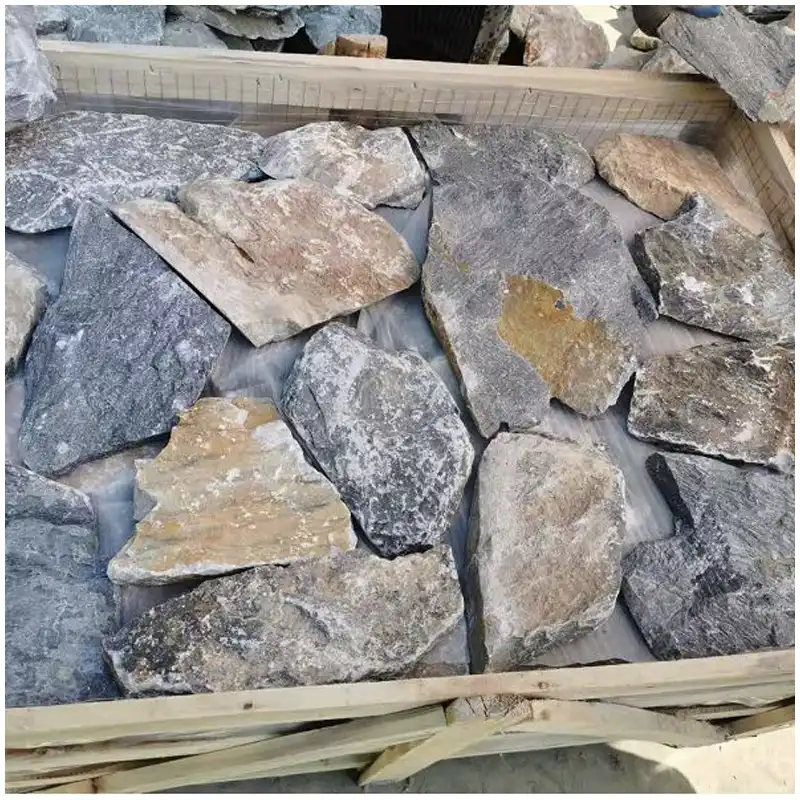
The exposed faces of natural slate reflect the internal structure of the stone. Cleavage planes, mineral concentrations and variations in grain can produce surfaces ranging from relatively smooth to distinctly textured.
In these Grey Slate Tiles, the surface character is emphasized rather than concealed by polishing. Silver-grey areas can reflect light differently from charcoal sections, while warmer mineral coloration introduces contrast without relying on artificial pigments.
The appearance also changes with lighting direction. Under direct sunlight, raised edges and ridges create pronounced shadows. Diffuse daylight produces a softer surface, making the overall grey-brown color distribution more apparent.
Brown and ochre-colored mineral areas should be evaluated separately from unwanted staining. Iron-bearing minerals can contribute to natural coloration, but an image alone cannot establish whether a particular area is stable or susceptible to further oxidation under exterior exposure.
A project requiring a predominantly cool-grey facade may need the warmer pieces distributed sparingly. Another design may deliberately retain more brown-toned stones to connect the wall with surrounding timber, soil and planting.
Rather than requesting an unrealistic uniform grey color, the buyer can approve a representative material arrangement that establishes the permitted degree of natural variation across the entire stone field.
Random Rubble Slate, Rectangular Slate Tiles and Ledgestone Cladding
These natural stone products can share similar mineral characteristics while producing very different architectural surfaces. Understanding their geometry helps determine the appropriate fabrication and installation approach.
| Stone Format | Geometry | Visual Result | Installation Consideration |
|---|---|---|---|
| Random Rubble Slate | Mixed irregular polygonal pieces | Traditional natural rubble composition | Individual piece arrangement and irregular joints |
| Rectangular Slate Tiles | Regular square or rectangular modules | Orderly tiled surface with consistent joint lines | Dimensional calibration and grid alignment |
| Ledgestone Cladding | Elongated strips or assembled linear sections | Horizontal layered stone appearance | Course alignment and panel transition details |
Random rubble is particularly useful when the intended elevation should not reveal obvious repeating rectangular modules. However, the absence of a grid does not remove the need for careful planning.
The designer must still establish the acceptable stone scale, pattern density, corner treatment and joint appearance. These decisions determine whether the final wall resembles coordinated rubble stonework or an uncontrolled collection of mismatched fragments.
Grey Slate Crazy Tiles and the Distribution of Irregular Stone Shapes
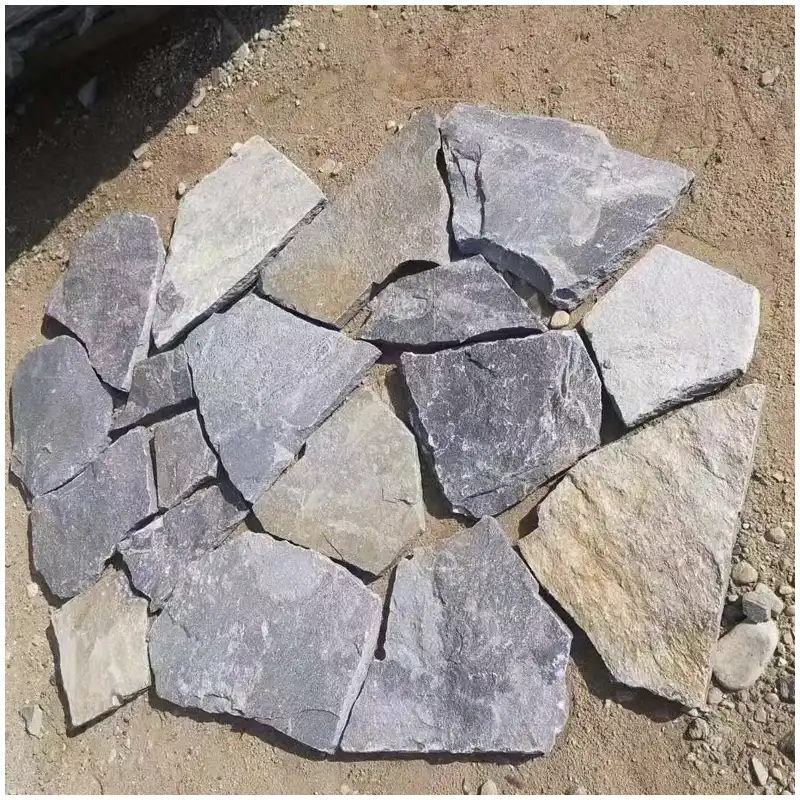
A convincing rubble composition requires more than irregular stone edges. The proportion of large, medium and small pieces influences how the finished surface reads from both close range and a distance.
Large stones create the main visual structure of the wall. Medium-sized pieces connect these dominant forms, while smaller stones can resolve awkward spaces between adjoining boundaries.
If an order of Grey Slate Crazy Tiles contains too many small fragments, the installed surface may appear busy and fragmented. An excessive concentration of large pieces can create a different problem by leaving insufficient intermediate shapes for natural transitions.
Stone proportions are also relevant. Broad polygonal faces contribute visual stability, whereas unusually elongated pieces introduce stronger directional movement. A limited number of narrow pieces can help resolve the layout, but they should not become the dominant visual form unless specified by the architect.
For large orders, a representative assembled sample is more useful than photographs showing individual pieces in isolation. It reveals whether the available shape distribution can produce the desired wall pattern without excessive on-site cutting.
The approved sample can also establish how frequently warmer brown stones appear among the grey pieces. This gives the factory and installation team a shared visual reference rather than relying on subjective descriptions such as rustic or natural.
Grey Slate Random Tiles: Joint Width, Grout Color and Wall Pattern Density
The spaces between irregular stones form a substantial part of the finished wall composition. Joint treatment affects the apparent size of the stones, the overall color balance and the visibility of their natural edges.
A dark recessed joint can emphasize the outlines of individual slate pieces. A lighter mortar color creates a different visual character, introducing contrast between the grey stone faces and the surrounding joint network. Neither treatment is automatically appropriate for every installation.
| Joint Direction | Architectural Appearance | Approval Requirement |
|---|---|---|
| Dark Recessed Joint | Emphasizes individual stone outlines and surface relief | Joint depth, mortar compatibility and moisture exposure |
| Neutral Grey Joint | Creates quieter transitions between adjacent grey pieces | Dry mortar shade and consistency across the sample area |
| Light Contrasting Joint | Introduces more visible separation between irregular stone shapes | Mortar staining, cleaning requirements and approved appearance |
| Tight-Fitted Appearance | Produces a visually dense natural stone field | Piece fit, supporting system and permitted joint construction |
When arranging Grey Slate Random Tiles, avoid allowing the joints to form unintended long continuous lines that divide the wall into obvious bands. Such lines can undermine the random rubble appearance even when every individual stone has an irregular shape.
The approved joint treatment must also account for construction requirements. A dry-stack appearance does not automatically mean the stones can be installed without mortar, mechanical restraint or another approved attachment system.
Joint depth, width and composition should follow the selected installation assembly. Visual preferences cannot replace the technical requirements of a wall exposed to water, wind or movement.
Grey Random Rubble Slate for Outdoor Landscape Architecture
The following application image illustrates how irregular grey slate can be incorporated into outdoor landscape design, where natural stone texture connects constructed surfaces with the surrounding environment.
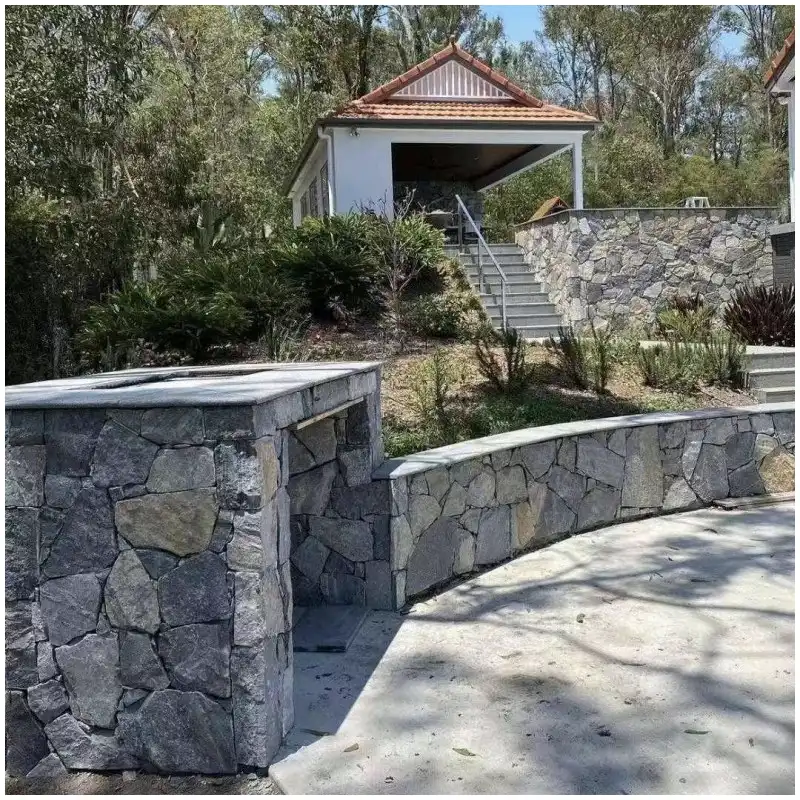
Landscape walls are often viewed against planting, timber, water features and open sky. The mixed grey and brown coloration of rubble slate allows the architectural surface to relate to these surrounding elements without creating a completely uniform manufactured appearance.
Garden enclosure walls and courtyard boundaries can use a larger stone scale where sufficient viewing distance is available. Smaller landscape structures may require a finer distribution of pieces to maintain a balanced relationship with steps, planters and adjoining paving.
For raised planting beds, the construction must distinguish between decorative facing and the structure retaining the soil. Soil pressure, irrigation water and drainage requirements belong to the retaining-wall design rather than the slate finish alone.
Frequent irrigation can also create different exposure conditions near the base of a stone wall. Repeated wetting, mineral deposits and moisture retained behind the cladding may affect its appearance and service performance.
Outdoor suitability should be established for the specific stone selection and installation environment. A landscape design image is not evidence of completed freeze-thaw, water absorption or structural attachment testing for the supplied product.
Stone Thickness, Backing and Edge Conditions of Grey Slate Wall Panels
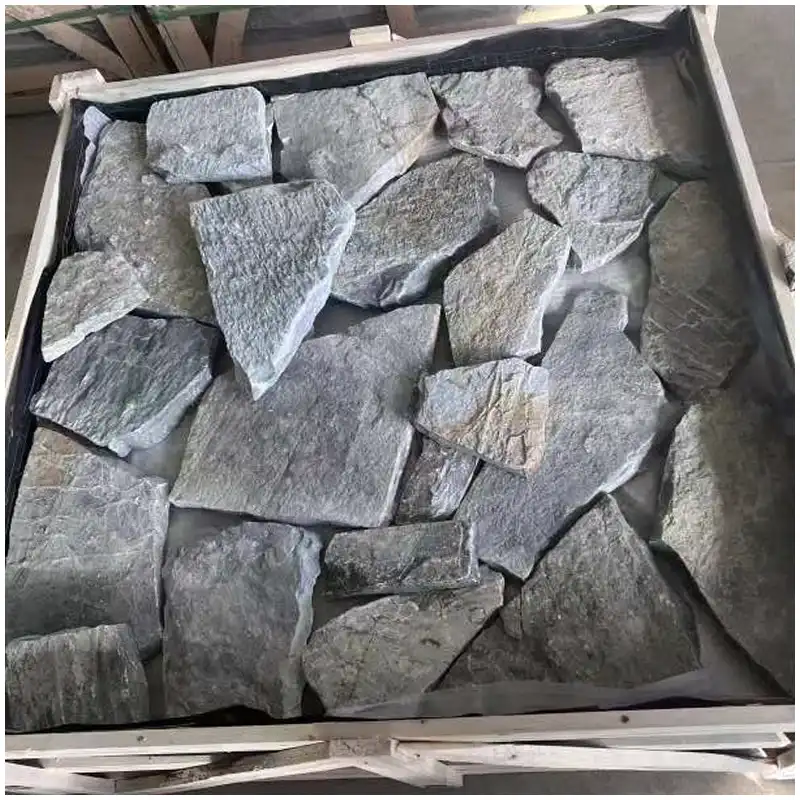
Irregular wall stone requires a different dimensional review from polished modular tiles. Its visible face may contain natural ridges and uneven relief, while the back surface determines how the stone interacts with the proposed installation system.
For individually installed pieces, the required thickness range should be coordinated with the permitted wall buildup. Significant variation between adjacent pieces can affect the bedding arrangement, finished projection and total weight of the cladding.
Buyers sourcing Grey Slate Wall Panels should distinguish between loose random rubble pieces, preassembled stone sections and products mounted onto a backing system. These formats have different handling characteristics and installation requirements.
A photograph showing stones assembled into a square display does not prove that the supplied units are mesh-backed or permanently bonded together. The actual delivery configuration should be confirmed before preparing the installation specification.
The back surface requires particular attention where direct bonding is proposed. Loose stone layers, excessive dust, incompatible treatments or unstable mineral surfaces may interfere with the selected attachment method.
The front face should also be inspected for unstable projecting fragments. Natural texture is a desirable feature, but visibly loose layers or fragile projections may require removal or separate assessment before installation.
Stone thickness and surface relief must be considered together with unit weight, maximum piece dimensions, substrate capacity and the proposed fixing system. These requirements become increasingly important on tall exterior elevations and walls above occupied spaces.
Planning Corners, Openings and Finished Wall Transitions
A rubble stone wall can look convincing across a broad flat surface yet reveal an unresolved construction detail at the first external corner. The irregular pieces must terminate against another architectural element without exposing an inappropriate backing or creating a visibly artificial edge.
For external corners, the architect may prefer a coordinated arrangement of return pieces or purpose-prepared corner components. Their availability and geometry need to be established before ordering rather than assuming every random stone piece can be used at a corner.
Window and door openings introduce another set of constraints. The surrounding wall buildup must accommodate frames, flashing, sealants and other enclosure details. Highly projecting stones close to an opening may interfere with the required construction clearance.
At the top of landscape walls, an approved coping or termination detail can protect the assembly and establish a deliberate horizontal boundary. An exposed random stone edge should not be treated as a substitute for the required weather-protection construction.
Before processing or allocating pieces, identify the total lengths of exposed corners, window surrounds, wall ends and other interfaces. These areas may require separately selected stone rather than material taken indiscriminately from the general wall quantity.
Grey Slate Crazy Wall Cladding Tiles for Building Exterior Elevations
This exterior wall design reference demonstrates the architectural scale of irregular slate cladding and its relationship with the building elevation.
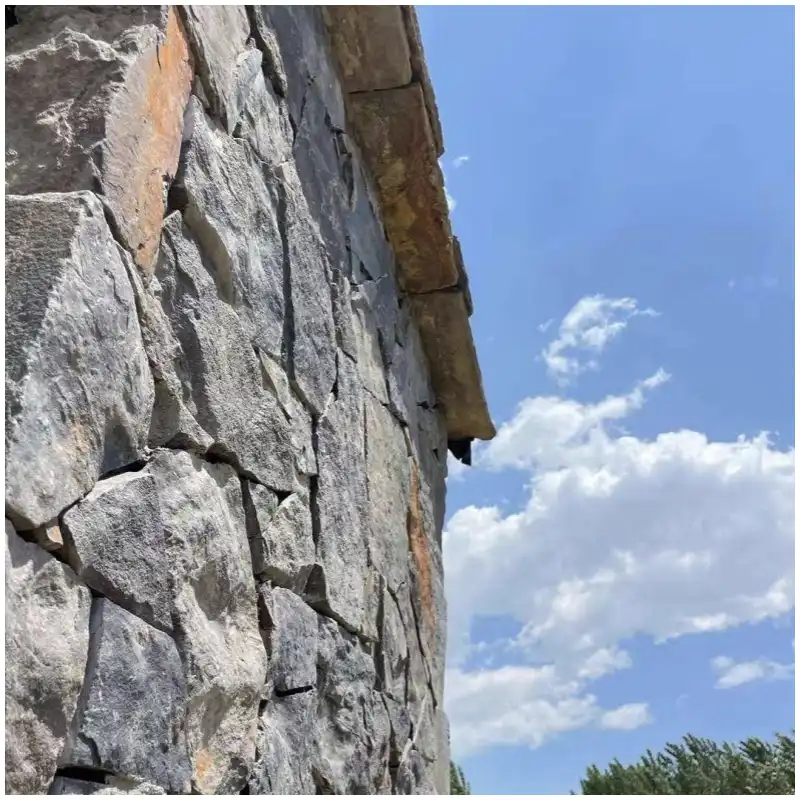
Grey Slate Crazy Wall Cladding Tiles can introduce the character of traditional stone construction into contemporary building envelopes. Their irregular stone boundaries provide a visual contrast to precisely aligned windows, flat rendered walls and manufactured facade materials.
On a large exterior elevation, the overall stone scale must be appropriate to the building proportions. A dense arrangement of small pieces may lose much of its individual texture when viewed from the street. Larger faces can preserve the rubble character at greater viewing distances.
Color allocation also changes at architectural scale. Concentrating brown-toned stones in one section may produce a visible patch rather than the naturally distributed effect intended by the design.
The exterior cladding system must address the actual stone dimensions and weight, wind exposure, substrate construction, water management and movement accommodation. Depending on these conditions, the system may require engineered mechanical support rather than relying on direct adhesive bonding.
Existing movement joints in the building should be incorporated into the cladding design. An irregular stone pattern may help coordinate their visual location, but the stones must not obstruct movement that the underlying construction requires.
Exterior approval therefore involves both the natural stone and the complete wall assembly. The decorative appearance of rubble slate does not independently establish compliance with facade attachment or building safety requirements.
Architectural Application and Installation Decision Guide
Random rubble slate can serve several architectural and landscape purposes. Each application introduces a different set of design, fabrication and installation constraints.
| 申し込み | Architectural Direction | Key Technical Requirement |
|---|---|---|
| Building Facades | Large exterior stone fields and architectural elevations | Engineered attachment, weather exposure and enclosure detailing |
| Villa Exterior Walls | Entrance walls, porch elevations and natural stone accents | Corner transitions, openings, stone projection and substrate compatibility |
| Garden Enclosures | Boundary walls and courtyard divisions | Wall construction, coping, drainage and ground-level moisture |
| Landscape Retaining Walls | Decorative facing to engineered retaining structures | Independent structural support and water management |
| Interior Feature Walls | Living rooms, restaurants, hotel lounges and reception spaces | Surface projection, lighting, fixing and accessible-edge safety |
| 暖炉周り | Decorative textured stone facing outside the firebox | Temperature exposure, clearance and heat-compatible assembly |
| Commercial Landscape Features | Entrance monuments, planter surrounds and public-space walls | Impact exposure, accessible edges and inspection requirements |
This product is primarily positioned as irregular wall cladding. Outdoor paving, pool surrounds and other walking surfaces require separate confirmation of thickness, flatness, structural support, abrasion and slip performance. The rugged appearance of a wall stone is not sufficient evidence of paving suitability.
Calculating Grey Random Rubble Slate Coverage and Purchase Quantities
Square-meter purchasing for irregular stone requires a clearly defined coverage convention. Some transactions are calculated from the combined visible stone-face area, while others refer to an estimated installed area that includes the spaces between stones.
The distinction matters because a tightly fitted composition and a wall with broader mortar joints will consume different quantities of stone over the same architectural elevation.
The following example demonstrates how preliminary purchase quantities can change when additional material is allowed for shape selection, edge cutting and installation losses.
| Net Wall Area | Illustrative Additional Allowance | Estimated Purchase Area |
|---|---|---|
| 100m² | 5% | 105m² |
| 100m² | 10% | 110m² |
| 100m² | 15% | 115m² |
These percentages are illustrative estimating scenarios, not measured waste rates or recommended fixed allowances for the current product. The final order depends on the actual coverage convention, available stone sizes, number of corners and the approved joint arrangement.
A project with numerous openings, short wall returns and exposed boundaries may require more selective cutting than a continuous garden wall. Strict color requirements can also reduce the usable proportion of a mixed natural stone batch.
Where future maintenance requires replacement stones, agree on a separate reserve quantity from a compatible material lot. Matching the original random shape is rarely essential, but the replacement pieces should remain consistent with the approved color and texture range.
Technical Properties and Exterior Performance Testing for Natural Slate
Natural slate can exhibit directional mechanical properties because of its internal structure and cleavage. Water absorption, flexural behavior and resistance to environmental exposure vary between deposits and even between selections from the same commercial stone category.
For projects requiring formal technical documentation, the tested stone must be identifiable and representative of the supplied material. The suitability of a test method also depends on the actual product geometry and intended architectural use.
The following methods provide a technical framework for evaluating natural slate and related architectural stone products where applicable.
| Test Property | Reference Method | Project Relevance |
|---|---|---|
| Water Absorption of Slate | ASTM C121/C121M | Moisture-related material assessment |
| Flexural Properties of Slate | ASTM C120/C120M | Directional mechanical behavior of representative specimens |
| Weather Resistance of Slate | ASTM C217/C217M | Relevant weather-resistance characterization |
| Apparent Density and Open Porosity | EN 1936 | Stone characterization and preliminary weight assessment |
| Frost Resistance | EN 12371 | Evaluation for relevant freezing and thawing exposure conditions |
| Slate Dimension Stone Requirements | ASTM C629/C629M | Material specification where the supplied product falls within its scope |
These references identify potential material evaluation methods. They do not represent completed tests, certified numerical results or demonstrated compliance for Grey Random Rubble Slate Tiles.
The weight of an installed random rubble system must also account for actual piece thickness, stone distribution, bonding materials, support components and other elements of the assembly. A generic slate density value cannot establish the total installed wall load.
For exterior construction, laboratory material properties form only one part of approval. The proposed attachment arrangement, environmental exposure and building-specific requirements must be assessed independently.
Factory Selection and Quality Inspection of Grey Random Rubble Slate Tiles
The factory image illustrates the arrangement and preparation of irregular natural slate pieces. For bulk orders, the inspection process must address the distribution of usable shapes and stone condition rather than checking only the appearance of individual display pieces.
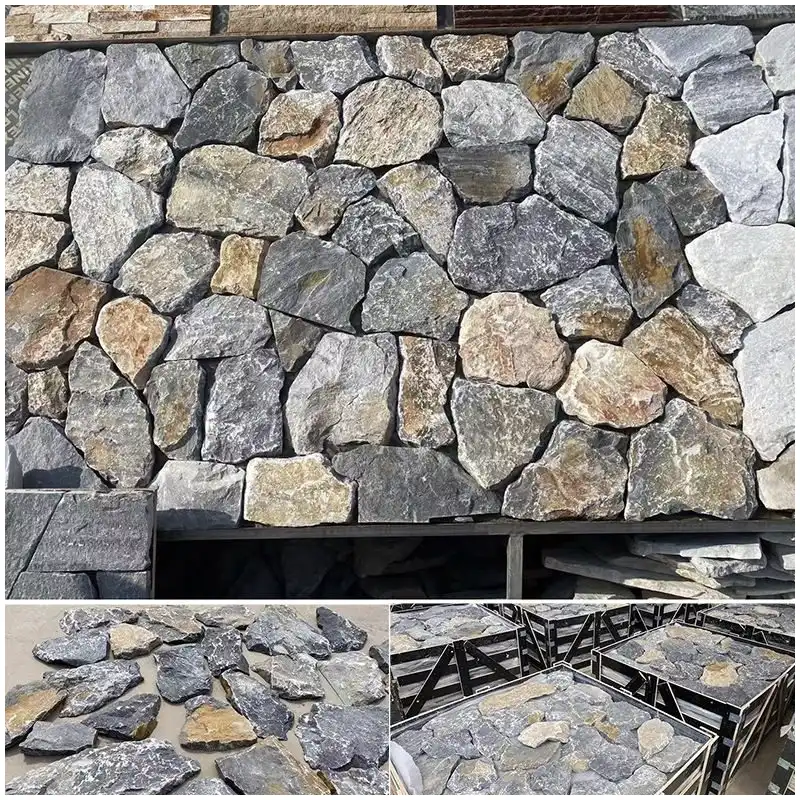
A useful quality-control specification for random rubble stone establishes an approved appearance range while separating acceptable natural texture from unwanted damage or unstable material conditions.
| Material Identification | Record the approved stone selection, production lot and material documentation required by the project. |
| Shape Distribution | Review the mixture of large, medium and small pieces against the approved arrangement and permitted fragment content. |
| Color Acceptance | Check the distribution of charcoal, silver-grey, light grey and warmer mineral coloration across representative quantities. |
| Thickness Inspection | Measure representative pieces against the agreed thickness range, considering natural face relief and backing geometry. |
| Surface and Layer Condition | Distinguish acceptable cleavage texture from loose layers, unstable projections, unwanted fractures and handling damage. |
| Back Surface Review | Confirm whether the supplied backing condition is consistent with the specified product format and proposed attachment requirements. |
| Sample Arrangement | Prepare a representative stone field where specified to demonstrate size distribution, color balance and achievable joint patterns. |
| Quantity Verification | Check the packed quantity according to the agreed square-meter measurement convention. |
Natural surface variation is integral to this product. Inspection should preserve the approved irregular appearance while controlling material conditions that could compromise handling, fabrication or the intended installation.
Export Packing and Shipment Planning for Random Rubble Slate
Irregular stone pieces do not have the stacking geometry of identical rectangular tiles. Differences in their perimeter shape and surface relief can create concentrated contact points during handling and transportation.
Packing must account for the actual stone thickness, weight distribution and fragility of projecting edges. Appropriate separation and restraint can reduce uncontrolled movement within crates, particularly where relatively thin pieces are packed alongside heavier stones.
For a project purchasing substantial quantities, each package should identify the relevant material lot, product configuration, measured quantity and gross weight. Where pieces have been selected for a particular color range or architectural zone, the package identification should preserve those distinctions.
Special corner pieces or separately processed components should remain identifiable rather than being mixed into the general random stone supply. Otherwise, suitable pieces may be difficult to locate when installation reaches an exposed wall boundary.
Before shipment, the buyer should confirm the packing method, crate dimensions, package weights, unloading arrangements and applicable destination requirements for timber packaging. The actual loading plan must reflect measured stone weight and transport limitations.
Care and Maintenance of Natural Grey Slate Wall Cladding
Textured slate walls require cleaning methods that account for their uneven faces and recessed joints. Dust, airborne deposits and moisture-related residue can collect in areas that would be easier to reach on a flat polished stone surface.
For interior maintenance, use a soft brush or other nonabrasive cleaning equipment with a suitable natural stone cleaner where required. Aggressive chemical treatments should not be used without checking their compatibility with the actual slate minerals, joint materials and surface treatment.
Exterior walls should be inspected periodically for loose stone layers, deteriorated joints, unusual discoloration and signs of moisture entering the assembly. These conditions require evaluation of the underlying cause rather than indiscriminate surface cleaning.
An impregnating treatment may be considered where appropriate, but it should first be tested on representative material. Some treatments change the apparent depth of grey and brown coloration or affect the natural cleft finish.
Surface sealing is not a substitute for correctly constructed flashings, drainage details, movement joints or other elements of the exterior wall assembly.
Frequently Asked Questions About Grey Random Rubble Slate Tiles
What are Grey Random Rubble Slate Tiles?
Grey Random Rubble Slate Tiles are irregular natural slate pieces with textured split faces, mixed polygonal shapes and variable grey-brown mineral coloration. They are arranged to create traditional rubble stone compositions for decorative architectural walls, building facades and landscape features.
What is the difference between grey slate crazy tiles and regular slate wall tiles?
Grey slate crazy tiles have irregular polygonal shapes and are arranged without a fixed rectangular grid. Regular slate wall tiles have more consistent geometric dimensions. Crazy stone requires greater attention to piece distribution, irregular joints, cutting allowance and the overall assembled appearance.
Are Grey Random Rubble Slate Tiles suitable for building exterior walls?
Suitable material can be considered for exterior decorative cladding. Approval depends on actual stone properties, thickness, weight, substrate, weather exposure and an appropriate attachment system. Exterior facade suitability must be established for the specific project rather than assumed from the stone appearance.
Are the brown and rust-colored areas in grey slate natural?
Brown and ochre coloration can occur naturally through mineral variation, including iron-bearing minerals. However, the stability of a particular colored area cannot be established from photographs alone. Exterior projects requiring strict color consistency should assess the selected stone and its potential response to environmental exposure.
Are random rubble slate tiles supplied as loose pieces or assembled wall panels?
The featured product shows individually shaped irregular stone pieces arranged into rubble compositions. Whether the commercial order is supplied as loose pieces, preassembled sections or backed panels must be confirmed. A display arrangement does not independently establish the actual delivery configuration.
What information is required for a Grey Random Rubble Slate Tiles quotation?
Provide the net wall area, required stone thickness, preferred piece-size distribution, approved color range, joint arrangement, installation location and destination. Include corner requirements, backing configuration, project drawings, inspection criteria and the intended square-meter coverage convention.
Final Note: Specifying Natural Rubble Slate as an Architectural Wall Finish
The character of Grey Random Rubble Slate Tiles emerges from the assembled wall rather than a single representative stone. Individual shapes, natural mineral coloration and irregular joints create an architectural surface that cannot be adequately specified through color and square meters alone. A successful purchase establishes the acceptable mixture of stone sizes, the intended wall pattern, actual material thickness and the required attachment system before commercial quantities are prepared. This preserves the visual individuality of natural rubble stone while giving the contractor a defined material specification for installation.
Request Grey Random Rubble Slate Tiles for Your Cladding Project
For a random rubble slate quotation, provide the total wall area, required stone thickness, preferred grey and brown color distribution, individual stone-size range and proposed joint appearance. Include exterior or interior application details, wall elevations, corner requirements, backing configuration, delivery destination and any specified material testing or inspection criteria. Esta Stone can review the requested stone arrangement, quantity measurement basis and processing requirements against the selected natural slate supply.