

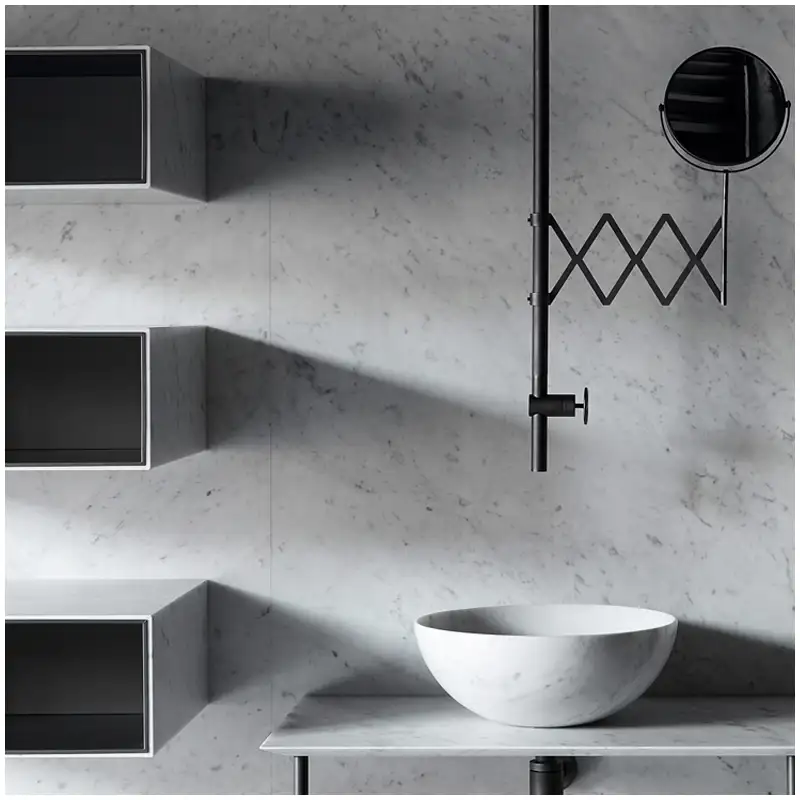
Volakas Marble Thickness for Walls and Vanity Tops
The generic inspection route for white marble sits in the parent guide, White Marble Slab Thickness: 18 mm, 20 mm, and 30 mm for Walls, Vanities, and Furniture, which owns application breadth across the whole stone family. This page owns a narrower decision: the Volakas order language that turns a nominal board description into a finished, measured requirement for this stone, and the caliper record that proves the delivered Volakas boards match it. Volakas marble thickness carries weight only when those two records agree.
List the Volakas formats the catalogue offers
について Volakas white marble slabs product page lists big slab sizes from 2400 mm up by 1200 mm up at thicknesses of 1.6 cm, 1.8 cm and 2.0 cm, plus tile formats at 10 mm and 20 mm and vanity top and countertop formats at 3/4 in and 1-1/4 in. The Volakas white marble vanity tops page repeats the 3/4 in and 1-1/4 in thicknesses for its 24 in, 36 in, 48 in, 60 in and 72 in series, and the Volakas marble slab page presents polished slabs that can be cut and finished to project requirements. Taken together, the catalogue lists the nominal formats this stone family offers, and that list is the correct place for an order to start.

A catalogue list is an offer, not an acceptance standard. Nominal formats vary by factory and by batch, so the figure on a website never replaces a dated production document tied to the actual lot. Confirm the reserved lot, the processing stage and the finished figure before the order closes: two 2.0 cm descriptions can mean different boards when one refers to sawn stock and the other to a calibrated, polished piece. That is the first discipline of Volakas marble thickness: treat every catalogue figure as nominal until the lot record proves otherwise. When the order repeats a catalogue figure, name the page and the format it came from, for example the big slab format at 2.0 cm, so a later dispute starts from one reference instead of two recollections.
Write nominal, calibrated and finished into the Volakas order
The purchase order should name the stage of the figure, because sawing, calibration, grinding and surface work each change the result. Volakas marble thickness may be quoted as nominal sawn material, as calibrated material trued to a stated band, or as the finished thickness after polishing and edge processing. A supplier and a buyer can both write 2.0 cm while picturing different acceptance ranges. Put the stage beside the number, add the tolerance, name the reference standard and say where the reading is taken, so the shorthand does not travel into fabrication.
Volakas marble thickness also enters the weight plan as a finished figure, so the order should declare the density it assumes. Mass comes from volume and density: for a flat rectangular piece, multiply length by width by finished thickness and the stated density in consistent units. For illustration only, a 1.0 m by 1.0 m panel at 20 mm with an assumed density of 2,800 kg/m³ has a calculated mass of 56 kg, and the same area at 30 mm becomes 84 kg under that assumption. Confirm the density source and the test basis, and treat the result as a planning input rather than a lifting or fixing design.
A calibrated Volakas slab can tighten the planning, but the calibration request has to name the face that is referenced, the band that was trued and how the final surface treatment follows. That wording, not a spoken assumption, is what lets the fabricator and the supplier read one finished figure the same way.
State the tolerance and the measuring rule in the same unit system as the format, because the Volakas pages list some figures in millimetres and centimetres and others in inches. A 3/4 in vanity format and a 1-1/4 in option are not interchangeable with a millimetre figure inside the record, so pick one unit system for the order and keep the caliper readings in that system. A later change to the format has to be written as a new order line rather than a note on the delivery sheet, so the lot record always answers the wording that was current when the boards were measured.
Measure the delivered Volakas boards in the finished condition
Measure the delivered boards at several locations in the finished condition the order names: near each corner, at mid length and beside the processed edges that will meet a fixing, a mitre or a sink cutout. Clean each point, use a suitable calibrated instrument, record its identification and compare the range with the finished figure instead of the sawn stock label. One reading cannot reveal a taper across a long Volakas panel, and a resin patch or a local grind can sit exactly where the next cut lands.
The vanity top page declares a thickness tolerance of ±0.5 mm and a surface flatness of ±0.3 mm under its quality control heading, with pieces checked piece by piece before packing. Treat that text as the factory statement for the format and confirm the reserved lot is actually verified against it. The caliper record then answers the question this page owns: does the delivered Volakas marble thickness match the finished figure written in this order? Record the board’s own markings, such as a factory lot stamp or a piece number, on the same sheet as the readings so the record can be matched to the reserved lot without guesswork.
State a separate finished requirement for walls, vanity tops and tiles
Walls, vanity tops and tiles do not share one Volakas marble thickness answer, because each receives a different finished figure and a different measuring rule. The checklist below keeps the requirement separate for each application so the delivered board is judged against the wording that matches its use.
- Wall panels from the big slab formats: write the finished figure the wall design needs, the panel size and the readings required beside the fixing locations, not only the 1.6 cm to 2.0 cm sawn shorthand.
- Vanity tops from the 3/4 in and 1-1/4 in formats: write whether the figure describes the body or the built-up edge and which tolerance the reserved lot is verified against.
- Tiles from the 10 mm and 20 mm listed formats: write the finished face condition and the range the setting method accepts so the completed surface can land flush.
The structural choice for walls, vanity tops and their cutouts remains an engineering and fabrication decision for the responsible parties; this checklist fixes the wording that lets each application receive a measured Volakas board rather than a repeated stock description. Stating the finished Volakas marble thickness per application is what keeps the wall, the top and the tile from inheriting one another’s tolerances.
| 申し込み | Catalogue format listed | Finished requirement to write |
|---|---|---|
| Wall panel | Big slab at 1.6 cm, 1.8 cm or 2.0 cm | Finished figure, tolerance and fixing-location readings |
| 洗面台 | 3/4 in or 1-1/4 in, 24 in to 72 in series | Body or built-up edge figure and verified tolerance |
| タイル | 10 mm or 20 mm listed tile format | Finished face condition and accepted range |
Keep the caliper record tied to the reserved Volakas lot
Give every reading a piece ID and a location on the inspection sheet, and note the finished condition at the time of measurement. Photographs should show the reading and enough of the board to identify the piece, then sit beside the recorded range and outliers. Report the range rather than one average, because an average can hide a thin section beside a single processed edge, and keep an inconvenient reading with a recorded reason instead of discarding it.
Tie the record to the processing stage and its revision, and measure again if the finish changes between calibration and delivery. A stale early sheet creates false confidence at final inspection. The lot record proves the Volakas marble thickness when a reviewer can walk from the order wording to the board marks to the readings without a gap.
Close the order with the lot record, then hand to fabrication
Release the boards only when the two documents close together: the purchase order naming the finished Volakas figure, its tolerance and the declared density, and the caliper record showing the delivered lot inside that figure. If the record and the pieces disagree, nothing is cut or ground while the comparison stays open. The generic white marble inspection route, application matching and method breadth belong to the parent guide; this page keeps the Volakas order language and the lot verification so the two pages do not repeat each other. A Volakas marble thickness record that pairs the order wording with the caliper readings is the deliverable of this page.
The Hard-Won Lesson: Volakas marble thickness lives in the order language and the lot record
A project can approve a Volakas board from the catalogue text, say a 2.0 cm big slab, while the fabrication drawing expects a calibrated finished piece inside a stated tolerance. Purchasing prices one meaning and production cuts another, and the caliper settles the gap only when the order names the stage and the record names the lot. I now write the finished figure beside the reserved lot before fabrication starts, and I keep the readings with the board marks that produced them.
The Lesson: write the finished Volakas figure and tie every reading to the reserved lot.
What Makes a Volakas Thickness Approval Usable
The figure names a stage and a method
Volakas marble thickness means something only when the record identifies nominal, calibrated or finished condition, the measuring points, the instrument and the acceptance rule. The report should stand alone for a reviewer who was not at the board.

The reserved lot owns the answer
A catalogue format and a delivered board are different facts. Walls, vanity tops and tiles state separate finished Volakas figures, and the reserved lot record connects the order wording to the readings that arrived.
A discrepancy is contained first
If the delivered range and the order wording disagree, keep the affected pieces and their photographs together while the project team compares the finding with the approved specification. Nothing is cut, ground or concealed before that comparison closes.
When Volakas Marble Thickness Falls Outside the Range
A delivered lot can show Volakas marble thickness readings outside the finished figure written in the order. Keep the response controlled so the record stays useful to the fabricator, supplier and project team.
- Document: photograph the instrument reading, piece ID and the affected interface before anything moves.
- Isolate: stop installation of those pieces and separate them from the accepted stack.
- Escalate or hold: send the record to the fabricator and supplier and keep the disposition open until the authorized parties reply.
よくある質問
1. What does nominal mean in a Volakas thickness order?
It means the figure has no stage yet. Nominal sawn, calibrated and finished Volakas marble thickness are different requirements even when they share one number. Write the stage, tolerance and measuring points into the purchase order, confirm the reserved lot, then measure the delivered boards in the finished condition the order names.
2. Which finished Volakas thickness should a wall order state?
State the finished Volakas marble thickness the wall design needs rather than the sawn shorthand of the slab format. The catalogue lists big slab thicknesses of 1.6 cm, 1.8 cm and 2.0 cm; confirm the reserved lot and write the finished figure, panel size and fixing-location readings the wall drawing expects.
3. How do I calculate the weight of a Volakas marble panel?
Multiply length by width by finished thickness and the declared density in consistent units. For illustration, a 1.0 m by 1.0 m panel at 20 mm with an assumed density of 2,800 kg/m³ gives about 56 kg, and the same area at 30 mm gives about 84 kg. Treat the result as a planning input, not a lifting or fixing design.
4. Where should Volakas marble thickness be measured on delivery?
At several locations in the finished condition the order names: near the corners, at mid length and beside the processed edges. Record the piece ID with each reading, report the range and the outliers, and compare the result with the finished figure rather than with one average or the sawn stock label.
5. What happens when the delivered Volakas boards do not match the order?
Isolate the affected pieces, photograph traceable readings and stop their fabrication or installation. Compare the readings with the finished figure, the tolerance and the lot details in the order, then contact the supplier. Reprocessing, reassignment or replacement each needs a new verification record.
Final Conclusion
A Volakas marble thickness decision closes when the order language and the lot record agree: one finished figure per application, one tolerance, one set of measuring points and caliper readings on the reserved boards that match them. I write the finished requirement before the order closes and keep the record with the lot until the last piece is fabricated. The generic white marble inspection breadth stays in the parent guide; the Volakas order language and lot verification belong to this page.
References
- 大理石, Wikipedia.
- Dimension Stone Design Manual, Natural Stone Institute.
- ASTM C503/C503M Standard Specification for Marble Dimension Stone, ASTM International.
- ASTM C97/C97M Standard Test Methods for Absorption and Bulk Specific Gravity of Dimension Stone, ASTM International.
- ASTM C880/C880M Standard Test Method for Flexural Strength of Dimension Stone, ASTM International.
- Handbook for Ceramic, Glass, and Stone Tile Installation, Tile Council of North America.
- Bathroom Planning Guidelines, National Kitchen and Bath Association.