
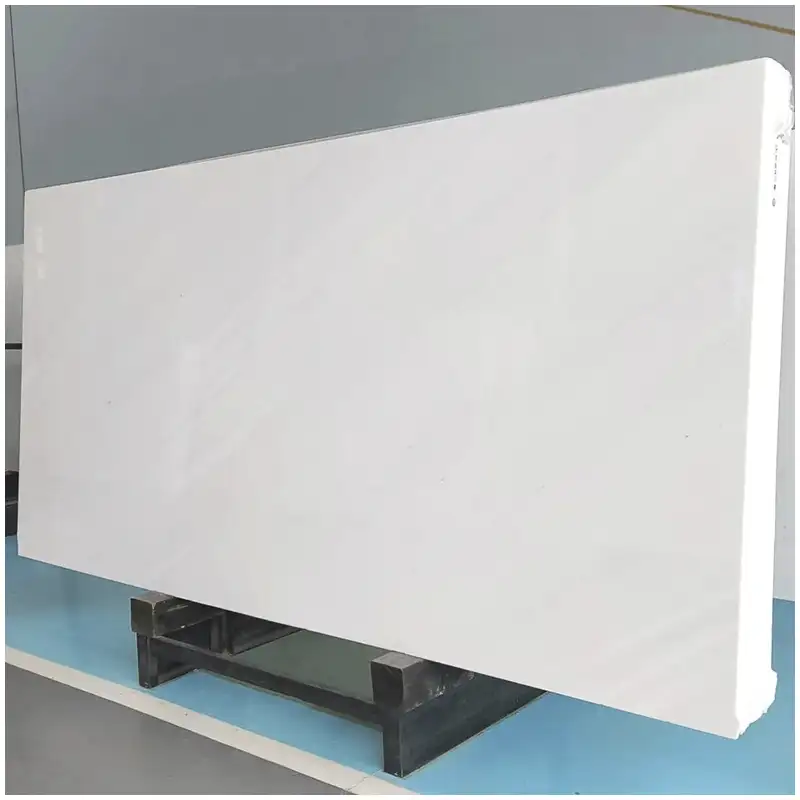
Bookmatched Volakas Marble Under Real Bathroom Light
Bookmatched Volakas marble is a claim about a block and a saw before it is a claim about beauty. The two halves must be proven bundle-adjacent faces whose grey-brown movement, undertone, centre seam and finish stay disciplined when they open as a mirror under real bathroom light. This page decides what the Volakas pair itself must prove. Where seams, niches, valves and lights sit on that pair is the room-side layout owned by the bookmatched white marble shower and feature wall guide, so read that guide for placement and keep this review for the stone.
Prove a genuine bookmatched Volakas marble pair first
A genuine bookmatch uses adjacent faces created when consecutive cuts from one block are polished so the two surfaces open like pages. With bookmatched Volakas marble, that cutting relationship decides how faithfully the pattern repeats, because the stone varies through the block from quiet pale lots to stronger grey-brown movement. The commercial name alone proves nothing, so the review starts with the slab numbers, the bundle or block reference and a written statement of which faces were sawn adjacent and how each face will be finished.

Ask how the proposed pair was produced. Two faces mirror because they were resawn as a matched set, or they merely look similar because the whole lot carries one consistent pale field. Volakas marble slab bookmatch discipline needs that difference on record: draw an orientation arrow for each face, keep the face labels in every photograph and hold the A-left and B-right instruction so the relationship survives after the pieces leave the warehouse.
When candidate faces are in the yard, compare the complete pair through our Volakas marble slabs range before reserving smaller pieces, because the mirror decision can change which two faces belong together.
Mirroring the grey-brown movement of bookmatched Volakas marble
Volakas can carry diagonal grey or brown-grey streaks across a pale white to light-grey field, and quiet lots, cloudy mineral zones and broader directional bands all occur within the commercial range. A mirror layout doubles that direction: a streak that slants one way on the left face slants the opposite way on the right, so the movement can close into a V, open into a wide chevron or break into an unrelated drift depending on where the dominant bands sit on each half.
Stand both faces upright beside each other under one light before judging the pattern. Check whether the dominant streaks actually meet at the seam or only pass near it, and whether cloudy zones fall in matching positions or land on opposite edges of the wall. A balanced bookmatched Volakas marble layout can hide in a small screen image and then dissolve when the full faces stand together, so review the whole elevation at normal viewing distance before stepping close for fills, scratches and edge conditions.
Directional movement is part of Volakas character, so a mirror changes what the stone promises. A band that climbs across the left face appears to climb from the other side on the right face, which may be the intended symmetry or an accidental reversal of a directional pattern. Decide which streaks should cross the centre and which should stop at the outer edges, then mark that reading on the approved layout.
Undertone between the halves of a bookmatched Volakas marble pair
The pale field carries the main risk for a Volakas pair. Undertone develops across the block rather than along one cut, so one half can read warmer or creamier while the other stays cooler and greyer even when the grey-brown movement mirrors cleanly. Under a cool inspection lamp the two halves may look close; beneath warmer bathroom light the difference becomes visible, and no mirrored vein rescues a visible undertone split in bookmatched Volakas marble.
Judge both halves together in the light that will actually wash the wall, with the centre joint closed to its proposed width and both faces in one field of view. Look again from the direction a person enters the room, because a cool grey face reflects its surroundings differently from a creamy one. Record the lamp used for the comparison, and when the difference sits inside the project tolerance, keep that undertone reading attached to the acceptance instead of promising a match the pair cannot deliver.
Inspect the corners and the cut edges as well as the centre field, because fills, resin lines and polished repairs can read as warmer zones on one half only. A local repair visible at the edge will sit inside the finished elevation unless the layout moves it beyond the crop, so check the full perimeter of both faces before the pair is approved.
Centre seam and finish consistency in a bookmatched Volakas marble pair
The saw blade removes a thin band between adjacent cuts, so a genuine pair can lose the very streak that crossed the seam. Expect the grey-brown movement of a bookmatched Volakas marble pair to interrupt at the centre: the question is whether the interruption reads as a deliberate joint in a disciplined composition or as a break across the strongest feature of the wall. View the closed seam at a shallow angle, with the light raking across it, and run a fingertip across the line to check for a step before the joint is accepted.
Finish discipline applies to both faces together. A polished face deepens the grey-brown streaks and throws bathroom light back in bright points, while a honed treatment softens the movement and can make the field read whiter, so a mixed pair shows the change at the seam as a shift in depth as well as tone. Approve both faces in the same finish state under the same light, and do not compare one face from a polished stock photograph with the other from a partly processed factory image.
What the order file and retained sample must prove
The order file carries the evidence that a pair is a pair. Request the block number, the bundle number, both slab numbers in their cutting sequence and a written resawn statement confirming that the two faces were sawn adjacent and are intended to open as a mirror. Attach the finish specification, the orientation arrows and the lamp used for acceptance, so the fabricator, installer and designer work from one statement of the relationship. The control sheet below lists the points I keep beside a bookmatched Volakas marble pair.
Hold a coded retained sample of the defining zone on each half, including the dominant grey-brown streak and any cloudy area, together with the approved layout. When one half is later damaged, that sample is the reference for continuity: if the reserved bundle still supplies the adjacent face, the relationship can hold; if the only candidate comes from a different block, treat it as a coordinated face and re-judge the whole pair under the bathroom light before cutting.
| Control point | What I mark | What can invalidate approval |
|---|---|---|
| Slab relationship | Bundle, slab numbers and adjoining faces | One slab is replaced from another sequence |
| 성분 | Centre joint, outer limits and dominant veins | Wall dimensions or opening positions change |
| 외관 | Finish, lamp identity and viewing direction | A different finish or unrelated light is used |
| Fabrication | Cut outlines, top arrows and usable boundaries | Nesting moves into a rejected edge or repair |
| 설치 | Piece marks, room location and packing order | Labels disappear or panels swap positions |
When provenance cannot be documented
Slabs leave some yards with no readable block or bundle reference, and a pair can arrive described only as a visual match. When the supplier cannot document the adjacency, do not stretch the term: name the proposal a coordinated pair, approve it on the actual relationship of the two faces and keep that label in the record.
Honest naming protects the later claim. A coordinated pair can still serve a quiet Volakas wall well when the pale field dominates and the grey-brown movement is gentle, but its label decides what the client can expect and what a replacement half can promise. When the sawing relationship cannot be proven, say so in the approval and let the visual acceptance describe what was actually delivered.
Where openings, valves and lighting decisions live
The checks above settle what the Volakas pair is and how its two faces must read together. From there, the room-side work belongs to the general bookmatched white marble shower and feature wall guide: where the centreline lands in the elevation, how seams, niches, valves and cutouts cross the faces, how the mirror and fittings are placed and how the lighting layout is confirmed before cutting. Carry the approved pair and its record into that guide instead of repeating its steps here; the material evidence and the application layout together form the approval, and neither replaces the other.
The Hard-Won Lesson: the order file, not the eye, makes a bookmatched Volakas marble pair
A pair can be approved from photographs that mirror beautifully while the two halves actually come from separate bundles that merely share a quiet pale field. Nothing looks wrong at a glance, yet the grey-brown movement does not continue across the seam and the undertones part company under bathroom light. The photographs approved an appearance, but the order file carried no proof of a relationship, and no dry layout could repair that gap.
The Lesson: Verify the sawing relationship first, because a mirror is only as honest as the bundle that produced it.
What a defensible Volakas pair record contains
The provenance statement stays attached
The approved record ties both faces to one block and bundle, states the resawn or adjacent-cut relationship, and names the finish and the light used for acceptance. A file that cannot be traced to physical slab marks is not a pair record, whatever its photographs suggest.

The honest label controls the later claim
Write bookmatched only where the sawing relationship is documented, and coordinated where it is not. When a half needs replacement, the label decides what the retained sample must match and what the supplier owes. Keep the label, the sample and the approved layout linked to one revision.
When the Bookmatched Volakas Pair Fails Approval
Treat a delivered bookmatched Volakas marble pair that fails the approved layout as a containment problem first. Fixed images and labels keep the later decision reversible.
- Document. Photograph both faces, the joint, the labels, the room lights and nearby finishes against the approved layout.
- Isolate. Pause that location and preserve both pieces in their sequence so nothing is swapped or re-cut.
- Escalate or hold. Send the inspection record and the original approval images to the supplier, and keep the release open until an authorised disposition arrives.
Frequently Asked Questions
1. How do I prove that a Volakas pair is a genuine bookmatch?
Ask the supplier for the block number, the bundle number, both slab numbers in sequence and a written resawn statement confirming the two faces were cut adjacent. Then stand the faces together under one light and compare the grey-brown movement, undertone and finish. When the file cannot document the sawing relationship, name the proposal a coordinated pair instead of a bookmatch.
2. Why does one half of a bookmatched Volakas marble pair look warmer than the other?
Undertone can develop across the block rather than along one cut, so one half may read creamier or warmer while the other stays cooler and greyer under bathroom light. Compare both halves in one field of view with the joint closed and note the lamp used. A visible undertone split is not a vein problem, so accept it deliberately or set the pair aside.
3. Does the grey-brown movement of a bookmatched Volakas marble pair need to cross the seam unbroken?
Not necessarily. The saw blade removes material between adjacent cuts, so a streak can interrupt at the centre even in a genuine pair. Decide whether the interruption reads as a deliberate joint within a disciplined composition, and attach that reading to the acceptance record.
4. Should both halves of a Volakas pair carry the same finish?
Keep the finish state consistent across the two faces. A polished face deepens the grey-brown streaks while a honed treatment softens them and can whiten the field, so mixed finishes show at the seam as a shift in depth and tone. Approve both halves together under the installed light.
5. What should I do when one half of the pair needs replacement later?
Go back to the coded retained sample and the approved layout before ordering anything new. If the original bundle still holds the adjacent face, continuity can hold; if the only candidate comes from another block, treat it as a coordinated face and re-judge the whole pair under the bathroom light before cutting.
Final Conclusion
Approve bookmatched Volakas marble as a pair whose sawing relationship is documented and whose grey-brown movement, undertone, centre seam and finish have been judged together under bathroom light. Keep the block, bundle and slab references with the coded retained sample until installation is complete, and write coordinated where the file cannot prove a bookmatch. That record is what stops a beautiful mirror image from becoming two unrelated white panels.
References
- Bookmatching, Wikipedia.
- Dimension Stone Design Manual, Natural Stone Institute.
- Natural Stone Care and Cleaning, Natural Stone Institute.
- ASTM C503/C503M Standard Specification for Marble Dimension Stone, ASTM International.
- Handbook for Ceramic, Glass, and Stone Tile Installation, Tile Council of North America.
- Bathroom Planning Guidelines, National Kitchen and Bath Association.
- Stone Flooring Technical Guidance, Stone Federation Great Britain.