

Thassos Marble for Bathrooms: Grade, Light, Wet Zones, and Finish Selection
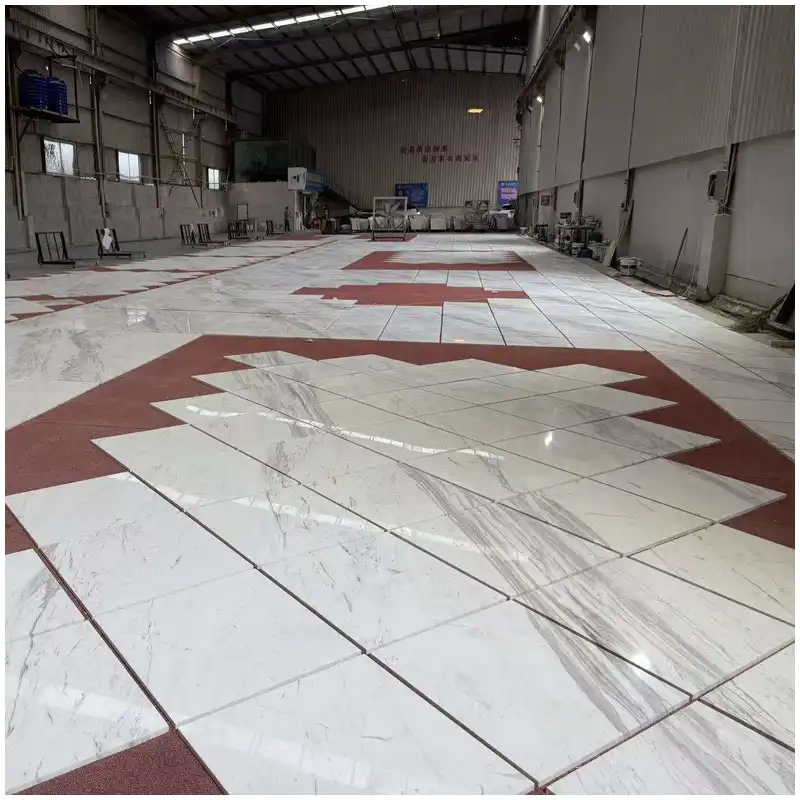
A white marble sample can be approved under a bright warehouse lamp and then read quite differently in the bathroom, where warmer, more directional light gives the finished field a softer tone. Different lighting conditions reveal differences in undertone, reflection and crystal contrast, so the approval condition has to be the one the room will actually provide.

For a Thassos marble bathroom, the lighting condition, the slab range and the intended application are fixed before any piece is called acceptable.
In a Thassos marble bathroom, the full slab and the dry-lay settle what a single lit sample cannot.
Do Not Call White One Color with Thassos Marble Bathroom
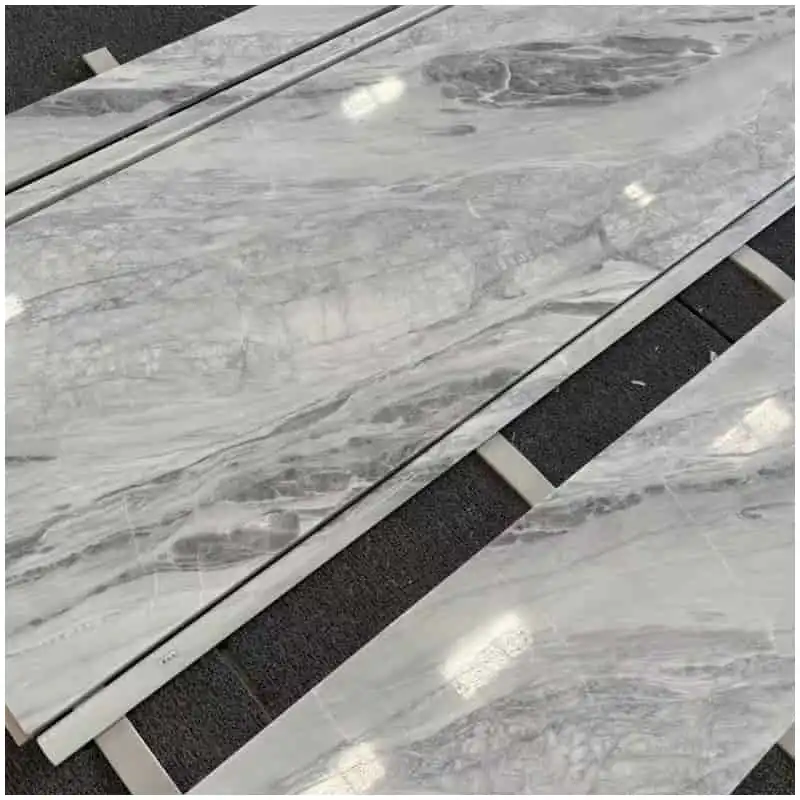
Enough material is laid out to read a crystalline white field as one thing rather than as separate boards. The bathroom is judged from the full field, because a single panel cannot show how the range distributes across a wall.
For later comparison, the slab range record is filed with the lighting record taken at approval. Shared references allow the installed Thassos marble bathroom to be compared with the original approval. Those records indicate whether a polished Thassos face changed or the viewing conditions did.
The warehouse check works from the slab outwards. A warmer vein-free zone is read against the signed reference, and the reading is kept as the condition the bathroom will be judged against.
Read the Full Thassos Slab before Allocation
The judgement is taken at the distance the room is used from. What the slab shows at arm’s length and what it shows from the doorway are different readings, and the bathroom is lived in at the second one.
A warmer vein-free slab zone is checked at the intended viewing distance, from the position the room is entered from. Wet and dry are both judged against the signed reference at the same time. Without the full comparison, the risk is that a polished finish reads too reflective for the intended wet-area role. The finished setting shows whether the result for a warmer vein-free slab zone remains within the approved range. Either the set is taken as a group or it returns to be re-sorted.
Par Thassos marble bathroom, the grade, finish and wet-zone detail are written down while the material can still be changed. Drawing, signed reference and the material actually on the rack are expected to match.
Choose Finish by the Wet-Zone Role
The face is moved between warehouse and project light because the two conditions do not agree. That difference is the reason the project light belongs in the approval rather than in a later complaint.
The inspection sheet connects the dry-lay map with the repair record. Holding both records means a casual phone photograph cannot stand as the only evidence. The site result for a 3000K mirror light has a physical range to answer to.
A honed sample is checked against the signed reference while the surface is still unworked. Once polishing or sealing has been applied, the comparison can no longer show what changed.
| Decision point | Evidence to inspect | Release condition |
|---|---|---|
| Slab field | Crystal scale, undertone, and calm or active zones | Allocated pieces read as one white field at room scale |
| Apdare | Polished or honed sample in intended location | Reflection and cleaning behavior fit the wet-zone role |
| Lighting | 3000K and 4000K comparison | Approval records the color shift before installation |
| Pieteikums | Wall, floor, vanity, or shower condition | Selected piece and finish suit the specific exposure |
| Batch range | Dry-lay and allocation map | Replacement and adjacent pieces remain within the approved range |
The Hard-Won Lesson in Thassos marble bathroom: A quiet sample can create the worst replacement
One very quiet white sample can be approved for a warm bathroom, and a later piece from a different crystal field then reads colder beside it even though both carry the same name. The name does not control the range; the signed reference does.
The Lesson: Approve the full white field under the project light before using one sample as a promise for every later piece.
Compare 3000K and 4000K before Release
Close inspection at the bench is read against the same reference the room will be judged against, so a condition that only works under inspection light is caught before the material is released.
As looking at a full-slab inspection rack, a honed wet-area sample is put into the dry-lay before deciding. The affected piece is marked and written up before any repair touches it. Adjacent pieces quickly reveal that one finish is applied everywhere without considering cleaning and traction. The complete setting reveals a honed wet-area sample without the mercy of a cropped photograph. Only the complete arrangement earns a release mark.
Grade, finish and wet-zone detail are recorded before the batch leaves the inspection stage. The drawing, the approval and the piece on the bench are meant to describe one thing.
Keep Floor Wall and Vanity Decisions Separate
The batch is compared as a set under the project lighting. Where one panel reads differently from the rest, the question belongs to the batch before it belongs to the room.
The batch register and the room allocation sheet are kept together: one names the material, the other fixes the light, finish and location it was accepted for.
The accepted range is recorded before any finish pass begins, because polishing or sealing changes what the surface can still demonstrate.
Dry-Lay the White Field before Cutting
The grout line is settled at the parent level as a colour and tone decision, since it is the element that frames every other choice in the room. How the joint behaves in a wet area belongs to the shower floor page.
A replacement piece is compared against the approved range for that area rather than against the piece currently installed, because the installed piece may already have weathered.
The bathroom decision is documented while the material is still open to change. What was approved and what arrived are both measured against the drawing.
Record the Accepted Bathroom Range
The field is read as a whole under the project light. A single grout line judged on its own says little about how the room will read once every line is in place.
The dry-lay file carries the slab range sheet with the light comparison taken at approval, so the accepted condition can be reconstructed later.
A shower-wall return is read against the reference in both wet and dry states, since a return faces a different way from the wall it joins. Its finish allocation is set out on the shower floor page.
Allocating One White Range across the Room
A Thassos bathroom is seldom a single surface. A wall field, a floor, a vanity top and a shower enclosure can each be cut from the same selection, and the question at this level is how a single approved range is shared between them. The parent decision is which zones take the quieter part of the block and which can carry the more active crystal, because the largest continuous surface sets the tone the rest are read against.
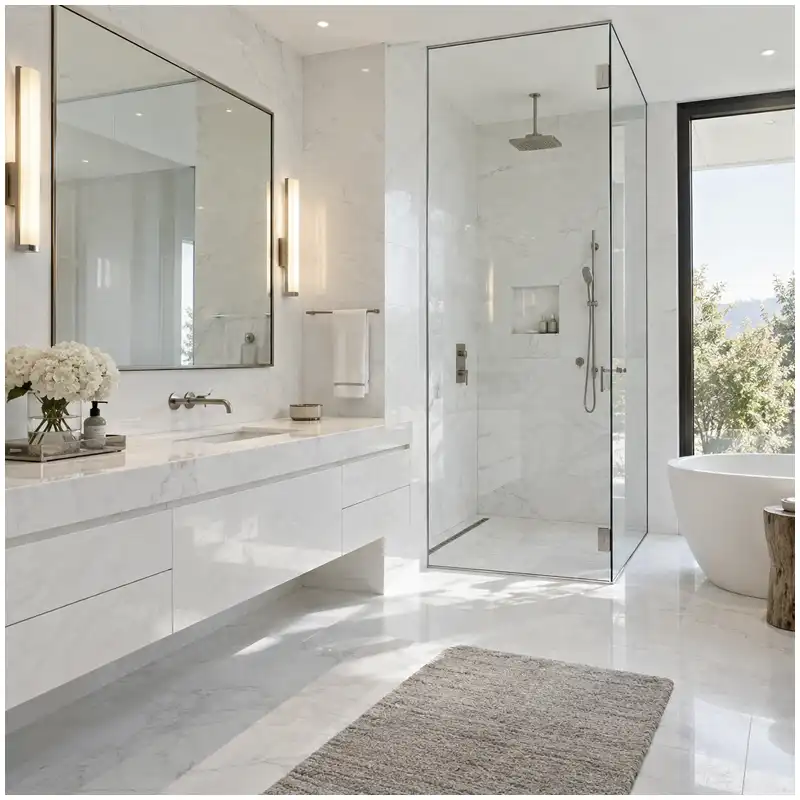
Wall area dominates that reading. A large wall field is seen in one glance, so a slight change in tone across it is visible before any detail in the room is. Floor and vanity surfaces are interrupted by fixtures, joints and objects, which gives them more tolerance for variation. Allocation therefore starts from the wall and works down, rather than selecting each surface independently and hoping they agree.
Finish Belongs to the Zone, Not to the Stone
A polished finish deepens contrast and a honed finish flattens it, and the same slab reads differently under each. In a bathroom that matters because the zones are viewed under different conditions: a wall is read in reflected light, a floor in downward light, a vanity top under the mirror. Where a single finish is used throughout, the choice is a compromise between those conditions; where finishes differ by zone, the difference is visible at every junction between them.
The practical rule is to fix the finish by the zone’s role, then confirm it on the actual material. A finish chosen on a sample can read as a different colour once it is installed in a wet area that receives less light than the showroom.
The Lighting Condition Is the Approval Condition
Different lighting conditions reveal differences in undertone, reflection and crystal contrast, and a bathroom provides two of them: a warm, directional light at the mirror, and a cooler, more diffuse light overhead. A white that looks uniform under one can show a visible shift under the other, so the approval is taken under the condition the room will actually provide rather than under corrected inspection light.
This is also why a single photograph is a weak record. It fixes one lighting condition and one distance, and the room will be experienced under several. The accepted range and the conditions it was accepted under are recorded together, so a later comparison has something to work from.
Where the Child Decisions Begin
Two decisions sit below this page and are owned elsewhere, because they depend on geometry this page does not fix. How the floor meets the drain, what module the fall allows and how the joints behave under water are set out in Thassos marble shower floor. Where the basin opening lands on the field, how the edge profile reads under mirror light and how the splash meets the wall are set out in Thassos marble vanity top.
This page owns what comes before both: the approved slab range, how that range is allocated across the bathroom, the finish by zone, and the lighting the approval was taken under. Those four decisions constrain everything the child pages then do.
Where a White Bathroom Starts to Look Uneven
Light exposes the difference
Warm and neutral light can make crystal structure and undertone more noticeable than the warehouse sample suggested.
Each wet-zone surface needs its own answer
Floor, wall, shower, and vanity conditions do not ask the same thing of a polished or honed white face.
A batch needs a visible boundary
The accepted range should be drawn, photographed, and allocated before cutting removes the chance to rebalance the field.
Under the project light, tone, veins, finish and wet-area placement are all judged on the full face of Thassos White Marble Slab.
This detail is read alongside How to Identify Premium Thassos White Marble, because one white has to hold across slabs, wet areas, lighting and joints.
The approved reference stays with Thassos White Marble Slab, because the material name alone will not expose a batch change.
Before the batch is accepted, this detail is checked against Thassos and Bianco Sivec Marble and against the bathroom it will be installed in.
A Thassos marble bathroom needs full-slab approval because small white samples hide the field, crystal movement, and lighting shift.
The finish decision has to be made separately for the wall, the floor, the vanity and the shower, rather than assumed from a claim that one white marble suits everything.
Approval is taken under the actual bathroom light as well as a controlled inspection light.
One further comparison is made at the intended viewing distance, and the affected piece is recorded before any repair work begins.
Before applying the release mark, a 3000K mirror light is placed in the recorded view at a full-slab inspection rack, and the batch holds until the full relationship is clear. The range sheet is entered in the warehouse log, because one sample hides the crystal scale and undertone elsewhere on the face. The condition that exposes the issue is recorded with the range it belongs to, not just the image that minimises it.
At final release, Thassos marble bathroom stays tied to the signed drawing, approved reference, and marked condition.
During the last review, Thassos marble bathroom is checked against the same evidence that guided the initial selection.
Bieži uzdotie jautājumi
1. Is Thassos marble suitable for bathrooms?
It may be used where the selected slabs, finish, application, wet-zone detailing, maintenance plan, and project-specific installation requirements are assessed together.
2. Why does Thassos look different under warm light?
Light color, surface finish, crystal structure, adjacent materials, and viewing angle can change how a white marble field reads. Compare actual material under the intended light.
3. Should Thassos marble be polished or honed in a shower?
The answer depends on the application, slip considerations, cleaning plan, drainage, selected material, and responsible project team. Test the chosen finish in context.
4. Can one Thassos sample represent an entire bathroom project?
No. Use full-slab review, dry-lay, lighting comparison, and a documented acceptance range for batch-scale decisions.
5. What should happen if the installed white field looks uneven?
Photograph it under comparable light, stop further allocation, compare the pieces with the accepted dry-lay and batch records, then resolve the range before more cutting or installation continues.
Quick-Reference Checklist for Thassos marble bathroom
- Review full Thassos slabs before selecting bathroom pieces.
- Compare polished and honed samples under 3000K and 4000K.
- Allocate calm fields around sink cutouts and main sight lines.
- Dry-lay representative floor and wall pieces before cutting.
- Record the accepted batch range and lighting conditions.
Final Conclusion
A bright bathroom stays coherent when the approved white range survives real light, wet surfaces, grout, and future replacements. The final decision on Thassos marble bathroom must stay attached to the evidence that production and site teams can verify.
Don’t just look at samples. Esta Stone would rather reject one flattering white crop than install a bathroom field that cannot hold together.
References
- Tassa marmors, Wikipedia.
- Dimension Stone Design Manual, Natural Stone Institute.
- Natural Stone Institute Technical Bulletins for Wet Areas.
- TCNA Handbook for Ceramic, Glass, and Stone Tile Installation.
- Stone Federation Great Britain Technical Guidance for Natural Stone.
- Search Essentials, Google Search Central.