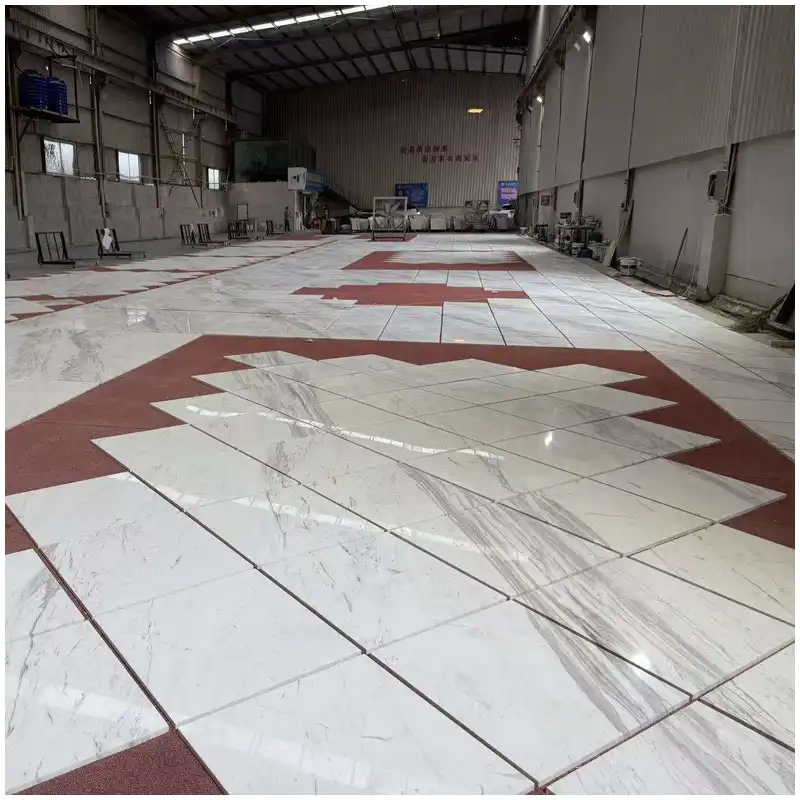


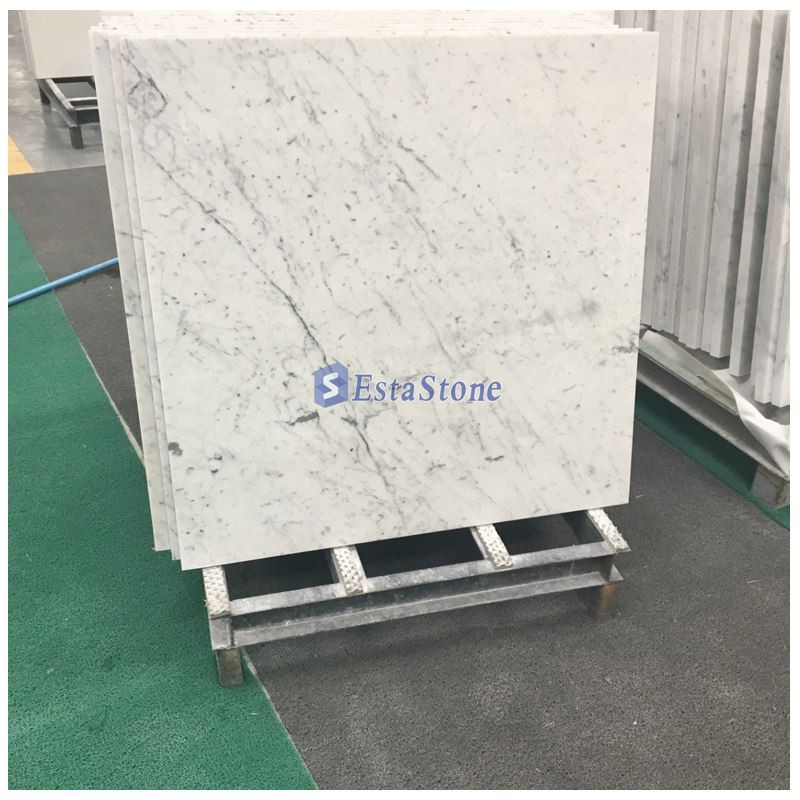

Volakas Marble Maintenance Samples: Water Marks, Soap Film, and Cleaner Approval Before Handover
The handover question is narrow: which cleaning method may touch the finished pale field, and who confirms it before the room is released? A white marble bathroom often finds its cleaning limit in the first month of use, when a housekeeping team reaches for the product already on the shelf. The sample set closes that gap while the reserved lot is still on site and matching offcuts are still available.
This is a handover decision rather than a diagnosis. Marks that appear after installation belong to the installed stage; the work here is to fix the reference set, the product, and the written record before the keys change hands. A recorded sample outlives the meeting that approved it.
Reserve the reference offcuts before the crate is closed
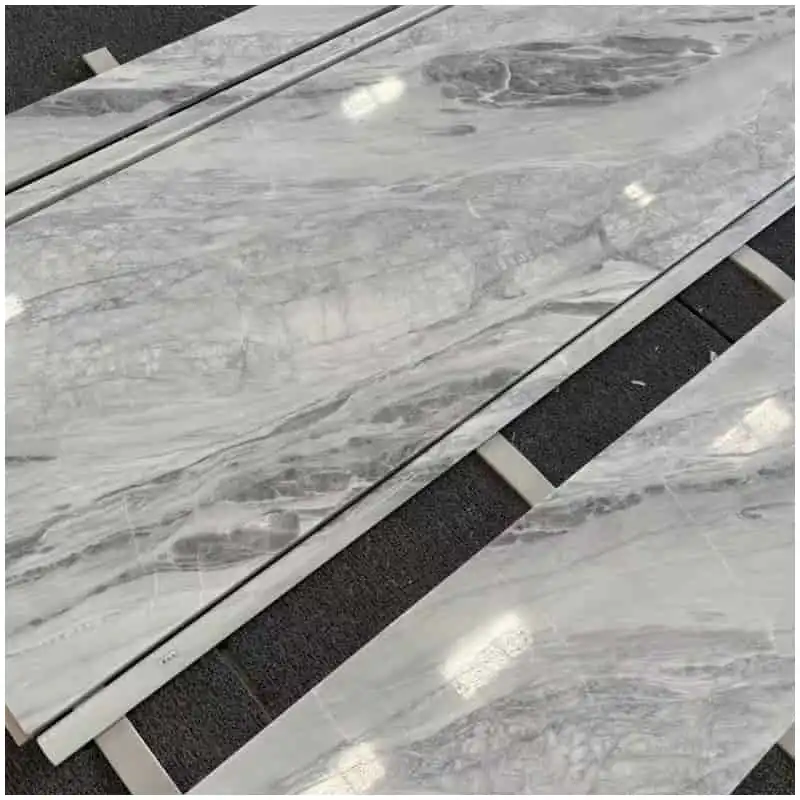
The reference set for Volakas marble maintenance samples starts with two offcuts from the same reserved lot as the installed material: one sealed to the project sealer schedule and one left unsealed. Both carry the finish that will be delivered, whether that is polished, honed, or another documented surface. A catalogue chip or a piece from an earlier order cannot show how this particular lot behaves.

The sealed and unsealed pieces answer different questions. The unsealed face shows how the pale field takes water and how quickly it dries back. The sealed face shows how the specified sealer sits on the dolomitic surface, and whether haze, sheen, or a patchy film appears where it was applied. Keeping both lets the maintenance team compare a treated and an untreated reaction under the same product.
Cut those offcuts while the slabs are still stacked, not after fabrication begins. Once a lot is partly cut, sold, or returned, a matching reference piece may no longer exist, and the handover has to fall back on photographs alone. I take the reference pair at selection and seal it with the same product that will be used on the installation.
Label each piece with the lot number, the finish, the sealer product, and the date it was prepared. Size matters more than people expect. A piece about the size of a hand lets the team read a field, an edge, and a joint in one view; a chip the size of a coin only proves that the material is white. Include one piece with the joint or grout detail the room will contain, because a cleaner that is safe on a slab face can behave differently against a grout line. The set remains a reference only while the pieces can still be traced to the material on the wall.
Record the cleaner and its dilution, not just the word approved
An approval of Volakas marble maintenance samples that names no product cannot be followed. The record carries the cleaner name, the dilution ratio, the dwell time on the surface, and a confirmation that the product is neutral pH for routine use. Volakas is a dolomitic marble, so an acidic or abrasive routine can still dull the finish, and a product that suits one finish may not suit another.
Write the routine the way the cleaning team will use it: dilution measured per litre or per bucket, dwell time in minutes, agitation with a cloth or soft pad only, then a rinse and dry step. Dilution and dwell time matter, but cleaner chemistry, finish, sealer, agitation, rinse, and residue also affect the result. A product diluted stronger than the label allows, or left on the surface far longer than the label allows, can dull a finish that the same product would leave untouched at the tested strength. The sample sheet should carry both numbers, and I would not approve a product that arrives without them, because the maintenance team cannot reconstruct either one later.
The finish belongs in the same sentence. A polished face and a honed face do not respond alike, and a routine approved for one is not automatically approved for the other. I test the dilution on both the unsealed offcut and the sealed reference to validate the routine against the installed treated surface, then photograph the results dry and wet. If the surface dulls, streaks, or holds residue after the stated dwell time, the product is changed rather than the marble. Condition every cleaning instruction on the approved product, the supplied finish, and the sample result, because none of the three can be assumed.
What the sample proves and what it cannot
When I sign off a maintenance set, it answers a defined set of questions. The approved cleaner reproduces water marks and soap film on the offcut at its stated dilution, while sealer haze appears as an application condition on the sealed reference; both are recorded while fresh. The sample also shows how the product behaves on the finish that was actually supplied.
Sealer haze is the detail most often missed at handover. A sealer applied too heavily, or worked before the surface was fully dry, can leave a milky film that catches light at an angle across a pale field. On an offcut the film appears within the first pass and can be compared side by side with the unsealed piece. On a finished wall the same film is harder to see and far more expensive to correct.
What a sample cannot do is guarantee that every mark on the installed field will lift. A stain that has already been absorbed or etched, or that has been driven into a joint, is a different problem whose response depends on its cause. The diagnosis of those marks is worked out on site from the pattern and its location, so the reference set should not be read as a promise that a mark will come out. The reference set defines the ordinary routine; anything beyond it is a separate question. Sealer application, cure time, and acceptance are settled in the separate sealing handover file, while this set covers the cleaning routine and maintenance record.
The same limit applies to a mark that appears after the set was approved. A change of cleaner, a new pad, a stronger concentration, or a longer dwell time takes the surface outside the tested condition. The correct step is then to stop and repeat the test on the reference offcut before anything else touches the pale field. A sample also cannot certify a product that has since been reformulated; if the label or the strength changes, the old photographs no longer describe what is being used.
| Sample element | What it records | Handover value |
|---|---|---|
| Sealed offcut | Sealer and finish response | A reference for the treated face |
| Unsealed offcut | Water and soap film behaviour | How the bare field dries back |
| Cleaner sheet | Name, dilution, dwell time, neutral pH | A repeatable method for cleaning |
| Test photographs | Dry and wet condition of each test | What an accepted result looks like |
| Joint piece | Cleaner behaviour against grout | A method that protects the joint edge |
The Hard-Won Lesson: Approve only after the sample meets the actual cleaner on the supplied finish
An offcut wiped once with water and left to dry tells the eye very little. The difficulty appears when a housekeeping team works a soap film into the same surface and the pale field starts to look cloudy at an angle. The sample has to be exercised with the actual product before it is sealed into the record.
The Lesson: Approve the product and the finish on the same offcut, then hand the written procedure to the people who clean.
Write the cleaning record for the maintenance team
The handover file for Volakas marble maintenance samples is short and concrete: the two labelled reference offcuts, the cleaner sheet, the dry and wet photographs, and the finish and lot reference. Keep it with the room or the project record rather than in an email thread that will not follow the building.
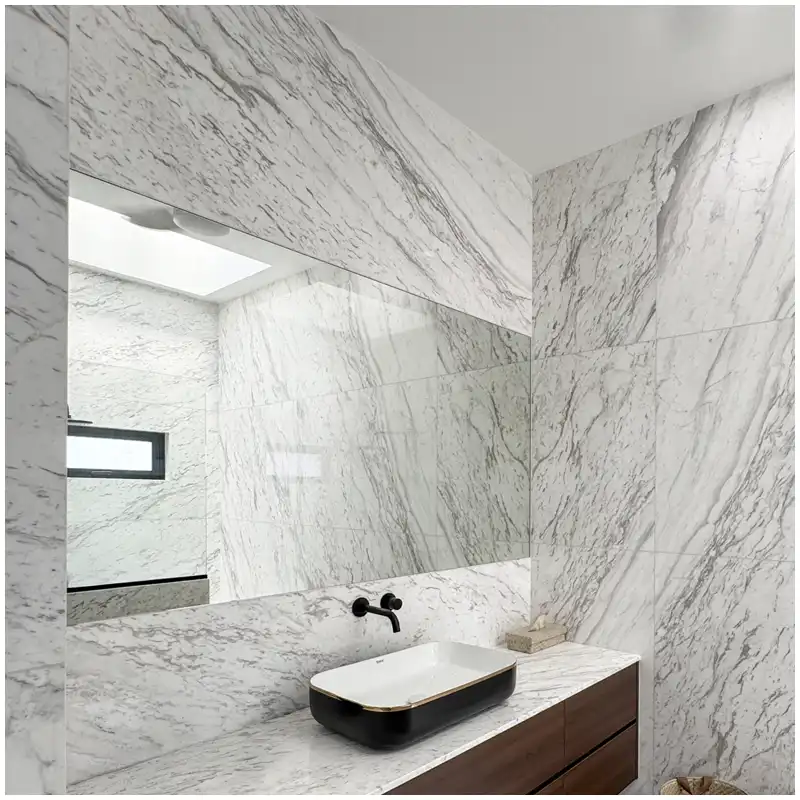
I keep the cleaner sheet, the photographs, and the lot reference in one file, and I name the person who approved it and the date. When a new cleaning product is introduced, the same test is repeated on the reference offcut before it enters the routine. The sample set stays useful only while the reference still matches what is installed, and a record without an owner is usually the first document to disappear.
The written method should also survive a change of cleaning contractor. A sheet that lists the product, the dilution, the dwell time, the permitted pad, and the products that are excluded can be handed to a new team without translation. Where a later repair is made from replacement stock, note the new piece in the same file so the maintenance team is not testing against material that is no longer on the wall.
One routine does not cover every Volakas surface
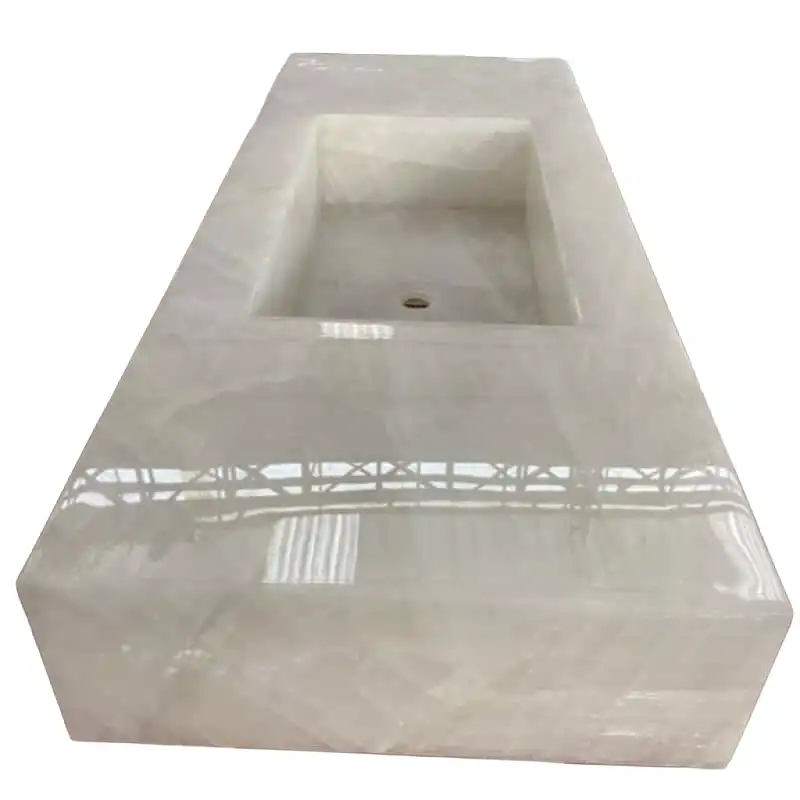
A single cleaner sheet may not suit a whole room, because a bathroom usually holds more than one surface condition. A honed floor tile with grout joints, a polished wall panel with a sealed edge, and a Volakas balta marmora tualetes topi surface around a cutout can all be Volakas and still ask for different handling. The maintenance set should represent each finish and each joint type that the room will contain.
Grout changes the method. An acidic grout cleaner used on a ceramic floor can dull a dolomitic marble edge, and the damage shows along the joint rather than in the middle of the tile. The record should state plainly which products are excluded and which tool is permitted, so the exclusion is followed even when a different team takes over the cleaning.
Cutouts and fittings deserve their own note. Around a sink cutout, a drain, or a niche return, residue collects in the seam between stone and metal, and the approved method for that seam is not always the same as for an open field. A reference piece beside a Volakas Marmora Plāksne and a note on the joint detail give the maintenance team somewhere to practise before an issue appears.
Keep the sample valid after handover
I would store the set where it can be found again, because it only earns its value that way. Store the two offcuts, the cleaner sheet, and the photographs with the room or project file, and name the person who owns them. Questions about the sealer itself (colour shift, cure time, grout contact, sealer acceptance) sit with White Marble Sealer Test rather than with this cleaning set. A sample left in a site container is easily lost after handover.
Review the record whenever anything changes. A new cleaning contractor, a new product line, or a change of finish all invalidate the previous test. The response is the same each time: condition the new situation on the reference offcut, photograph the result dry and wet, and update the sheet with the date and the approver. Update the sample set at that point rather than quietly forgetting it.
When a mark goes back to the supplier
Some marks fall outside the routine recorded for Volakas marble maintenance samples. I treat those as an escalation, not a cleaning problem.
- Document the mark: photograph the field and the detail, and note the cleaner, dilution, dwell time, and date.
- Isolate it: stop cleaning, polishing, or re-sealing that area and stop using the suspect product in the room.
- Escalate with the lot number, finish, cleaner sheet, and photographs, and hold replacement until the reference offcut is compared.
Questions We Hear Before Handover
1. What has to be in a Volakas marble maintenance samples set?
Two reference offcuts from the reserved lot, one sealed and one unsealed, with the finish, lot number, and sealer identified.
2. Why record the cleaner by name and dilution?
A cleaner approved without a dilution and a dwell time cannot be repeated, so the result drifts away from the tested sample.
3. What does the sample prove about water marks and soap film?
It shows how the approved cleaner and the supplied finish respond dry and wet on the pale field. It does not prove that every mark is removable.
4. May the maintenance team use a stronger product later?
Not without a new test on the reference offcut, because a higher concentration or a longer dwell time moves the surface outside the approved routine.
5. When does a mark go back to the supplier?
Document it, isolate the area, and escalate with the lot number, cleaner sheet, and photographs, holding replacement or treatment until the reference offcut is compared.
Quick-Reference Checklist: Release only after the five items below are recorded
- Cut sealed and unsealed offcuts from the reserved lot and label them.
- Name the cleaner, dilution, dwell time, and neutral pH on one sheet.
- Test the dilution on the unsealed piece and photograph it dry and wet.
- State what the sample cannot prove before the room is released.
- Put the record, the approver, and the date in the handover file.
Final Conclusion
Volakas marble maintenance samples are small pieces of material carrying a large decision: which cleaner may touch the pale field, at what dilution, and for how long. Sealed and unsealed offcuts from the reserved lot, a written cleaner sheet, and dry and wet photographs give the maintenance team a tested method and a written approval. Esta Stone keeps the sample set, the lot record, the finish, and the handover decision together so the room is released with the tested reference and the named approver.
References
- Marmors, Wikipedia.
- Dimension Stone Design Manual, Natural Stone Institute.
- Standard Specification for Marble Dimension Stone, ASTM International.
- Standard Guide for Selection of Dimension Stone, ASTM International.
- TCNA Handbook for Ceramic, Glass, and Stone Tile Installation, Tile Council of North America.
- Bathroom Planning Guidelines, National Kitchen and Bath Association.