

Volakas Marble Thresholds: Door Clearance, Wet-Side Falls, and Batch Tone
The threshold looked pale and clean on the cutting list. Under the bathroom door, it became a grey stripe that met a warmer floor field at the worst possible angle. The door cleared by almost nothing. Water sat on the wet side. Nobody had looked at the small piece as part of the entire doorway.
Do not just look at samples. For Volakas marble thresholds, the finished floor levels, the door swing, wet-side fall, slab direction, grout, and the neighboring batch must be available for direct comparison.

Lighting lies, especially at a doorway where corridor light and bathroom light meet on one narrow stone. Buyers have rejected a perfect slab when the threshold was judged under a single overhead bulb in the showroom rather than the mixed ambient light of the actual site.
Read the Doorway as One Floor Detail with Volakas Marble Thresholds
The finished floor field is judged across every piece, under the light specified for the project. The trouble appears when a thin piece becomes the darkest line in the doorway. Once grout and water enter the picture, the finished floor level reads as one continuous surface rather than a set of separate pieces. The larger field decides; the flattering detail shot does not.
A full-slab range sheet is recorded alongside a two-light comparison. The first document locates the specific slab zone, while the second preserves the exact viewing conditions used during approval. If the installed threshold appears darker on site, it is compared directly against this recorded baseline to determine if the shift is due to lighting, moisture, or a mismatched batch. This prevents arguing over subjective impressions when physical records exist.
Before fabrication begins, the corridor floor line is examined relative to the bathroom entry. Both damp and dry views are maintained beside the approved reference sample until polishing, sealing, or cleaning alters the surface state. The critical pass-or-reject criterion is simple: does water move away from the dry side? The overall flow is assessed from a step-back view, then edge integrity, pore structure, joint alignment, and any residual manufacturing marks are inspected close up.
This detail is kept beside Volakas Marble for Bathrooms because the same white marble must agree across slabs, wet areas, lighting, joints, and maintenance.
Set the Wet-Side Fall before Choosing the Cut
Volakas thresholds sit inside a bathroom floor build-up that the guide to bathroom marble thresholds already sets out in detail, including the wet-side fall, the waterproofing interface and the clearance available under the door leaf. Those decisions follow from the bath or shower geometry, the substrate and the door itself, and they apply to any stone threshold in that position rather than to Volakas in particular. This page treats them as fixed inputs and works on the part that is material-specific: which batch the threshold comes from, how the vein direction reads across the doorway, and how the cut is allocated.
What a Volakas threshold has to answer for is tonal continuity. The bathroom floor is usually read as one field from the corridor, and the threshold is the narrow band that either continues that field or interrupts it. A doorway strip cut from a paler slab than the surrounding floor reads as a deliberate border; the same strip cut from a noticeably darker slab reads as a patch, even when both pieces are sound and correctly installed.
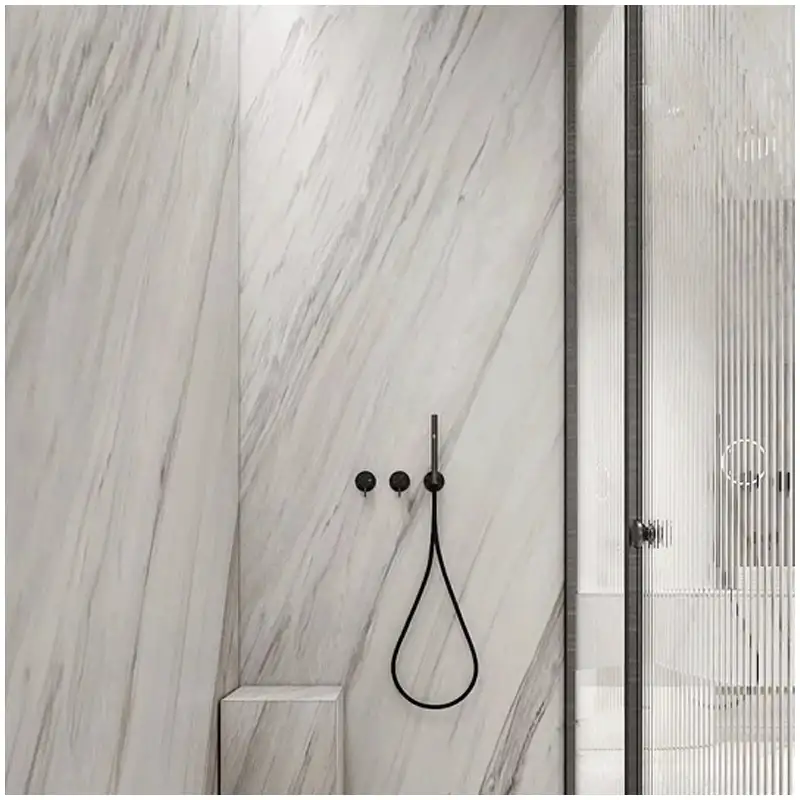
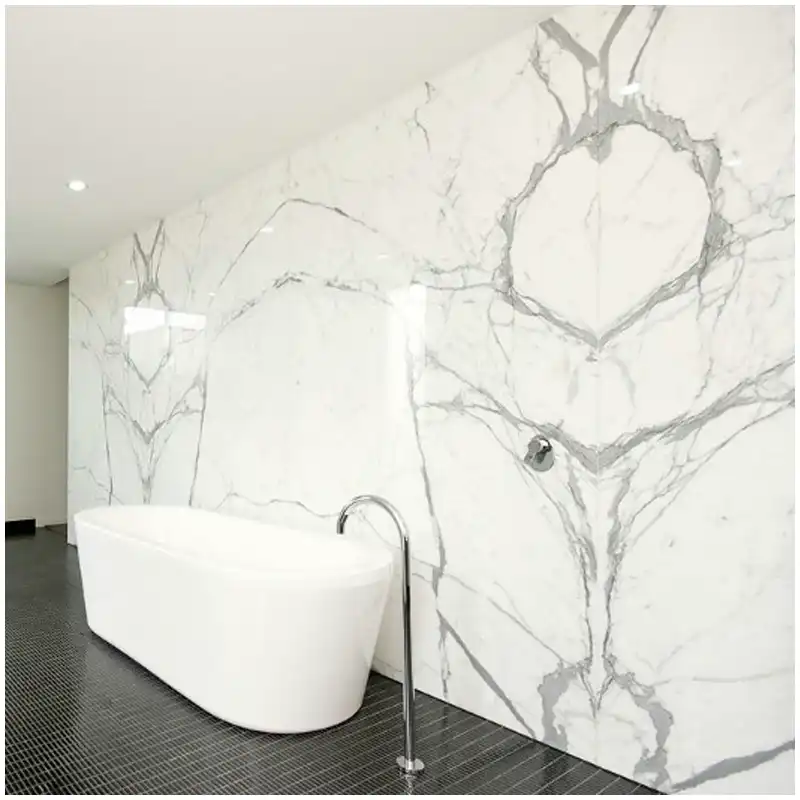
Vein direction is the second material decision that belongs here. A long grey Volakas vein running through the doorway should either be carried straight across the opening or stopped cleanly at the jamb line. A vein that enters one side of the threshold and disappears mid-opening leaves a visible discontinuity that no amount of joint filling resolves.
Reading the vein correctly starts with deciding which face will be visible. How the face and the exposed arris read depends on the slab and block involved and on the direction it was cut, so the two surfaces are not assumed to match: the face may show broad diffuse veining while the edge presents a tighter pattern, or the two may read very similarly. A threshold is short in depth and long in width, so it exposes both surfaces, and a piece selected only from its face can turn out to present a different pattern along the visible arris. Both surfaces are therefore confirmed on the actual material before the cut is approved. Where the threshold is deep enough to expose a meaningful edge band, the piece is selected on the edge as well as the face, and that requirement goes to the fabricator with the cut list rather than being left to whoever sets the slab on the saw.
Batch tone is what makes this page different from a general threshold guide. Volakas supplied from different blocks can vary noticeably: one lot may run cool and grey with diffuse veining, while another carries a warmer cream ground and more pronounced grey streak. A threshold cut from a different lot than the floor field can read as a mismatched band across the doorway, before any question of slope or clearance arises.
The practical response is to reserve the threshold from the same block as the field it meets. Where that is not possible, the closest tonally available piece is chosen and its batch number is recorded against the doorway, so the mismatch is at least a documented decision rather than an accident discovered on site.
The record that goes with the doorway matters more than the cut itself. It carries the block and lot reference for every piece in the threshold, the finish applied to the exposed arris, the direction the vein runs, and the lighting conditions the tone was approved under. Without those four items, a replacement ordered two years later is matched by eye against an installed floor that has since been cleaned, sealed and lit differently, and the match becomes a matter of opinion rather than a documented decision.

Where the Volakas marble threshold was cut from a lot other than the floor field, that fact belongs in the record explicitly, with the reason. A deliberate tonal step documented at approval reads as a decision; the same step discovered on site reads as an error, even though the stone has not changed.
Keep Door Clearance and Edge Finish Together
Edge profile and doorway allocation are the two decisions this page owns. A polished arris beside a honed floor field reads as an intentional transition line; the same arris beside a polished field disappears into it, which is sometimes wanted and sometimes not, and the difference should be decided from the room rather than left to the fabricator.
A doorway wider than the longest sound piece available forces a joint into the threshold. Where that happens, the joint position is treated as a design decision rather than a leftover: setting it on the vein axis makes the vein appear to continue through the break, while placing it deliberately off the axis turns the joint into a visible line that has to justify itself against the surrounding field. Either can work, but the choice is made on the drawn layout, not on site once the pieces are cut.
The joint orientation matters as much as its position. A joint that crosses the vein at a right angle stops the line abruptly; a joint running with the vein hides inside it. Where the doorway is long and the vein is diagonal, the cut angle of the two pieces decides which of those two readings the visitor sees, so the orientation is agreed before the pieces are fabricated.
Allocation matters more than it first appears. A wide doorway is often cut from a single piece, but where the opening exceeds the available length, the threshold is built from two or more pieces and the joint position becomes a visual decision. Placing that joint on the vein axis, or deliberately off it, changes how the doorway reads far more than the joint width does. The batch number for every piece in the threshold is recorded with the cut, so a later replacement can be drawn from the same block rather than matched by eye.
A second allocation question is how much of the doorway the threshold should visually own. In a wide opening, a deep strip creates a strong band across the floor; a shallow strip almost disappears and lets the field run through. Both are legitimate. As a design preference rather than a material rule, a small bathroom is often kept shallow so the floor reads as one field, while a long corridor entrance can carry a deeper band without breaking the space.
Choose Vein Direction from the Floor Field
The doorway allocation is settled from the full face before any finishing step: the polished edge is read at normal viewing distance, and the batch selection stays on hold until the visual relationship between threshold and floor is established. Once polishing, sealing or cutting begins, that evidence is no longer recoverable.
With Volakas marble thresholds, the stated wet-side detail must carry water away from the dry side rather than relying on a flat strip.
Match the Threshold to the Active Batch
Tone is the part that survives installation, so it is reviewed under the light specified for the project rather than under warehouse lamps. The comparison is made across the full range of candidate pieces, which is where a strong vein or a tone step between lots becomes visible; a single favourable crop will not show it.
Volakas Marble for Bathrooms is kept beside the approved physical reference so batch drift cannot hide behind a material name.
Inspect the Threshold under Both Room Lights
The long grey Volakas vein is the detail that decides the cut. Its path across several pieces is traced so the doorway strip either follows it or stops it cleanly at the jamb, and the batch references behind that choice are recorded, because a later replacement has to come from a known lot.
Before the batch is accepted, Volakas Marble Slab Approval is revisited to check whether this detail still belongs with the complete Volakas bathroom.
When the specification calls for Volakas marble thresholds, the vein direction and tone should come from the adjacent floor field, not from a pleasing isolated offcut.
Record a Replacement Condition
Grout, water, lighting and the neighbouring floor finish change how the threshold reads once it is installed, so the decision is confirmed against the installed conditions rather than against the slab alone.
Where a Volakas Threshold Fails the Doorway
A threshold is a drainage decision
It must respect the approved wet-side fall and the finished floor levels before it can be judged as decoration.
Door clearance is a finished dimension
Measure after the relevant floor build-up is known. A nominal frame detail cannot prove the final gap.
Tone belongs to the adjacent field
Compare the threshold with the floor tiles or slabs under both room lights before release.
The completed floor build-up and door condition are required before the slab crop is chosen.
The wet-side fall must send water away from the dry side rather than letting it sit against a flat strip.
The piece should take vein direction and tone from the adjacent floor field, not from a pleasing isolated offcut.
Where the assembly is measured, it is measured in the sequence the trades work in: the corridor floor line is re-checked against the approved reference sample, and any piece affected by a later adjustment is mapped before repairs alter it. Light-dependent shifts are noted in the record so a future inspection is not read as a change in the material.
In the approval record, link the product route for Volakas marble slab. Attach this reference to the signed record to avoid reopening decisions based on memory alone.
Document the related decision in Volakas Marble Slab Approval. Keep this reference with the signed record to prevent relying on recollection.
For operational comparison, retain Volakas Marble Batch Matching. Link this reference to the signed record to ensure consistency.
Address subsequent material questions via Volakas Marble Shower Walls. Keep this reference with the signed record to maintain audit trails.
Voor Volakas marble thresholds, the signed evidence must describe the physical condition that the next team will actually receive.
A final check of Volakas marble thresholds belongs in the close-out record, because a good detail cannot survive a missing reference.
Frequently Asked Questions
1. How should a Volakas marble threshold slope in a bathroom?
The fall and waterproofing relationship belong to the project detail and finished levels. Confirm the wet-side direction before the threshold is cut or installed.
2. Can a marble threshold be polished beside honed floor tiles?
It can be a design choice, but compare reflection, edge feel, cleaning, and visual continuity with the actual adjacent floor.
3. How much door clearance does a marble threshold need?
The required clearance depends on the door system, finished floor build-up, seals, local requirements, and installation detail. Measure the real condition.
4. Why does a threshold look darker than the floor?
It may come from a different slab zone, finish, wetness, lighting condition, grout contrast, or a combination. Compare it with the active batch under both lights.
5. What should happen if a fitted threshold does not match the floor?
Photograph the piece and adjacent field under fixed light, pause related cutting or installation, compare the batch and dry-lay records, then decide on correction before treating it as a cleaning issue.
Quick-Reference Checklist for Volakas marble thresholds
- Confirm finished floor levels and the wet-side fall.
- Measure the actual door leaf and clearance condition.
- Overlay threshold direction on the adjacent floor layout.
- Compare the small piece with the active batch under both room lights.
- Record the chosen slab zone and replacement reference.
Final Conclusion
A good threshold is almost invisible because it works with the door, the water, and the marble floor instead of fighting them. The final decision on Volakas marble thresholds must stay attached to the evidence that production and site teams can verify.
That slab does not belong next to your bathtub until its doorway condition is settled; Esta Stone would rather reject a pretty offcut than make it the wrong first step into a bathroom.
References
- Marmer, Wikipedia.
- Dimension Stone Design Manual, Natural Stone Institute.
- Natural Stone Institute Technical Bulletins for Wet Areas.
- TCNA Handbook for Ceramic, Glass, and Stone Tile Installation.
- Stone Federation Great Britain Technical Guidance for Natural Stone.
- Search Essentials, Google Search Central.