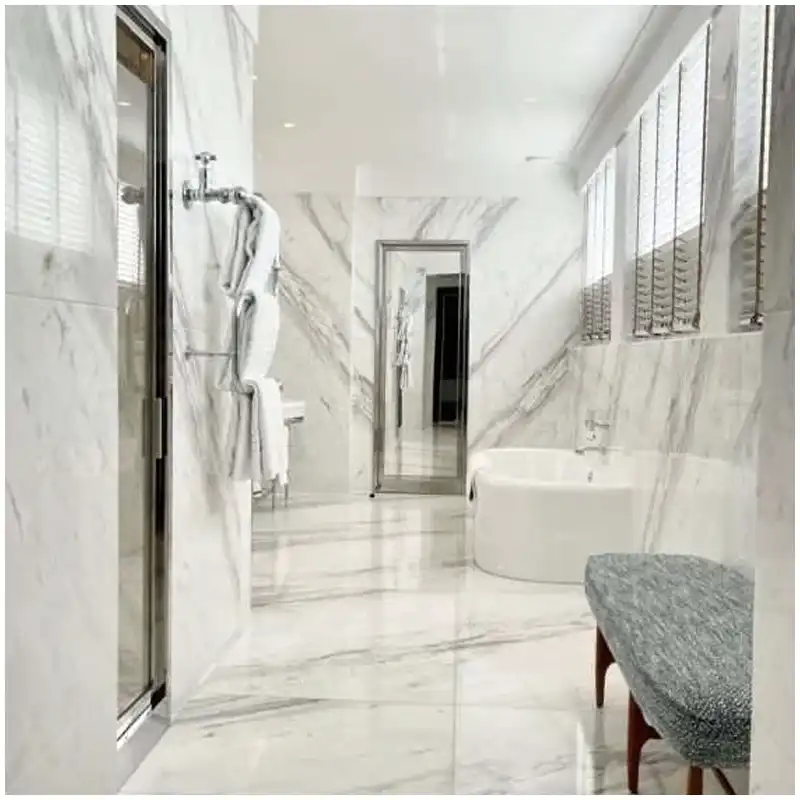
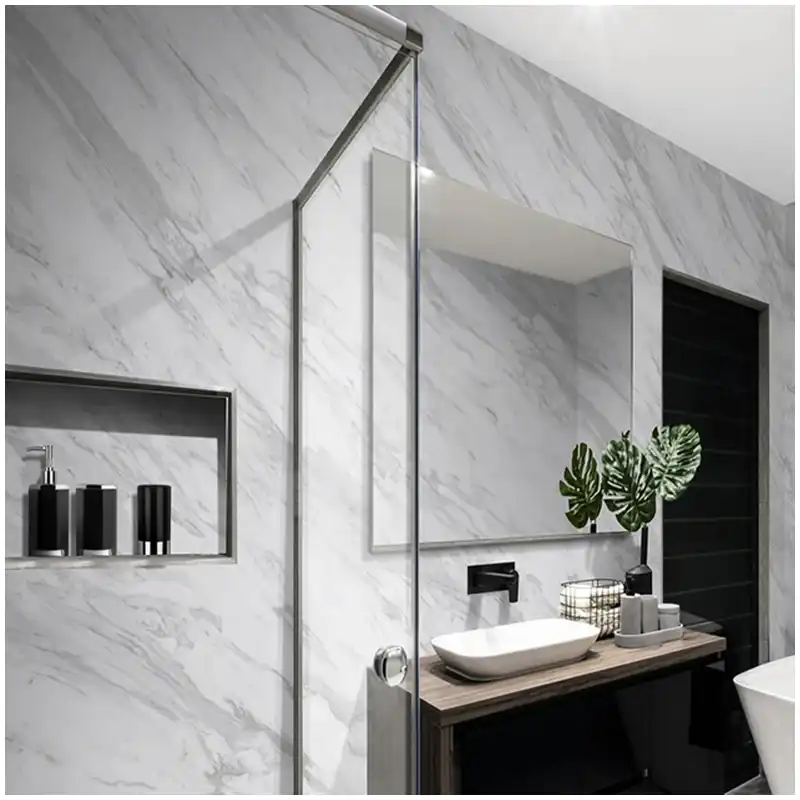
A white marble bathroom usually discovers its cleaning limit in the first weeks of use, not in the drawing review. Volakas marble maintenance samples fix that before handover: sealed and unsealed reference offcuts from the reserved lot, the approved cleaner written down with its dilution, dwell time, and neutral pH, and photographs of how water marks, soap film, and sealer haze appear on the pale field. The set also says what it cannot prove, so an absorbed or etched mark is not mistaken for ordinary residue. Esta Stone keeps the sample, the lot record, the room condition, and the release decision together so the maintenance team starts from a tested method rather than a guess.
A pale Volakas slab can look calm in a small cut and busy the moment it becomes a floor. The difference is the tile module, the joint grid, where the grey diagonal movement lands across the field, and how the drain cut interrupts it. Volakas marble shower floor work is decided while the pieces are still loose, not after the layout is fixed. Plan the heavy movement, hold back the cloudy zones, and photograph the field toward the drain. Esta Stone keeps the slab, the allocation and the bathroom record together.
A Volakas bathroom passes sealing at handover only when the evidence survives the last coat. Susan Zheng closes the room against a fixed file: the reserved lot and its installed finish and zones, the exact sealer product and batch, treated and bare reference offcuts, cure and release dates, the edges deliberately left unsealed, and the cleaning method handed to the maintenance team. The test method itself belongs to the sealer trial; this record is what protects the room after the crew leaves. Esta Stone signs Volakas marble sealing only when all seven entries match the stone that stays in the wall.
One Volakas lot carries quiet panels and active panels at the same time, and a single grout decision does not read the same on both. Susan Zheng matches Volakas marble grout color to the vein density of each field inside the reserved batch, because the joint that lets a quiet panel disappear can turn a cloudy panel into a grid. Esta Stone groups the panels before the joint tone is fixed and records which reading each field received, so the grout follows the stone instead of fighting it.
A single Volakas slab can look calm, but a hotel bathroom run exposes every difference in grey vein direction, white ground tone, cut order, and lighting. Volakas marble batch matching is the work of deciding which blocks and bundles can sit in the same room before the saw starts. I match the ground tone first, keep the reserved reference sample beside the lot record, and hold any bundle that reads outside the agreed span instead of pushing it into a repeat room. The full-slab photo set, the room-by-room dry-lay, and the stated lighting condition travel with that decision. Esta Stone ties slab approval, bundle continuity, dry-lay inspection, lighting checks, and final quality control into one white-marble decision.
A wall panel drawing rarely fails all at once. Volakas carries a pale field with grey movement running at an angle across the face, and that angle ignores where a joint is placed later. Volakas marble wall panels work best when the project drawing, the reserved lot, and the approved full-slab reference are read together before any panel is cut. Vertical joints, mirror lines, and fitting lines can all still move at that stage. I would rather settle the setout on paper and on the slab photograph than find it on a fixed wall. Esta Stone keeps the slab map, the numbered layout, and the fabrication record in one place.
A shower niche is small, wet, and placed close to the eye. Volakas marble niche shelves can look refined or immediately expose a wrong vein, a flat shelf, or an awkward edge. Esta Stone uses full-piece review, a slope check, and the actual bathroom light to settle those details before a wall panel is cut.
The floor-to-wall line is where a white-marble bathroom can either look deliberate or look patched together. Volakas marble skirting needs the same slab, light, joint, and vein review as the floor and wall above it. Esta Stone uses full pieces and a dry-lay to settle that narrow but highly visible transition before cutting starts.
A sink cutout removes the center of a slab crop and can leave a strong grey vein pointing into a tap hole, breaking across the front edge, or disappearing behind the basin. Susan Zheng checks the full slab with a scaled template before any vanity piece is nested. Esta Stone fixes the basin, faucet, backsplash, edge, joint, repair, and spare-piece relationship under both warehouse and bathroom light so the finished top reads deliberately rather than
A box label cannot tell you how grey veins will repeat across a bathroom floor or climb a wall. The sort starts at the slab face, because a diagonal line divided by the saw is never described by a size. Group the pieces by undertone first, then by vein weight and cloudy zones; reserve the calmest group for panels read at eye level; send heavier movement to long floor runs; keep one face lot per box; and hold any piece outside the written span. Esta Stone keeps each accepted group tied to face numbers, wall and floor allocation and spare stock so installation does not create a patchwork field.
A small Volakas sample may contain one thin grey line and a clean white field, while the production slab carries warmer clouds, broader veins, open features, or repaired areas outside that crop. Susan Zheng builds approval from square full-slab photographs, controlled lighting, slab identity, finish, repair maps, cut overlays, and dry-lay transitions. Esta Stone treats the sample as a color reference only; the complete face decides where the stone can be cut and installed. My warehouse rule is simple: Approve the visible crop after cutouts are drawn, not before.
Volakas marble vs Carrara is a full-slab decision. Both stones look pale on a sample, but their movement and white marble undertone behave differently under warm mirror light, neutral ceiling light, water, grout, and adjacent finishes. I compare the production range rather than ideal pieces, then check vein scale, finish, wet appearance, cutouts, dry-lay, and replacement control before either name is approved for repeated bathrooms. Esta Stone uses the room and the warehouse evidence together, so the batch you approve is the batch your bathroom receives.