


Quick Summary
Blue Louise Quartzite is an exotic Brazilian natural stone distinguished by its interwoven blue, turquoise, green, ivory and copper-colored mineral formations, creating large slab surfaces with a composition reminiscent of abstract landscape paintings. Its expressive coloration and quartz-rich character make it an attractive material for architectural feature walls, custom countertops, kitchen islands, decorative floors, reception areas and bespoke furniture. Unlike blue stones defined by a single directional vein system, Blue Louise presents irregular changes in color intensity and mineral scale, giving each slab an individual visual identity that can shape the architectural character of an entire interior.
Blue Louise Quartzite Slabs for Luxury Villas and Hotels Interior Designs
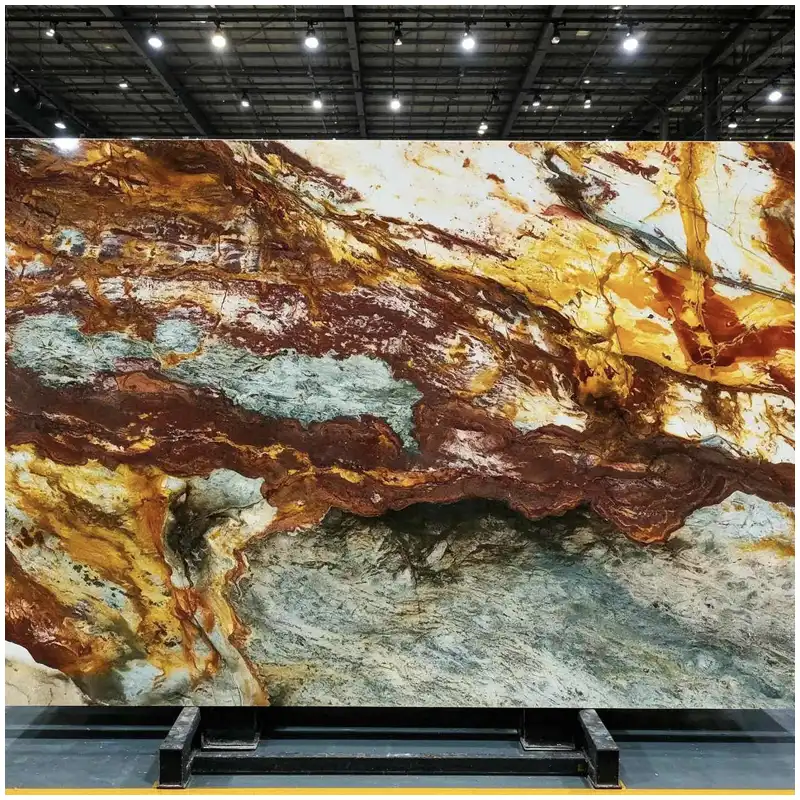
The appeal of Blue Louise lies in the interaction between several mineral colors within a single stone face. Broad blue-green areas are interrupted by pale crystalline formations, darker mineral boundaries and warmer copper or rust-colored movement. The resulting composition is considerably more complex than that of a uniformly blue decorative stone.
On an uncut slab, these formations can resemble overlapping brushstrokes, fragmented landscapes or layers of color moving across an abstract painting. Their scale and distribution give the material a different architectural role from conventional stones selected primarily for background color.
Blue Louise Quartzite Slabs are particularly valuable where the natural stone itself is intended to become a significant part of the interior design. A carefully positioned slab can establish the principal visual composition of a reception wall, living room or kitchen island without additional decorative materials competing for attention.
Unlike patterned manufactured surfaces, the composition cannot simply be reproduced across every supplied slab. Some faces may contain extensive blue and turquoise fields, while others display stronger warm mineral movement or broader ivory-colored interruptions.
For stone importers and architectural buyers, these differences create opportunities to develop distinct material selections within the same commercial stone family. A quieter slab may suit a coordinated interior package, while a more expressive face can be reserved for a principal decorative feature.
The value of the material is therefore closely connected to its individual slab character, rather than color classification alone.
Brazil Blue Louise Quartzite Product Specifications
| Название продукта | Blue Louise Quartzite Slabs |
| Коммерческий материал | Natural Brazil Blue Louise Quartzite |
| Alternative Trade Names | Azul Louise / Louise Blue Quartzite / Blue Luise Quartzite |
| Связанные коммерческие названия | Dunhuang Impression Quartzite / Van Gogh Quartzite; Material Identity by Confirmation |
| Классификация камней | Natural Exotic Quartzite; Petrographic Identity by Material Verification |
| Справка по происхождению | Brazil; Specific Source According to Material Documentation |
| Primary Colors | Ocean Blue / Turquoise / Blue-Green |
| Второстепенные цвета | Copper / Rust / Ivory / Grey / Dark Mineral Areas |
| Размеры плит | 304×203cm / 308×198cm / 306×197cm |
| Толщина | According to Current Slab Selection and Approved Specification |
| Featured Product Form | Brazil Blue Louise Quartzite Polished Slab |
| Отделка поверхности | Polished Featured; Honed or Other Finishes Subject to Processing Approval |
| Символ шаблона | Multicolored Mineral Fields, Irregular Veins and Contrasting Natural Formations |
| Bookmatch Selection | Subject to Suitable Consecutive Slab Availability |
| Fabricated Forms | Full Slabs / Wall Panels / Countertops / Islands / Tiles / Furniture Components |
| Приложения | Villas / Mansions / Hotels / Luxury Apartments / Architectural and Commercial Interiors |
The featured large slab formats allow substantial portions of the original mineral composition to be retained in finished architectural panels and countertops. Actual usable dimensions, thickness and the position of unsuitable cutting areas should be confirmed during slab selection.
Azul Louise and the Geological Character Behind Its Multicolored Appearance
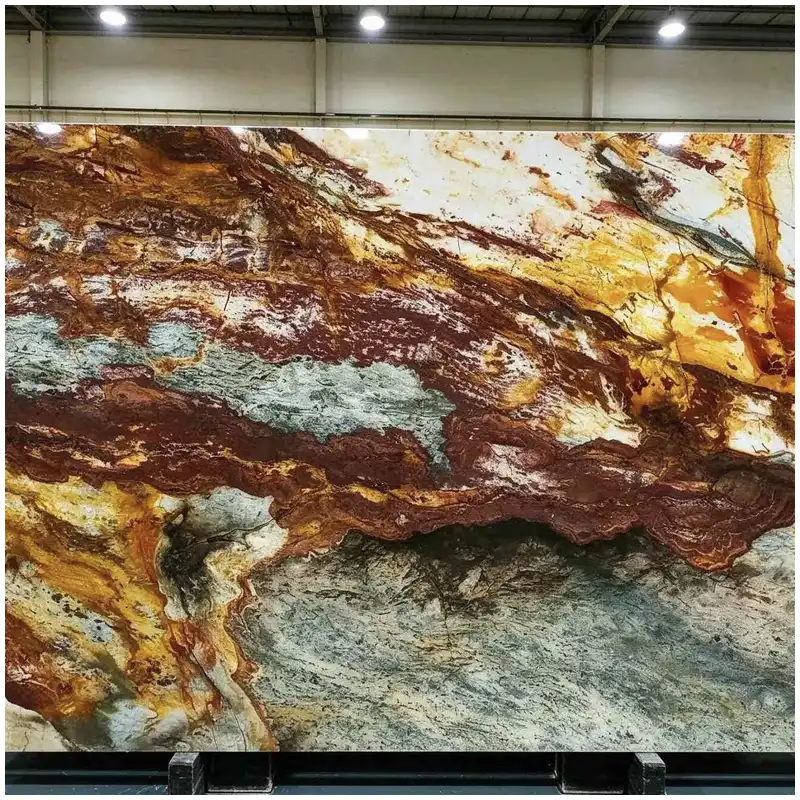
Quartzite develops through the geological transformation of quartz-rich rocks under heat and pressure. Recrystallization can create a tightly intergrown mineral structure, although the precise composition and mechanical characteristics vary between natural stone deposits.
The commercial material known as Azul Louise contains visually distinct mineral regions rather than a single homogeneous background. Changes in mineral concentration, geological deformation and accessory mineral content contribute to its complex appearance.
The warmer brown and copper-toned areas may be associated with iron-bearing minerals or related natural coloration. The presence of blue and green regions, however, does not by itself identify a specific mineral species.
Attributing every blue formation to one mineral without petrographic evidence can lead to an inaccurate description of the material. Commercially similar blue stones may contain substantially different mineral assemblages.
This geological variability also has practical implications. A quartz-rich crystalline region may respond differently during polishing and edge machining from an adjacent mineral-rich band. Processing behavior should be assessed across the whole stone face rather than inferred solely from its general quartzite classification.
The polished surface brings these differences into sharper visual focus. Reflections reveal the transition between darker mineral areas, pale crystalline formations and more saturated blue-green fields.
For buyers accustomed to selecting ordinary granite or relatively consistent quartzite, Blue Louise requires closer attention to the individual mineral composition of each slab.
Louise Blue Quartzite, Dunhuang Impression Quartzite and Van Gogh Quartzite
Exotic Brazilian stones frequently acquire different commercial names as they move between quarry operators, slab processors, international distributors and regional stone markets. A particular name may emphasize the predominant color, the appearance of the mineral formations or a visual association with art.
Blue Louise is one example where several related sourcing terms can appear in international purchasing inquiries.
| Коммерческое название | Market Association | Purchasing Consideration |
|---|---|---|
| Blue Louise Quartzite | Principal international commercial name for the featured Brazilian stone | Confirm actual slab composition and source documentation |
| Azul Louise | Portuguese-influenced commercial naming | Compare the current slab photographs rather than relying on spelling differences |
| Louise Blue Quartzite | Alternative English-language sourcing name | Establish the required blue, turquoise and warm mineral distribution |
| Dunhuang Impression Quartzite | Art-inspired name associated with selected Louise-type commercial materials | Verify whether the requested selection corresponds to Blue Louise or a related variation |
| Van Gogh Quartzite | Painting-inspired commercial designation used for expressive Brazilian stones | Do not assume that every Van Gogh selection has the same quarry identity or physical properties |
Buyers searching for Dunhuang Impression Quartzite или Van Gogh Quartzite may be looking for a particular combination of blue, turquoise, cream and warmer mineral colors rather than an identical geological material.
For accurate international sourcing, the approved slab references should take precedence over alternative commercial names. Where quarry identity is important, obtain appropriate source documentation before establishing the purchase specification.
Selecting Blue Louise Quartzite as a Natural Artistic Composition
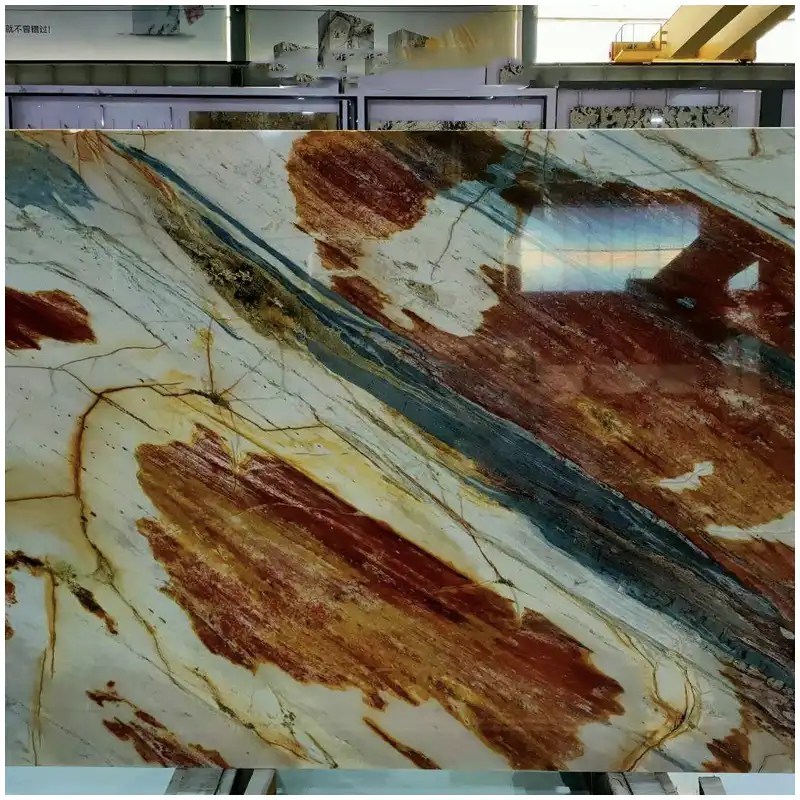
Selecting an expressive quartzite slab involves a different visual process from choosing a relatively consistent beige or white stone. The purchaser must consider the relationship between several mineral regions and how those regions will appear after fabrication.
A useful starting point is identifying the visual center of the slab. This may be a concentrated turquoise formation, a sweeping blue mineral field or a striking transition between pale and copper-colored areas.
The finished composition changes according to where this visual center is positioned. On a reception wall, it may be appropriate to place the strongest mineral formation near the principal viewing axis. On a kitchen island, a less central placement may preserve the composition when sinks, appliances or decorative objects interrupt the surface.
Color balance also matters. A slab containing extensive warm mineral areas may read as predominantly copper-colored after cutting, even though its original commercial classification is blue quartzite.
For interiors with several Blue Louise components, a single preferred slab is not enough to establish the complete material palette. Adjacent wall panels, horizontal surfaces and furniture inserts should be selected according to their intended visual roles.
A representative sample can establish general color and finish, but it cannot communicate the large-scale mineral composition of a complete Blue Louise slab.
Full-face photographs are therefore essential when the stone is expected to function as an integrated architectural artwork rather than a conventional background surface.
Blue Louise Quartzite Selection Guide for Different Interior Palettes
The following visual categories provide a practical way to communicate material preferences during slab procurement. They are project-specific selection descriptions, not standardized quarry grades.
| Selection Direction | Visual Composition | Architectural Positioning |
|---|---|---|
| Blue-Dominant Selection | Extensive ocean-blue and deeper blue-green mineral areas | Cool architectural palettes, contemporary walls and monochromatic interiors |
| Turquoise-Green Selection | More pronounced turquoise and green mineral movement | Interiors combining timber, vegetation-inspired colors and natural textures |
| Copper-Accented Selection | Strong warm mineral formations contrasting with the blue background | Artistic reception features, bronze-accented interiors and statement furniture |
| High-Contrast Selection | Clearly defined transitions between pale, blue and darker mineral regions | Large feature walls and individually specified decorative stone compositions |
| Balanced Multicolor Selection | Relatively distributed blue, green, ivory and warm mineral formations | Coordinated architectural stone packages across several interior areas |
A high-contrast slab is not inherently superior to a quieter selection. Its commercial value depends on whether the mineral composition supports the intended architectural design.
For larger orders, establish the acceptable color range using several representative faces. This provides a more realistic purchasing standard than requiring every slab to reproduce the appearance of one exceptional piece.
Bookmatching and Mineral Continuity Across Blue Louise Quartzite Panels
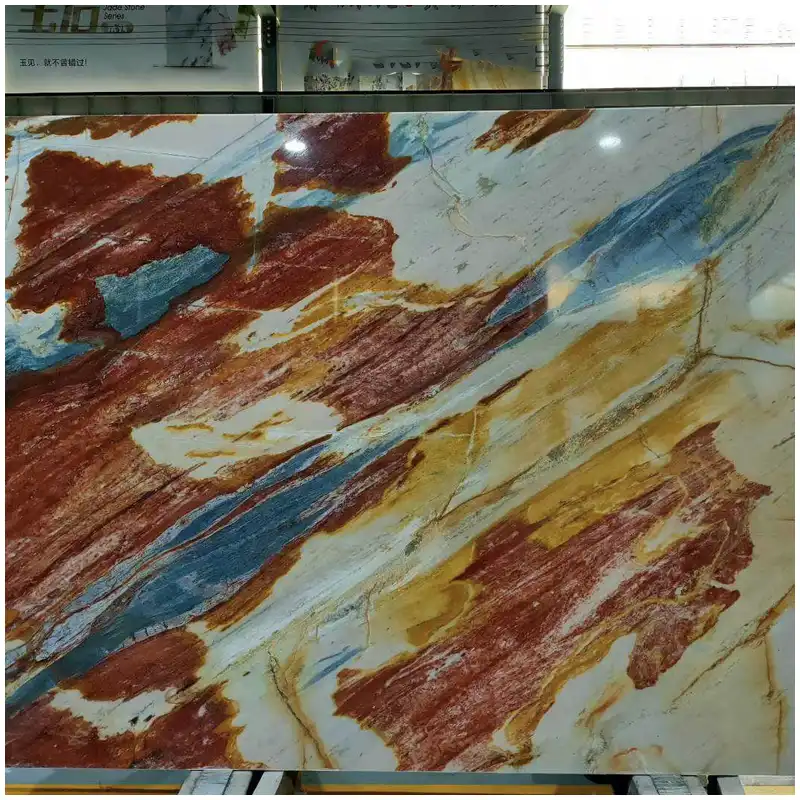
Bookmatching can create a striking composition when two suitable consecutive slabs are opened in a mirrored arrangement. With Blue Louise, the result may resemble a symmetrical landscape or an abstract mineral formation extending outward from a central joint.
The effectiveness of this approach depends on actual slab sequence, surface orientation and mineral continuity. Independently sourced slabs cannot be expected to produce a convincing mirrored composition simply because they share a commercial name.
Even consecutive stone faces may contain changes in mineral shape, color intensity or discontinuities caused by the internal geological structure of the block. The proposed arrangement needs to be reviewed as a complete elevation before fabrication.
Mirrored layouts are not the only suitable option. A sequential arrangement can preserve the natural progression between related slabs without introducing a deliberately symmetrical pattern.
This approach can be more appropriate for wide contemporary interiors where the desired effect is a continuous field of irregular mineral movement rather than a centered decorative motif.
For kitchen islands and other three-dimensional stone components, the visual arrangement must also account for corners and changes of plane. A mineral formation that appears continuous across a flat drawing may become fragmented when divided between a horizontal top and vertical waterfall panels.
Pattern continuity should therefore be evaluated using the selected slab sequence and actual finished geometry, with no assumption that perfect bookmatching is available from every material lot.
Polished Blue Louise Quartzite and the Interaction Between Color and Light
Polishing is particularly effective on expressive multicolored quartzite because the finish brings individual mineral boundaries into focus. Blue and turquoise fields may appear richer, while pale crystalline areas introduce contrasting reflections.
The appearance of a polished stone is not independent of its surroundings. A slab installed opposite a large window may reflect substantial daylight, temporarily reducing the visibility of some mineral details. Artificial spotlights can produce a similar effect when concentrated on one region of the wall.
For vertical architectural installations, broad and relatively even illumination can preserve the overall mineral composition more effectively than a series of intense isolated reflections. Grazing light may instead emphasize surface workmanship and joint alignment.
Different surface finishes also influence the decorative character of Louise Blue Quartzite.
| Отделка | Material Appearance | Specification Consideration |
|---|---|---|
| Полированный | Pronounced mineral contrast and reflective crystalline depth | Gloss consistency, reflected light and edge finish quality |
| Honed | Reduced reflection and softer transitions between mineral colors | Actual sample appearance, cleaning and surface uniformity |
| Leathered or Textured | Potential tactile variation between differently responding mineral regions | Processing feasibility, localized relief and intended application |
Polished slabs represent the featured supply direction. Alternative finishes should be evaluated on the actual material because the relative hardness and processing behavior of adjacent mineral regions may affect the final texture.
A finish selected from a different quartzite variety should not be assumed to produce an identical result on Blue Louise.
Blue Louise Quartzite Villa Feature Walls and Architectural Art Surfaces
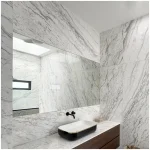
The following villa application reference demonstrates how the complex mineral composition of Blue Louise can become the principal decorative surface within a contemporary architectural interior.
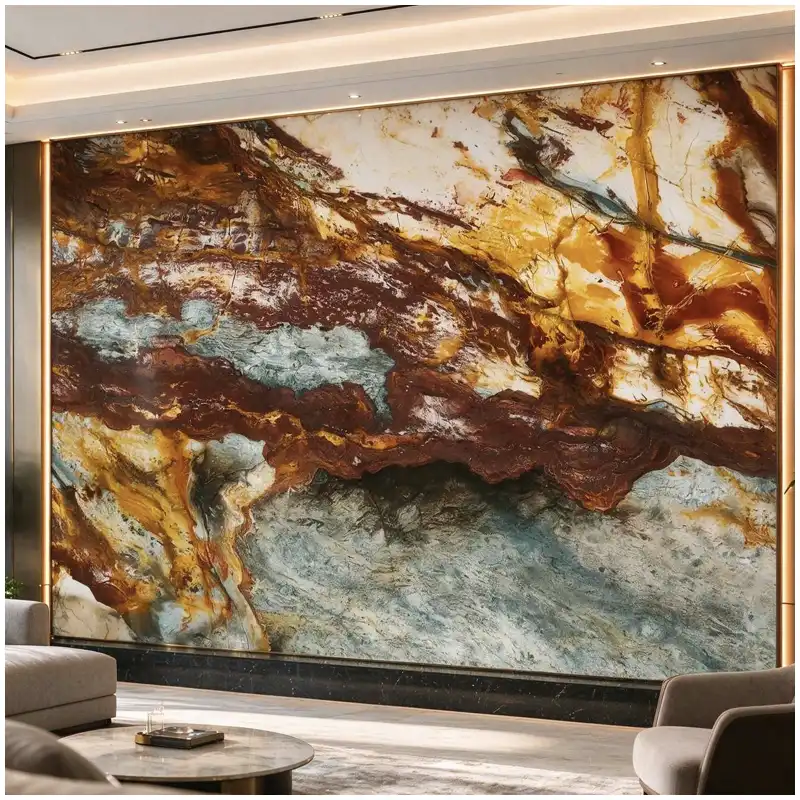
A feature wall composed of expressive natural quartzite has a different decorative purpose from an ordinary cladding surface. Its mineral composition can establish the focal point of the room, allowing adjacent materials to remain relatively quiet.
In a villa entrance or formal reception area, the principal blue-green formation can be positioned to correspond with the main viewing direction. This is particularly relevant where visitors first encounter the wall through a doorway or along an architectural circulation axis.
Door openings, recessed niches and wall-mounted equipment can interrupt the natural composition. Where possible, these elements should be coordinated with quieter mineral areas rather than cutting directly through the most distinctive section of the stone.
A deliberately restrained joint arrangement can help retain the impression of a large natural artwork. Nevertheless, joints must accommodate the actual cladding system, fabrication tolerances and applicable movement requirements.
Large quartzite panels also require an approved attachment design. Substrate stability, stone condition, panel weight, fixing geometry and the relevant structural requirements must be evaluated for the completed wall assembly.
The application image illustrates an architectural design direction; it does not establish a verified fixing system, panel thickness or engineering performance for a new installation.
Blue Louise Quartzite in Mansion Living Rooms and Double-Height Interiors
Large residential interiors provide an opportunity to appreciate the broader mineral scale of Blue Louise Quartzite, particularly where an expansive wall can retain the relationship between multiple color regions.

Establishing a Visual Hierarchy Within the Room
A dramatic quartzite elevation is often most successful when surrounding architectural finishes do not compete with its natural composition. Restrained plaster, quiet timber grain and neutral upholstery allow the blue and copper-colored formations to remain the principal visual element.
Where several decorative stones are used in one mansion, Blue Louise can occupy the primary reception or living room wall, while calmer materials connect adjacent circulation areas and secondary rooms.
Relating Mineral Scale to Viewing Distance
A large mineral formation that appears overwhelming in a small sample photograph may be appropriately proportioned when viewed across a spacious living room. Conversely, subtle details appreciated at close range may become less significant on an elevated or double-height wall.
The complete wall composition should be evaluated from the expected viewing positions, including seating areas, entrances and upper-level circulation spaces where relevant.
Coordinating Stone with Metal, Timber and Lighting Details
Brushed bronze and warm timber can relate to the copper-colored regions of Blue Louise, while stainless steel, charcoal and cooler neutral finishes emphasize its blue-green character.
The strongest material combinations are established using the actual selected stone face. A generic blue color sample is insufficient when the quartzite contains several prominent secondary colors.
Blue Louise Quartzite Countertops, Islands and Bespoke Stonework
Although large decorative walls reveal the full artistic composition of Blue Louise, the material can also be evaluated for functional architectural surfaces. Quartz-rich stone generally offers useful abrasion resistance and mechanical performance, subject to the characteristics of the actual supplied material.
Kitchen Islands and Countertops
A Blue Louise kitchen island introduces several mineral colors into a single furniture-like architectural element. Cabinet finishes can be selected to relate to either the dominant blue background or the warmer secondary formations.
Sink and cooktop openings deserve particular attention. The selected cutting arrangement should avoid vulnerable natural discontinuities where possible and preserve sufficient supported stone around openings. The location of an opening can also determine whether an important mineral feature remains visible after installation.
Hotel Reception Desks and Decorative Bars
Vertical counter fronts allow substantial mineral formations to remain visible without being obscured by objects placed on the working surface. Related stone areas may be used for horizontal tops, side panels and adjacent decorative walls.
For public environments, exposed edges, impact-prone corners and maintenance requirements should be reviewed alongside the intended decorative effect.
Custom Furniture and Bathroom Stonework
Smaller stone components provide a way to isolate individual blue, green or contrasting warm mineral formations. Coffee tables, console tops, decorative inserts and vanity surfaces can each express a different part of the original slab composition.
The suitability of these components depends on material condition, supporting construction, edge geometry and expected service conditions. Decorative appearance should not be used as a substitute for finished-product assessment.
Architectural Applications and Specification Priorities
| Приложение | Architectural Value | Technical Priority |
|---|---|---|
| Декоративные стены для виллы | Large natural mineral compositions as permanent interior artworks | Slab positioning, attachment system and visible joint treatment |
| Кухонные острова | Multicolored statement surfaces within coordinated cabinetry | Cutouts, structural support and edge construction |
| Luxury Bathrooms | Decorative vanity tops and expressive wall panels | Water management, basin details and compatible installation materials |
| Hotel Reception Areas | Distinctive architectural identity for arrival and reception spaces | Panel coordination, impact exposure and maintenance access |
| Decorative Flooring | Mineral-rich floor fields, borders and architectural inserts | Abrasion resistance, slip performance and substrate support |
| Лестницы | Coordinated stair components with individual natural patterns | Tread support, nosing geometry and pedestrian traction |
| Custom Furniture | Individual tabletops and decorative stone furniture components | Furniture stability, exposed edges and connection details |
Exterior cladding, permanently wet installations and demanding commercial flooring require additional application-specific testing and construction review. The commercial classification of a stone as quartzite does not independently establish suitability for every environmental condition.
Blue Louise Quartzite Physical Properties and Technical Performance
The technical characteristics of Blue Louise Quartzite are relevant to both natural stone fabrication and its final architectural application. However, heterogeneous mineral distribution means that performance should be assessed using representative specimens rather than assuming every visible region behaves identically.
The following figures are published reference ranges for commercially identified Blue Louise Quartzite. They are indicative material data and are not certified laboratory results for the current Esta Stone slab lot.
| Физические свойства | Справочное значение | Relevant Assessment Method |
|---|---|---|
| Насыпная плотность | 2,760–2,924kg/m³ | EN 1936 / ASTM C97/C97M |
| Поглощение воды | 0.17–0.36% | EN 13755 / ASTM C97/C97M |
| Compressive Strength | 207–254MPa | EN 1926 / ASTM C170/C170M |
| Flexural Strength | 14.91–21.78MPa | EN 12372 / ASTM C880/C880M |
| Mineral Hardness | Quartz: Mohs 7; Mineral Reference Only | Mineral Identification and Scratch Assessment |
| Петрографическая классификация | By Representative Material Examination | EN 12407 |
| Abrasion Resistance | By Application-Specific Testing | EN 14157 / ASTM C1353 |
| Slip Resistance | Dependent on Actual Surface Finish | Applicable Finish-Specific Slip Test |
Technical data clarification: The values above represent reference material ranges rather than guaranteed properties of the featured slabs. The associated assessment methods identify relevant testing options and do not establish which methods were used to generate the original reference figures.
Mechanical Strength and Finished Component Design
The published compressive-strength range indicates substantial resistance to crushing under the conditions represented by the reference data. It should not, however, be used directly to determine countertop overhangs or the safe attachment of large wall panels.
Flexural behavior, natural discontinuities, attachment details and support conditions are more directly relevant where the finished stone experiences bending or concentrated loads.
Absorption and Surface Protection
Relatively low water absorption can be beneficial for interior stone applications, but it does not establish complete resistance to staining. Local mineral boundaries, existing resin treatments and the finished surface condition may influence liquid penetration.
Where formal project compliance is required, obtain representative test reports for the actual material and establish the applicable requirements for quartz-based dimension stone and its finished construction.
Fabrication Challenges in Multicolored Brazilian Exotic Quartzite
Blue Louise should be approached as a heterogeneous natural material during processing. The same characteristics that create its decorative appeal can also introduce variations in machining behavior across individual stone faces.
Mineral Transitions and Exposed Edges
A finished edge may cross several mineral regions over a relatively short distance. Differences in local hardness, crystal structure or previous repairs can affect edge consistency and polishing response.
A carefully finished countertop or tabletop should retain a continuous edge profile without unacceptable chipping, abrupt machining marks or visually disruptive filler at these transitions.
Natural Discontinuities and Reinforcement
Dark or light mineral boundaries are not automatically structural defects. Conversely, a visually attractive region is not necessarily free from fractures or previously stabilized areas.
Existing backing mesh, resin treatments and repaired sections should be inspected in relation to the intended fabrication. A reinforced slab still requires appropriate support and material assessment when used for a finished architectural component.
Color Compatibility of Joint Materials
One universal joint color may not be appropriate for every region of Blue Louise. A filler matched to a deep blue mineral area can appear conspicuous when the same joint passes through a pale crystalline formation.
Joint appearance should be established using the actual adjoining stone edges. Where appropriate, representative seam samples can help determine the acceptable treatment before full-scale fabrication.
Professional processing must also include suitable crystalline silica dust controls. Quartz-rich stone should not be dry-cut or ground without the required occupational exposure protections.
Commercial Slab Grading and Batch Allocation for Blue Louise Quartzite
Exotic quartzite procurement often involves balancing individual slab value with the visual requirements of a larger architectural package. Rejecting every piece that differs from a preferred photograph can unnecessarily restrict material availability.
A more practical approach is to divide the intended project into visual priority zones. Principal feature walls may require the most expressive and closely coordinated material, while smaller architectural components can use related selections with a broader range of mineral variation.
The purchasing specification should distinguish acceptable natural variation from unacceptable departures in material identity, color distribution or workmanship. These are different acceptance issues and should not be grouped under a vague requirement for premium quality.
For distributors, maintaining photographs of individual slab faces creates a useful commercial record. Customers selecting high-value exotic quartzite can then evaluate the actual available material rather than relying exclusively on a representative catalog image.
Projects requiring later replacement pieces should also consider retaining suitable reserve material. A future shipment may reproduce the general Blue Louise color family without matching the original composition closely enough for a prominent architectural repair.
The objective is a coordinated material package with clearly defined visual tolerances, not artificial uniformity across naturally different stone faces.
Quality Inspection and Production Release for Blue Louise Quartzite Slabs
An inspection schedule for expressive quartzite should address the accepted mineral composition, actual stone condition and the workmanship required for its final application.
| Material Identification | Record the approved commercial material, slab references, source documentation and production lot. |
| Full-Face Appearance | Inspect dominant blue-green areas, warm mineral concentrations and the accepted range of natural variation. |
| Slab Sequence Verification | Check consecutive slab identity and surface orientation where bookmatching or sequential layouts are specified. |
| Material Condition | Identify open fractures, potentially unstable mineral regions, repairs and areas excluded from fabrication. |
| Polished Surface Quality | Assess machining marks, scratches, localized surface relief and acceptable finish consistency. |
| Dimensional Inspection | Verify actual slab thickness, finished dimensions and applicable tolerances against the approved specification. |
| Edge and Joint Workmanship | Inspect exposed mineral transitions, edge profiles, seam appearance and finished corner condition. |
| Architectural Dry-Lay | Arrange related panels where specified to verify the approved visual composition and installation sequence. |
| Final Production Release | Review approved quantities, inspection records, finished component identification and unresolved acceptance issues. |
For custom architectural orders, any necessary adjustments to slab allocation should be reviewed before irreversible cutting begins. Replacing one piece after fabrication may disturb the composition of several related components.
Export Packing and Preservation of Approved Slab Sequences
The packing arrangement for high-value exotic quartzite must protect both the physical stone and its established material identity. Consecutive slabs intended for a coordinated feature wall have limited replacement flexibility if they are damaged or incorrectly separated.
Full slabs require suitable transport support, protective separation and restraint according to their actual condition and measured weight. Finished stone panels and countertop pieces require protection suited to their individual geometry.
Polished faces should remain protected against abrasive contamination and uncontrolled stone-to-stone contact. Machined edges, miters and narrow components need particular protection from concentrated pressure during handling.
For sequential or bookmatched stone packages, slab and component identification should correspond with the approved layout references. Crate labels and packing documents should allow the destination team to locate related pieces without unnecessary unpacking and rearrangement.
Shipment planning must use actual package dimensions, gross weights, unloading arrangements and suitable transport restraints. Wooden export packaging should comply with applicable destination-market phytosanitary requirements.
Maintaining the Mineral Color and Surface Quality of Blue Louise Quartzite
The maintenance of exotic quartzite should account for its complete mineral composition, surface treatments and installation environment rather than relying on the general hardness of quartz alone.
Routine cleaning is best performed with a soft cloth and a compatible pH-neutral natural stone cleaner. Abrasive pads and aggressive chemical treatments may affect polished surfaces, accessory minerals or existing resin repairs.
For kitchen islands and countertops, use cutting boards, trivets and protective mats. High mineral hardness does not make an assembled natural stone countertop immune to scratching, impact damage or localized thermal stress.
Where an impregnating treatment is appropriate, the stone should be sufficiently dry before application. Test the selected product on representative material to assess potential changes in blue-green color intensity and surface appearance.
Some mineral regions may respond differently to prolonged moisture exposure. Unexpected discoloration should be investigated for its underlying cause rather than immediately treated with stronger cleaning chemicals.
For extensive polished feature walls, routine removal of dust and fingerprints helps preserve the mineral composition without introducing unnecessary polishing compounds or incompatible surface treatments.
Frequently Asked Questions About Blue Louise Quartzite
Is Blue Louise Quartzite the same as Azul Louise and Van Gogh Quartzite?
Azul Louise and Louise Blue Quartzite are commonly associated with the Blue Louise commercial stone family. Van Gogh Quartzite is also used for related expressive Brazilian materials, but the name does not guarantee an identical quarry source or mineral composition. Actual slab photographs and material documentation should establish the selected stone identity.
Why do Blue Louise Quartzite Slabs contain both blue and copper-colored areas?
The contrasting colors result from natural differences in mineral composition, mineral distribution and geological processes. Warm coloration may be associated with iron-bearing minerals, while the exact identity of the blue and green mineral regions requires representative material examination.
Can Brazil Blue Louise Quartzite be used for kitchen countertops?
Suitable Blue Louise Quartzite selections can be fabricated into kitchen countertops and islands. The proposed application should account for actual material condition, cutout geometry, support requirements, edge construction and surface maintenance. Representative material testing may be required for formal project specifications.
Are bookmatched Blue Louise Quartzite Slabs available?
Bookmatching depends on the availability of suitable consecutive slabs and their actual mineral continuity. The proposed mirrored arrangement should be reviewed using current slab photographs and layout drawings. Independently sourced slabs with the same commercial name cannot be assumed to produce a matching composition.
Is Dunhuang Impression Quartzite a standardized material grade?
Dunhuang Impression Quartzite is an art-inspired commercial designation associated with selected Louise-type natural stones. It is not a standardized geological or technical quality grade. Buyers should confirm the intended mineral appearance, stone identity and relevant physical properties before ordering.
What information is required for a Blue Louise Quartzite wholesale quotation?
Provide the required slab or finished component dimensions, thickness, quantity, surface finish, preferred mineral composition and delivery destination. For architectural walls, countertops or bookmatched installations, include the relevant layout drawings, joint details, fabrication requirements and any specified material testing or inspection criteria.
Final Note: Preserving the Artistic Identity of Blue Louise Quartzite
Blue Louise Quartzite occupies a distinctive position among Brazilian exotic stones because its architectural identity depends on the relationship between several mineral colors rather than a single dominant background. The most successful specifications preserve that individuality while establishing realistic standards for material condition, fabrication and finished workmanship. Whether supplied as full slabs, decorative wall panels or custom countertops, the selected stone should retain a coherent natural composition that contributes directly to the character of the finished architecture.
Blue Louise Quartzite Compared with Four Brazilian Exotic Stone Selections
Exotic natural stones differ in the way their mineral formations interact with architectural scale, lighting and surrounding materials. The following comparison distinguishes Blue Louise from four alternative stone selections without assuming equivalent geological composition or technical performance.
| Продукт | Mineral Appearance | Направление дизайна | Приоритет выбора |
|---|---|---|---|
| Blue Louise Quartzite Slabs | Blue, turquoise, green, copper and ivory mineral formations | Artistic walls, statement islands and expressive architectural interiors | Color balance, visual composition and mineral continuity |
| Brazil Pandora Quartzite Slab | Pale crystalline regions with contrasting darker mineral formations | Statement countertops, crystalline walls and selected illuminated features | Crystal distribution, material condition and actual light transmission |
| Зелёный кварцит «Амазонит» | Turquoise-green mineral areas with contrasting natural inclusions | Green statement walls, decorative islands and custom interiors | Mineral identity, green-tone distribution and optical characteristics |
| Плита кварцита Macaubas Azul | Blue and pale mineral formations with pronounced directional movement | Linear architectural walls, countertops and coordinated blue interiors | Vein direction, blue shade consistency and panel alignment |
| Кварцит Perla Santana | Lighter pearl-toned background with natural mineral movement | Coordinated luxury interiors and relatively restrained stone surfaces | Background tone, mineral variation and finish consistency |
Recommended Brazilian Exotic Quartzite Slabs
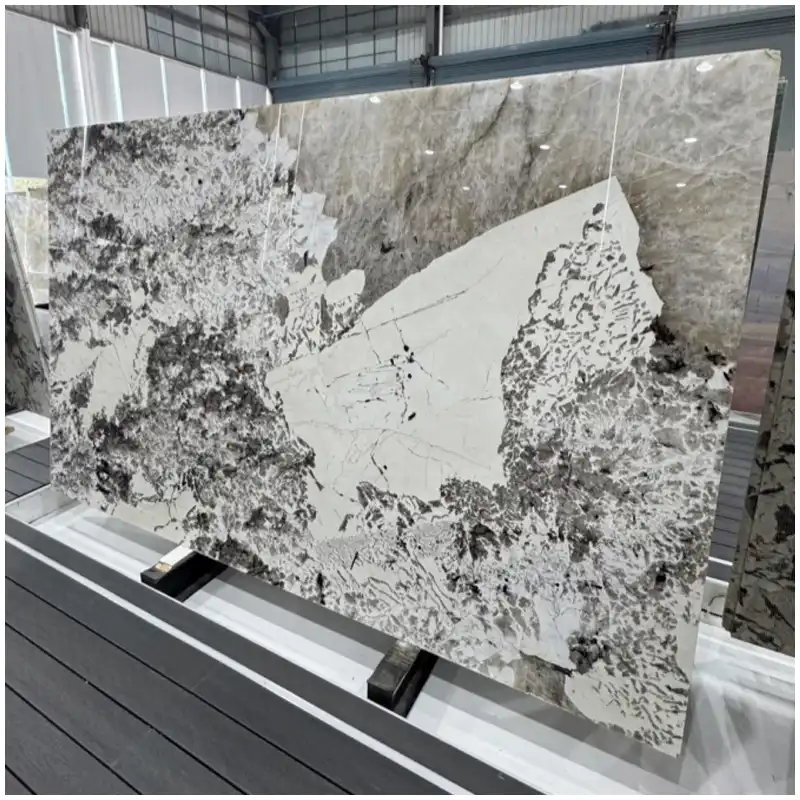
Brazil Pandora Quartzite Slab
Expressive crystalline quartzite with contrasting mineral formations for decorative walls, statement kitchen islands and selected illuminated architectural stone applications.
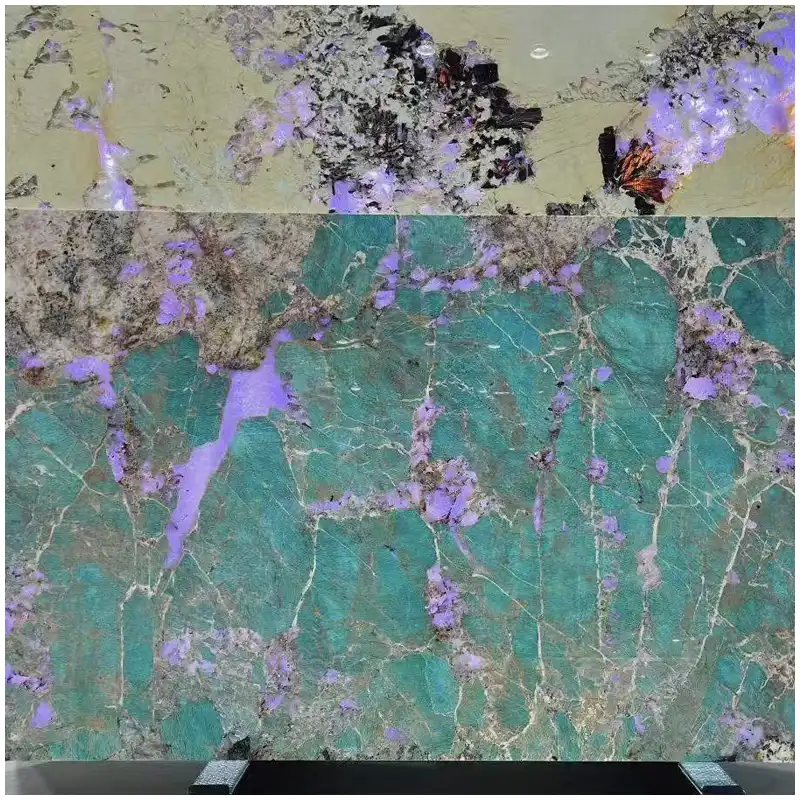
Зелёный кварцит «Амазонит»
Distinctive turquoise-green decorative stone for feature walls, bespoke countertops and mineral-rich interiors with a stronger emphasis on natural green coloration.
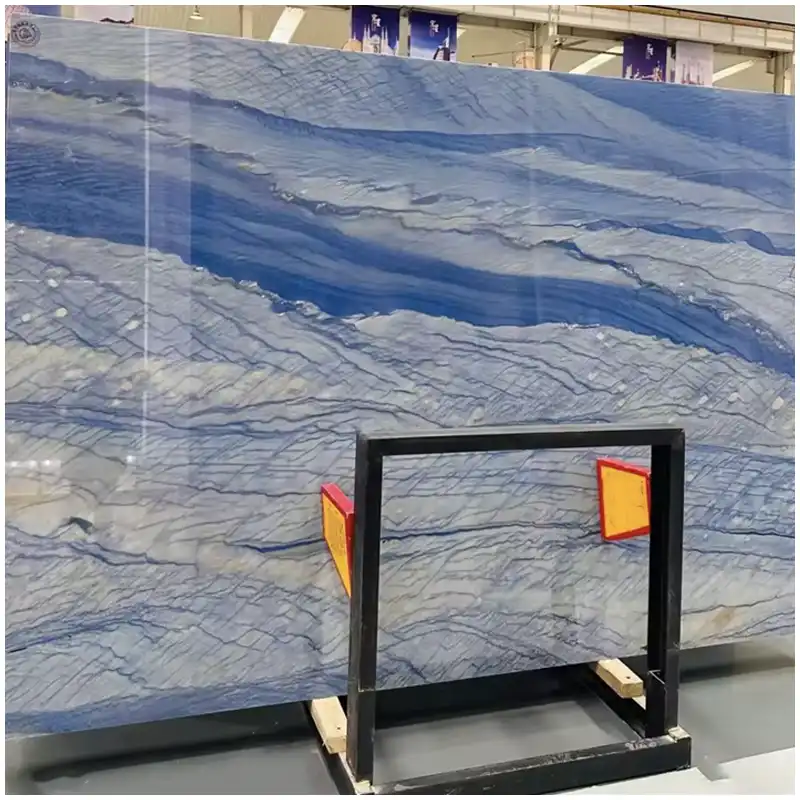
Плита кварцита Macaubas Azul
Directional blue quartzite with flowing mineral lines for coordinated architectural panels, contemporary countertops and interiors requiring a more linear stone composition.

Кварцит Perla Santana
Pearl-toned exotic quartzite for coordinated countertops, decorative walls and architectural interiors requiring a lighter natural stone palette with distinctive mineral movement.
Request Blue Louise Quartzite Slabs for Your Architectural Project
For a Blue Louise Quartzite quotation, provide the required quantity, slab or finished component dimensions, thickness, surface finish, preferred blue-green and copper mineral composition, and delivery destination. Feature-wall and bookmatch inquiries should include the proposed architectural elevations and panel sequence. Countertop and custom stonework orders should include fabrication drawings, edge profiles, openings and supporting construction details. Esta Stone can review the selected Brazilian quartzite faces against your material preferences and project requirements before establishing the supply and fabrication scope.