Опыт и качество мрамора, гранита, кварцита класса люкс, кварцевого завода в Китае
Профессиональная белая мраморная плитка и искусственный мрамор Производитель

White Marble in Minimalist Design: Calm 2026 Slab Selection

Категории

Свяжитесь с нами

White Marble in Minimalist Design: Calm 2026 Slab Selection

Quick Summary: White marble in minimalist design is decided before installation: the batch holds one base tone across the run, the stone is approved under the light recorded for the room, and the vein density is scaled to the space. Each check lands on the delivered run before release for cutting.

White Marble in Minimalist Design: Calm 2026 Slab Selection

The emptier the room, the more the stone surface has to do. A minimalist space reduced to one material field has no rug, panelling or cabinetry to hide a board that sits half a shade off, so every slab in the sightline performs the job of the whole decoration. When white marble in minimalist design fails, the failure usually starts at selection: a batch approved one photograph at a time, a tone chosen under showroom light, a board picked for a wall meant to recede.

That is why a minimalist order is a selection problem before it becomes a style statement. Four decisions fix the outcome before fabrication: whether the batch holds one base tone, whether the stone is approved under the light the room will use, whether the vein density suits the amount of pattern each plane can hold, and whether the delivered slabs confirm the photographs. No white marble in minimalist design order should reach the saw until the run itself has answered those four questions.

Table of Contents

Why White Marble in Minimalist Design Is Decided at Slab Selection

Minimalism is often described as less; in practice it means fewer elements with each one doing more work. The marble field is one of those few elements, and in a room without pattern the eye stops on every joint, tone step and vein, so white marble in minimalist design is a QC problem before a decoration problem: the surface either holds as one calm field or reads slightly off.

Three attributes decide the outcome and none of them travel well in a photograph: base tone across the batch, the light the stone will be read under, and vein density. The Marble Slabs Procurement Guide 2026 documents the full order cycle, and the slab selection stage for white marble in minimalist design sits inside that cycle.

The Slab Checks on a Minimalist White Marble Order

When a buyer asks to hold white marble in minimalist design, four checks run in a fixed sequence, because each one changes what the next can show. The sequence is the same whether the stone becomes a floor, a fireplace surround or a bathroom wall, and a fabricator or contractor can run it with the supplier. Compare the boards against the options in the marble stone category as much as against the project drawing, because the drawing fixes the layout while the category shows what is available.

Batch Base Tone: Buy the Group, Not the Board

“White” does too much work as a word. Stand ten white slabs in a row and the range appears: cream whites, grey whites, lilac-tinted whites. That difference is the base tone, and it comes from the block each slab was sawn from; slabs from one block group usually sit close, while slabs from different blocks under the same quarry name can sit far apart, because marble stone is a natural material and a quarry face changes as it deepens. For white marble in minimalist design the tone is the first risk: the style works only when the eye crosses wall to floor without interruption, and one cream piece meeting a grey piece draws a line no designer planned. The question is not whether two photographs show the same stone; it is whether every board in one sightline belongs together, so the order is held within one block group and whole-face photographs taken the same day under one light are compared, judging backgrounds, not veins, from standing distance.

Light Color Temperature: Approve under the Light the Room Will Use

The stone does not change colour; the light changes how the eye reads it, and a white stone face shows the shift first. The control is correlated color temperature, stated in Kelvin, and typical fixture ranges are a starting point: warm residential sources are commonly rated near 3000K, neutral sources near 4000K, and daylight or cool commercial light sits above that, commonly from 5000K upward. These ranges are references to read and record on the project, not fixed criteria, and the color rendering index matters as much as the Kelvin number, because two fixtures at the same 3000K can render the same slab differently. A warm cream base looks cohesive under warm light, while a cool bright-white base under the same 3000K source can lose its crispness; daylight does the reverse, sharpening grey and blue veins and flattening warm cream bases. Ask which fixtures and which time of day the surface will be seen under, stand the boards under that source or a neutral source near 4000K until the fixtures are decided, and record the condition in the order file. Orientation matters, and it depends on the hemisphere: a north-facing room in the northern hemisphere runs cool for much of the day, while south of the equator a south-facing room does the same; a room with direct sun shifts warm by afternoon. Approving under the wrong light is how white marble in minimalist design earns its changing-colour reputation.

Vein Density: Quiet Carrara-Type Fields or Statuario-Type Weight

Vein density sets how much the surface asks of the eye, and it is the attribute argued longest on white marble in minimalist design orders. Carrara-type stones with fine grey veining sit quietly over a large field, and a buyer who wants that effect should confirm the slab grade before fixing the cutting list, because the grade range controls how far a batch may drift. Statuario and Calacatta-type boards carry heavier veining that holds the eye from across the room, at home on one vertical plane meant to be looked at and heavy on a plane meant to recede. The discipline is one focal plane per sightline: when the surround, the floor and the vanity each carry a strong pattern, the room has three focal points, which reads as none. When a buyer wants that single statement plane, quote Statuario Bianco slabs and keep the field quiet; when the field itself must stay calm, point to a lower-contrast family such as lilac white marble slabs, whose soft grey pattern recedes at distance. Bookmatching doubles what the slab already says, so reserve it for one deliberate feature and keep the rest of the run straight.

Whole Slabs, Not Samples: Confirm What Will Be Delivered

Photographs prove range, not delivery. The sample fixes intent; the delivered run fixes the outcome, and the gap between the two is where minimalist rooms go wrong. The release rule belongs in the order file: stand the delivered batch together, photograph it with the slab numbers in the frame under the recorded light, and compare it with the approved reference before any piece goes to the saw. When a buyer cannot visit the yard, same-day whole-face photographs of the actual batch under one light can stand in, and the order stays on hold until the tone is confirmed. No white marble in minimalist design order should ship on a sample alone, and a fabricator who cuts without confirming the physical run carries that risk.

What the Slab Checks Mean at the Floor, the Fireplace and the Wet Area

A floor is where a minimalist home reads tone first: it runs wall to wall and sits under daylight and evening light at different hours, so the batch check decides whether the field holds. Floor slabs arrive in several groups, and the delivered run should be verified dry-laid as it will be cut, under the dry-lay discipline documented for marble floor tile layouts. A polished face reflects windows and lamps, raises the brightness, and makes a tone step between groups more visible; a honed face reflects less and softens that comparison. On a continuous floor, white marble in minimalist design answers to the dry-laid run rather than to any single board, and a straight-grain white marble keeps that run quiet over a large area.

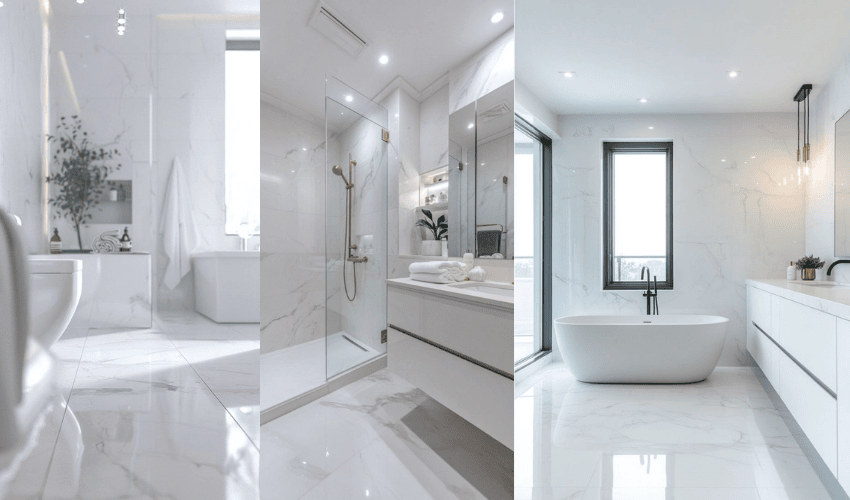
White marble in minimalist design: white marble floor for interior

The fireplace surround is the classic exception to a quiet field, and a legitimate one: a small vertical plane seen face-on can carry one stronger pattern without taxing the room. The discipline is the word once: one dense plane and everything else quiet. The surround must also hold its base tone against the floor even when the stones differ, because a warm surround over a cool floor reads as a mistake however good the pattern is. Judge both under the same recorded light before the cutting list is final.

Обрамление камина из белого мрамора

The bathroom is where a minimalist order meets water, steam, small-format light and the maintenance reputation that white marble in minimalist design carries in interiors. Light comes first: a warm cream stone lit near 3000K reads differently from the same stone under a cool vanity source, so the fixture schedule is fixed before the tone is approved. Finish is second and conditional, not automatic: a polished face reflects light and opens a small room, but it also shows etch marks from acidic products as dull spots, while a honed face reads matte and hides light etching better. Whether a bathroom marble needs a sealer depends on the finish, the measured water absorption of that stone, and the documented performance of the sealer on that surface; there is no universal answer. Slip behaviour follows the documented testing the project specification requires for the finish and conditions, not a blanket claim. Wall and floor pieces should come from one block group, because they meet in one sightline around the vanity.

White marble bathroom floor and wall

When a Slab Check Fails: A Three-Step Route

Sometimes the run in front of the buyer does not match the reference: the tone drifts between groups, the approved light was wrong, or the density band spreads wider than the layout can absorb. When that happens, hold the order and work a fixed three-step route, so the evidence stays clean and the decision can be reversed later.

  1. Document the run as it stands. Photograph every group under the recorded light with slab numbers visible, note the block group of each board, and mark where the drift starts.
  2. Isolate the drift before touching the stone. Dry-lay the affected boards against the approved reference and decide whether the difference is repositionable, whether a group needs re-sourcing, or whether the light condition was wrong and the tone holds under the real source.
  3. Escalate with the file and hold the release. Send the file to the supplier with a direct question and keep the run on hold until the answer comes back in writing. A verbal reassurance is not a release; the written confirmation is what lets the fabricator cut without carrying the risk.
Hard-Won Lesson: White marble for minimalist rooms earns its release only when the whole run has been seen together: one block group, judged under the light the room will use, with the slab numbers in the photograph and the tone compared against a physical reference. A single beautiful board is not a calm room, and a photograph of a board by itself cannot show whether a field will hold.

Frequently Asked Questions

1. Why does white marble in minimalist design fail at the slab stage?

Because a minimalist room has no elements left to absorb a mismatch: the marble field is the surface of the room, so every joint, tone step and vein is exposed. The failures follow one sequence: a tone judged from a photograph, a batch approved a board at a time, and a light never matched to the stone.

2. What is the difference between Carrara-type and Statuario or Calacatta-type veining in a minimalist room?

Carrara-type stones carry fine grey veining that merges into texture at standing distance, which suits a background field; Statuario and Calacatta-type boards carry heavier veining that holds the eye from across the room, which suits one focal plane used once. Judge the actual board, because density varies within every quarry name, and hold the tone across the run.

3. Should I approve the slab under 3000K warm light or under daylight?

Under the source the room will actually use, at the time of day the surface will be seen. Warm light near 3000K keeps warm cream bases cohesive and can soften a cool bright-white base; daylight sharpens grey veins and flattens warm creams. If the fixtures are not decided, approve under neutral light near 4000K and re-check under the final fixture before visible pieces are cut.

4. Can I confirm a minimalist white marble order from photographs instead of seeing the slabs?

Photographs confirm the range of a batch when they are whole-face, same-day and taken under one light with slab numbers visible, but the approval should land on the delivered run itself, not on the marketing shot that started the conversation. Hold the order until the buyer or fabricator confirms the tone from the actual batch.

5. Is white marble suitable for minimalist bathroom floors and walls?

It depends on the finish, the light and the project specification rather than on a blanket yes or no. Polished faces reflect light and open a small room but show etch marks from acidic products as dull spots; honed faces read matte and hide light etching better. Sealing follows the finish and the measured water absorption of the stone, and slip performance follows the documented testing the project requires. Wall and floor pieces should come from one block group because they meet in one sightline.

Final Conclusion

White marble in minimalist design asks little of the room and everything of the purchase. Hold the batch to one base tone inside one block group, approve the tone under the light recorded on the project, match the vein density to the amount of pattern each plane can take, and confirm the delivered run on whole slabs before cutting. Done in order, the stone holds one calm field and reads the same in the finished room as at approval. The batch photographs, the light notes and the slab numbers belong in the order file, so the room that gets built is the room that was approved.

Список литературы

  1. Мрамор, Wikipedia.
  2. ANSI/IES RP-16, Recommended Practice: Nomenclature and Definitions for Illuminating Engineering (correlated color temperature and color rendering terminology)
  3. Natural Stone Institute, Dimension Stone Design Manual (selection, fabrication and installation guidance for natural stone)
  4. ASTM C503/C503M, Standard Specification for Marble Dimension Stone
  5. ASTM C97/C97M, Standard Test Methods for Absorption and Bulk Specific Gravity of Dimension Stone
  6. ASTM C170/C170M, Standard Test Method for Compressive Strength of Dimension Stone
  7. ASTM C880/C880M, Standard Test Method for Flexural Strength of Dimension Stone
  8. ASTM C119, Standard Terminology Relating to Dimension Stone
  9. ASTM C1528/C1528M, Standard Guide for Selection of Dimension Stone

Вам также может понравиться

Отправить запрос

Запрос