


Rýchly prehľad
Rainbow Sandstone is a naturally banded sedimentary stone featuring warm yellow, beige, brown and reddish mineral formations. The featured tiles measure 600×600mm, 600×300mm and 300×300mm, with 20mm and 30mm thickness options for architectural floors, garden paving, decorative walls and facade applications. Its directional patterns can be arranged into coordinated modular layouts or more varied natural stone compositions. Procurement decisions should consider tile orientation, finish consistency, moisture exposure, dimensional tolerances and the bedding or fixing system required by the finished installation.
Rainbow Sandstone Tiles for Outdoor Paving and Architectural Stone Projects
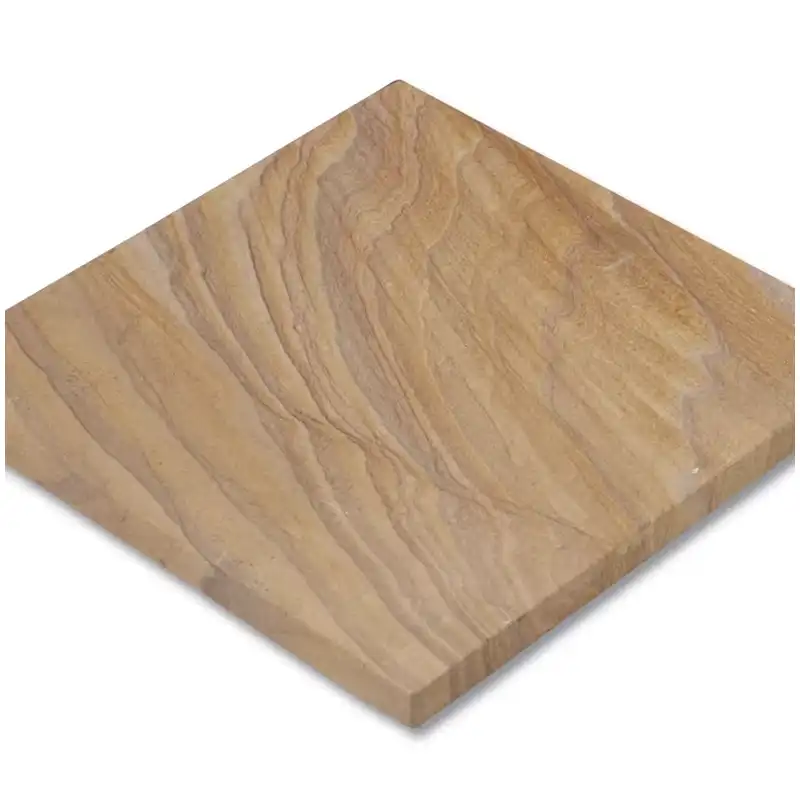
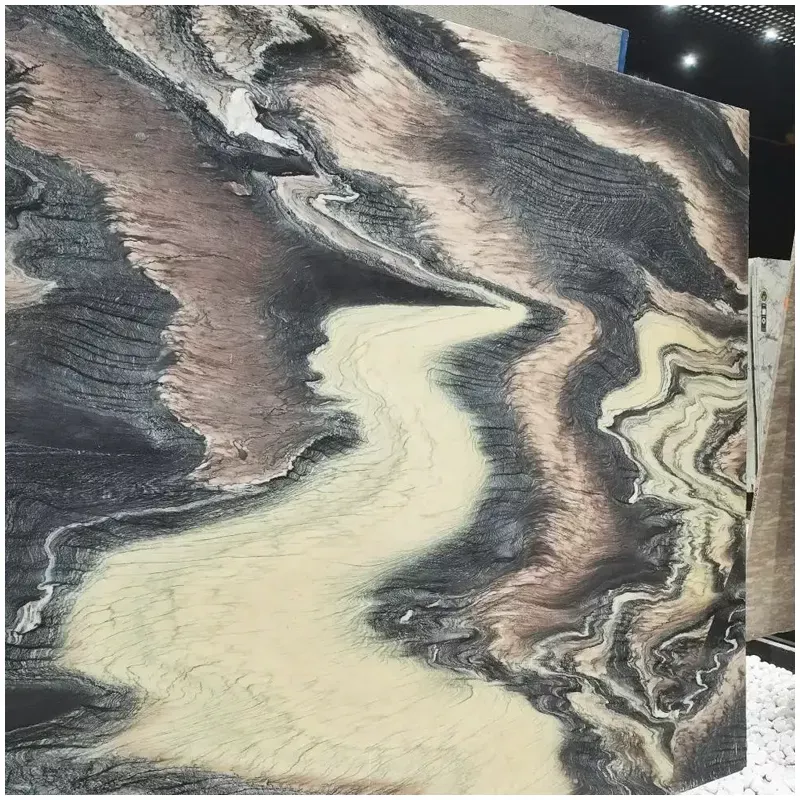
The visual character of rainbow sandstone comes from successive bands of mineral coloration rather than the pronounced crystalline veins associated with marble. Yellow, cream and brown areas flow through the stone, sometimes accompanied by narrower reddish or purple-brown transitions. Once the material is cut into tiles, these bands become an important part of the architectural layout.
Rainbow Sandstone is particularly distinctive when used across a surface large enough to reveal its directional character. A courtyard may contain individual tiles with different mineral formations, yet the completed paving can maintain a coordinated warm color palette. A decorative wall may instead use carefully oriented pieces to create a more continuous visual movement.
Unlike uniformly colored yellow sandstone, this material introduces variation within individual pieces as well as between separate tiles. Buyers should assess the distribution of stronger mineral bands throughout a production batch rather than approving only the background color.
The three available tile dimensions share a common nominal 300mm increment. This creates opportunities for coordinated square and rectangular compositions without requiring every section of the project to use an identical tile format.
For commercial developments, the material can connect entrance walls, pedestrian courtyards and selected interior floors through a consistent natural stone identity. Private residential projects may use smaller quantities for garden paths, terraces or prominent architectural surfaces.
A sandstone wall tile, an interior floor tile and an outdoor paving slab have different exposure and installation requirements, even when they are produced from the same natural material. The finished application must guide the stone specification.
Rainbow Sandstone Tile Sizes, Thickness and Product Specifications
The featured product is supplied in three rectangular and square tile formats with two nominal thickness options. Buyers can specify a single tile dimension or evaluate a coordinated combination according to the architectural drawings.
| Názov produktu | Rainbow Sandstone |
| Obchodný materiál | Natural Rainbow Yellow Sandstone |
| Related Sourcing Names | Rainbow Line Sandstone / Rainbow Teak Sandstone; Confirm Actual Material Identity |
| Klasifikácia kameňov | Natural Sedimentary Sandstone |
| Referencia pôvodu | Rajasthan, India; Specific Quarry and Material Lot Subject to Confirmation |
| Farba Charakter | Golden Yellow / Beige / Brown / Orange and Reddish Mineral Bands |
| Tile Size A | 600×600mm / Approx. 23.62×23.62in |
| Tile Size B | 600×300mm / Approx. 23.62×11.81in |
| Tile Size C | 300×300mm / Approx. 11.81×11.81in |
| Možnosti hrúbky | 20 mm / 30 mm |
| Povrchová úprava | Sawn or Honed Options Subject to Material and Sample Approval |
| Ošetrenie hrán | Straight-Cut Edges; Additional Edge Details by Approved Specification |
| Pattern Character | Directional Sedimentary and Mineral Color Bands |
| Formy produktu | Paving Tiles / Floor Tiles / Wall Tiles / Facade Components |
| Projektové aplikácie | Villas / Hotels / Courtyards / Garden Paths / Interior Floors / Building Cladding |
The listed sizes and thicknesses are nominal product dimensions. Finished dimensional tolerances, thickness calibration, edge treatment and the actual surface finish should be established in the purchase specification.
Rainbow Yellow Sandstone and Its Directional Mineral Coloration
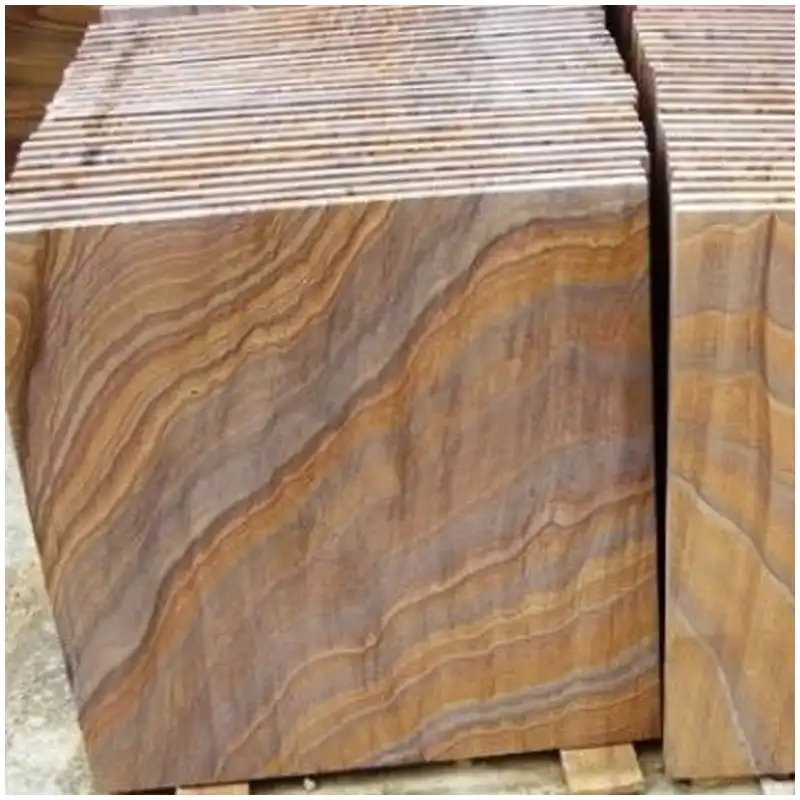
Sandstone develops from accumulated mineral grains that become consolidated through geological processes. Quartz is commonly an important constituent, although the stone may also contain other minerals and natural cementing materials that influence its appearance and physical behavior.
V Rainbow Yellow Sandstone, the visible bands of warmer coloration are associated with variations in mineral distribution. Iron-bearing compounds can contribute yellow, orange, reddish and brown shades, producing patterns that differ from the stone’s general background color.
The direction of cutting determines how much of this banded character is exposed on the finished tile. Different cutting planes may reveal long, closely spaced lines or broader, less regular color transitions.
For a project using directional tiles, a quarter-turn rotation can noticeably change the relationship between adjacent mineral bands. Installers who rotate pieces solely to improve dimensional fit may unintentionally interrupt an approved visual arrangement.
The visual direction of the bands should not be confused with the geological bedding orientation used for mechanical assessment. Where strength or weathering performance is critical, the relationship between cutting direction and the stone’s internal structure may require examination.
Before selecting a commercial quantity, establish whether the project requires a predominantly yellow appearance, a balanced mixture of warm colors or a more strongly contrasted rainbow composition. These are different purchasing requirements within the same natural stone category.
Planning Modular Layouts with 600×600, 600×300 and 300×300mm Sandstone Tiles
The three offered dimensions are useful for projects that need several tile proportions within a common architectural layout. Their nominal stone-face areas also provide a straightforward starting point for preliminary quantity calculations.
| Tile Size | Face Area | Pieces per m² | Layout Direction |
|---|---|---|---|
| 600×600mm | 0.36m² | Approx. 2.78 | Large square fields and uninterrupted mineral patterns |
| 600×300mm | 0.18m² | Approx. 5.56 | Linear arrangements, staggered courses and wall layouts |
| 300×300mm | 0.09m² | Approx. 11.11 | Smaller decorative fields, borders and coordinated modules |
These calculations use nominal stone-face dimensions and exclude joint allowances, perimeter cuts, damaged pieces and reserve material.
One 600×600mm tile has the same nominal face area as two 600×300mm tiles or four 300×300mm tiles. This relationship is useful during preliminary design, but it does not automatically establish a compatible modular pattern once installation joints are introduced.
For example, two rectangular tiles placed beside one another occupy their combined face dimensions plus the intervening joint. If the square tile has an exact finished width of 600mm, the adjoining rectangular arrangement may require dimensional adjustment or a specifically coordinated module.
A mixed-format paving layout should be drawn using the actual working dimensions rather than only the commercial tile names. Joint widths and manufacturing tolerances must be included before production.
For large architectural projects, approving the modular drawing first reduces the risk of excessive trimming, inconsistent joints and unnecessary rotation of the directional sandstone pattern during installation.
Choosing 20mm or 30mm Rainbow Sandstone Paving Tiles
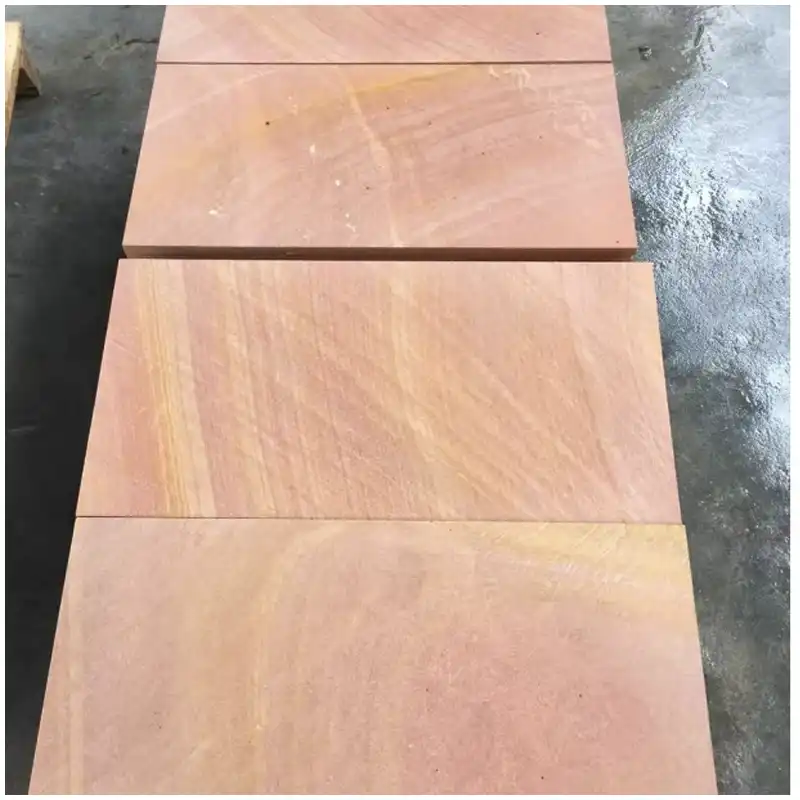
Stone thickness influences more than the apparent solidity of the finished tile. It affects material weight, handling, floor buildup, edge exposure and the relationship between the stone and its supporting construction.
The featured Rainbow Sandstone Paving Tiles are available in 20mm and 30mm thicknesses. At the same density and surface area, a 30mm tile contains approximately 50% more stone volume than a 20mm tile.
The 20mm format can be evaluated for supported interior floor assemblies, selected wall applications and suitable bonded paving construction. Its lower material volume may be useful where installation buildup or handling weight needs to be controlled.
The 30mm format can be considered for outdoor pedestrian paving, landscape surfaces and architectural components requiring a thicker stone section. However, greater thickness alone does not establish suitability for unsupported spans, vehicle traffic or heavy concentrated loads.
The actual breaking load of a stone tile depends on its dimensions, material strength, bedding orientation and support conditions. A large square tile may behave differently from a smaller tile made from the same stone at the same thickness.
Thickness selection should be coordinated with the tile format and installation system. It is not appropriate to approve 30mm sandstone for every outdoor use simply because it is thicker than the 20mm option.
Where several stone products meet at a doorway, terrace edge or architectural transition, the complete floor buildup must also be reviewed. Changes in stone thickness need to be resolved within the construction rather than left to improvised installation adjustments.
Thickness Selection Guide for Sandstone Floors, Paving and Wall Cladding
| Aplikácia | Thickness Direction | Required Technical Review |
|---|---|---|
| Interior Residential Floors | 20mm may be considered | Full support, substrate stability, dimensional calibration and wear conditions |
| Garden Paths | 20mm or 30mm by assembly | Bedding method, drainage, pedestrian loading and wet-slip performance |
| Outdoor Courtyards | 30mm may be considered | Tile format, actual breaking load, base construction and climate exposure |
| Interior Feature Walls | 20mm may be considered | Stone weight, wall substrate and approved attachment method |
| Exteriérové fasády | 20mm or 30mm by engineering | Mechanical properties, fixing arrangement, wind exposure and environmental durability |
| Vehicular Paving | Separate Specification Required | Vehicle loads, pavement engineering, material strength and complete support design |
Neither thickness should be treated as a universal installation specification. The final construction design must establish whether the supplied tile is appropriate for the intended service conditions.
Sandstone Paving Tiles for Garden Paths, Patios and Residential Courtyards
Rainbow sandstone creates a warmer outdoor surface than many conventional grey paving materials. Its natural yellow and brown coloration can relate to timber, brick, planting beds and other landscape elements without requiring a uniform manufactured finish.
For a garden pathway, rectangular 600×300mm tiles can be oriented along the principal walking direction. Larger 600×600mm pieces may suit wider courtyards where individual mineral formations remain visible across a more open paved area.
The outdoor suitability of Sandstone Paving Tiles depends heavily on moisture management. Sandstone can absorb water through its pore structure, and water retained within or beneath the stone may contribute to discoloration, deterioration or frost-related damage under unfavorable conditions.
An appropriate pavement design should address drainage falls, water collection points, support conditions and interfaces with surrounding construction. The paving surface should not be expected to resolve deficiencies in the underlying drainage arrangement.
Installation materials must also be compatible with the stone’s porosity. Inappropriate bedding, jointing compounds or contaminated water may introduce visible staining, particularly on lighter yellow and beige mineral areas.
Before large-scale installation, a representative paving mockup can demonstrate the proposed stone orientation, joint color, finished surface appearance and relationship between neighboring tiles under natural daylight.
Where the project is exposed to freezing temperatures, persistent moisture or deicing salts, evaluate the relevant durability properties of the actual stone. A commercial sandstone name does not establish suitability for every outdoor climate.
Rainbow Sandstone Floor Tiles and Interior Pattern Arrangement
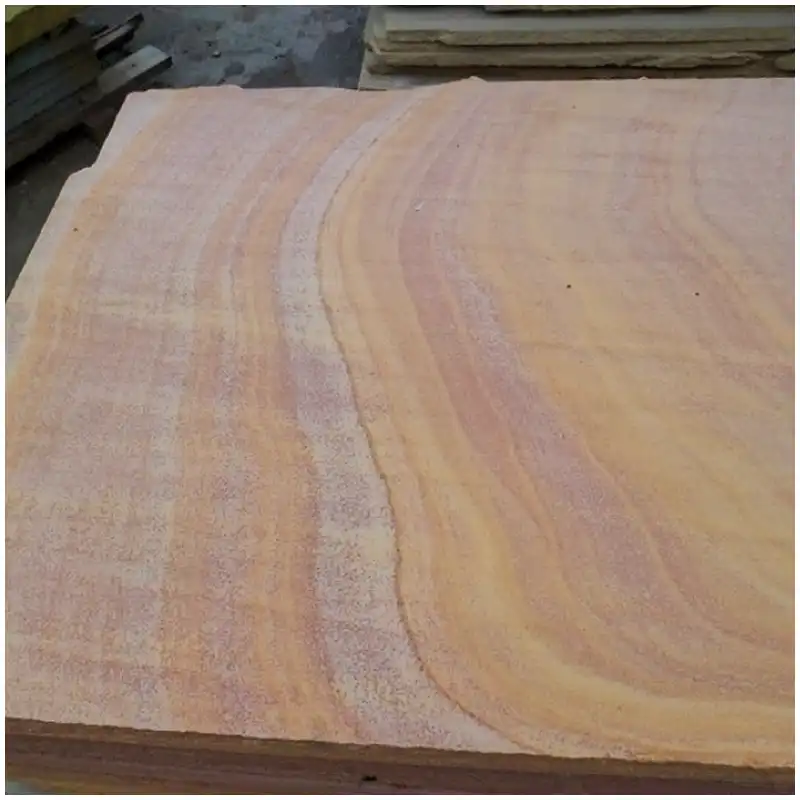
Interior flooring makes the relationship between individual sandstone pieces particularly noticeable. Unlike an exterior path viewed primarily in daylight, an interior stone floor is influenced by windows, ceiling lighting and the direction from which occupants approach the room.
Rainbow Sandstone Floor Tiles can be arranged with their dominant mineral bands following a common orientation. This gives the floor a directional character that may reinforce the length of a corridor or the main axis of a living space.
An alternative approach uses controlled rotation and blending. Strongly marked yellow-brown pieces are distributed throughout the floor rather than concentrated within one region. The resulting surface retains the variation of natural stone without requiring continuity between every tile.
A mixed layout can also help manage the different pattern intensities that arise when tiles are cut from multiple sandstone blocks. Uncontrolled mixing, however, may produce isolated areas of unusually strong coloration.
For interior floors, dimensional calibration has a direct effect on finished quality. Differences in thickness, flatness or squareness can complicate the installation and create visible edge irregularities under directional lighting.
The required surface finish should be reviewed alongside the anticipated traffic and cleaning conditions. A fine honed appearance may be visually appropriate for a private residence, while a heavily used commercial floor requires specific evidence of abrasion and slip performance.
Interior floor approval should follow the finished tile specification rather than the attractiveness of an individual sample. The decorative character of the stone does not establish its suitability for every pedestrian service condition.
Surface Finish, Wet-Slip Performance and Sandstone Moisture Behavior
Sawn and honed surfaces are commonly considered for fine-grained decorative sandstone. Their suitability depends on the actual material and the texture achieved through processing.
| Surface Direction | Architectural Consideration | Approval Requirement |
|---|---|---|
| Sawn Surface | Natural matte appearance with visible directional coloration | Surface consistency, machining marks and intended walking conditions |
| Honed Surface | Smoother finish emphasizing mineral patterns | Wet-slip performance and maintenance requirements |
| Additional Textured Finish | Potential surface modification for selected architectural uses | Processing feasibility and actual sample performance |
| Sealed Surface | Potential reduction in penetration of certain liquids | Color change, vapor compatibility and slip performance |
Natural sandstone should not be described as universally slip-resistant. The finished surface, moisture conditions, surface contamination and cleaning regime all affect traction.
For outdoor terraces, entrances and areas exposed to rain, obtain slip-resistance evidence appropriate to the finished tile and applicable project requirements.
Porous sandstone may also darken temporarily when wet. The appearance of a recently washed or rain-exposed surface should not be compared directly with a completely dry approval sample when assessing color consistency.
Any proposed sealing treatment should be tested before production-scale application. Some treatments can deepen the yellow and brown tones, alter the surface texture or affect the stone’s moisture behavior.
Yellow Sandstone Wall Tiles for Residential and Commercial Feature Walls
The following feature-wall design reference illustrates how the directional mineral coloration of rainbow sandstone can become the principal decorative element of an architectural elevation.
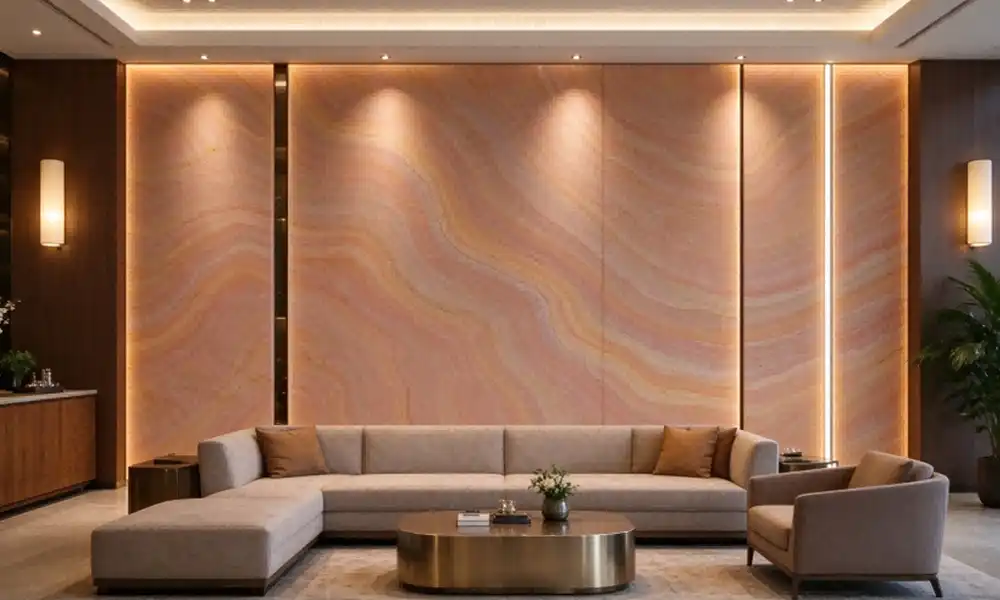
Vertical installation presents the stone’s mineral bands differently from horizontal paving. A wall can be composed with the movement extending across the elevation, emphasizing width, or with selected directional pieces reinforcing the height of the room.
The 600×300mm format is useful for evaluating linear wall compositions. Its rectangular proportion creates a more pronounced directional rhythm than the square 600×600mm format.
When using Yellow Sandstone Wall Tiles with stronger rainbow coloration, the designer should determine whether adjacent pieces need a closely coordinated pattern or simply an approved range of compatible shades.
A wall containing a doorway, recessed niche or decorative metal trim requires particular attention to the surrounding cut pieces. Narrow strips produced without an approved visual layout may interrupt the original mineral movement at highly visible locations.
Natural sandstone can also respond differently to grazing artificial light. Small variations in surface texture, edge alignment and joint depth may create noticeable shadows when wall washers are installed close to the finished surface.
For a prominent reception wall or residential living room, approve a representative tile assembly under lighting conditions similar to those proposed for the actual interior. This can establish both the acceptable pattern composition and finish quality.
The application image is a visual design reference. It does not establish that the pictured wall uses the exact listed tile thicknesses or a verified attachment system.
Sandstone Facade Tiles: Exterior Cladding and Building Envelope Requirements
Rainbow sandstone can introduce warm natural coloration into building elevations that would otherwise rely on render, concrete or uniformly colored manufactured cladding. Its banded appearance can be particularly distinctive around architectural entrances, low-rise exterior walls and decorative facade sections.
The selection of Sandstone Facade Tiles requires more than choosing a suitable color. Actual stone thickness, panel dimensions, weight, bending strength and attachment characteristics must be compatible with the proposed building construction.
A directly bonded wall tile and a mechanically supported facade component are different construction products in practice. The required attachment arrangement depends on installation height, substrate condition, environmental exposure and local building regulations.
Where mechanical fixing is proposed, the geometry of attachment points must be reviewed in relation to the stone’s natural bedding and available thickness. The 20mm and 30mm options should not be assumed to accommodate every type of anchor or fixing detail.
Exterior elevations also need properly coordinated flashings, drainage paths, movement joints and termination details. Decorative sandstone must not bridge required construction joints or prevent the building envelope from managing moisture.
At the lower portion of a facade, splash water and ground-level moisture may create different service conditions from those experienced by upper wall sections. These areas can require separate detailing or material treatment.
A facade specification should be approved using the actual stone properties and complete attachment assembly. Neither the visual appearance of Rainbow Sandstone nor its availability in 30mm thickness independently demonstrates compliance with exterior cladding requirements.
Rainbow Sandstone Applications and Project Specification Guide
| Project Application | Potential Stone Format | Primary Specification Requirement |
|---|---|---|
| Villa Courtyards | 600×600mm paving or coordinated mixed-format tiles | Drainage, surface traction and approved bedding construction |
| Garden Walkways | 600×300mm or 300×300mm pedestrian paving | Stable support, edge restraint and environmental exposure |
| Residential Floors | 600×600mm or rectangular floor tiles | Tile calibration, surface finish and mineral pattern layout |
| Hotel Interiors | Decorative wall tiles and selected floor surfaces | Maintenance, traffic assessment and consistent appearance |
| Akcentové steny | 600×300mm directional stone compositions | Joint arrangement, attachment method and lighting coordination |
| Building Facades | Project-approved square or rectangular cladding tiles | Engineered fixing, material strength and moisture management |
| Landscape Structures | Decorative facing for planters and boundary walls | Water exposure, termination details and substrate compatibility |
Permanent water immersion, heavy industrial flooring, vehicular traffic and demanding freeze-thaw environments require additional material and construction assessment.
Rainbow Sandstone Physical Properties and Technical Assessment
Rainbow sandstone is commonly associated with relatively fine-grained natural sandstone selections. Its density, absorption and mechanical behavior depend on mineral composition, natural cementation, pore structure and geological bedding.
The following technical reference figures are indicative values for commercially identified Rainbow Sandstone selections. They are not certified laboratory results for the current Esta Stone material lot and should not be used as guaranteed engineering design values.
| Physical Property | Indicative Reference | Relevant Assessment Method |
|---|---|---|
| Objemová hustota | Approx. 2,070–2,110kg/m³ | EN 1936 / ASTM C97/C97M |
| Absorpcia vody | Approx. 8–11% in one reference dataset | EN 13755 / ASTM C97/C97M |
| 140 – 160 MPa | Approx. 41–63MPa | EN 1926 / ASTM C170/C170M |
| Flexúrna pevnosť | Approx. 7–11MPa | EN 12372 / ASTM C880/C880M |
| Odolnosť proti oderu | By Selected Material Testing | EN 14157 |
| Odolnosť voči mrazu | By Project-Specific Verification | EN 12371 |
| Slip Resistance | By Actual Finished Tile Assessment | Applicable Finish-Specific Slip Test |
Technical data clarification: The numerical ranges describe reference material selections, not guaranteed properties of the listed tiles. The associated methods identify relevant options for new testing and do not establish which methods were used to generate the reference figures.
Using the indicative density range for preliminary calculations, a 20mm solid sandstone layer would weigh approximately 41.4–42.2kg/m², while a 30mm layer would weigh approximately 62.1–63.3kg/m². These estimates exclude bedding, adhesives, supporting components and packaging.
Actual facade loads, handling arrangements and container-loading calculations must be established using confirmed material density, finished dimensions and measured package weights.
Engineering Standards for Sandstone Paving and Architectural Cladding
Natural stone requirements differ according to the intended finished product. A material suitable for decorative wall cladding may not satisfy the mechanical or durability requirements associated with exterior paving.
| Reference Standard | Product Category | Specification Direction |
|---|---|---|
| ASTM C616/C616M | Quartz-Based Dimension Stone | Material classification and physical-property requirements |
| EN 1341 | Natural Stone Slabs for External Paving | Exterior paving product assessment where applicable |
| EN 1469 | Natural Stone Slabs for Cladding | Cladding product requirements and material documentation |
| EN 12058 | Natural Stone Slabs for Floors and Stairs | Relevant flooring and stair-product assessment |
These standards provide reference frameworks for specification. Their inclusion does not represent a declaration of conformity, certification or verified compliance for the supplied sandstone. Applicable requirements should be determined according to the finished product and destination market.
Rainbow Sandstone Tile Inspection, Batch Control and Export Packing
Bulk procurement of directional sandstone requires a defined visual acceptance range as well as measurable dimensional criteria. A single approved tile cannot establish the complete appearance of several hundred square meters of naturally banded material.
| Material Lot Identification | Record the approved stone selection, source documentation where required and production batch references. |
| Color Range Approval | Establish acceptable yellow, beige, brown and reddish mineral variation using representative dry samples. |
| Pattern Distribution | Review the proportion of strongly marked and quieter pieces against the approved architectural layout. |
| Tile Dimensions | Measure the 600×600, 600×300 and 300×300mm formats against the agreed working dimensions and tolerances. |
| Thickness Calibration | Check the specified 20mm or 30mm thickness, keeping different thickness groups separately identifiable. |
| Surface and Edge Review | Inspect finish consistency, machining marks, edge damage, cracks and potentially unstable stone sections. |
| Dry-Lay Arrangement | Arrange representative pieces where specified to assess mineral direction, mixed-format compatibility and shade distribution. |
| Package Identification | Identify tile size, thickness, quantity, material lot and designated installation zone where applicable. |
| Export Protection | Use appropriate seaworthy crates or pallets with face separation, edge protection and transport restraints suited to the finished tiles. |
When several tile sizes are ordered together, the packing list should preserve their separate quantities. Mixing different dimensions or thicknesses without clear identification can create unnecessary sorting work at the destination.
For installations requiring a particular mineral direction, numbered groups or approved layout references may be useful. The identification system should correspond to the actual construction drawing.
Before shipment, review package dimensions, measured gross weights, stone protection and unloading requirements. Moisture-sensitive appearance and vulnerable tile edges should be considered when selecting packing materials and handling arrangements.
Cleaning and Long-Term Maintenance of Rainbow Sandstone Surfaces
The pore structure of sandstone can allow moisture and contaminants to penetrate its surface. Regular maintenance is important for preserving the appearance of yellow and beige mineral areas, particularly in locations exposed to soil, plant residue or frequent pedestrian use.
Routine cleaning should use compatible natural stone products and nonabrasive equipment. Aggressive acidic cleaners, unsuitable bleach solutions and concentrated chemical treatments should not be applied without evaluating their effect on the actual sandstone and associated joint materials.
Outdoor paving should be kept free of accumulated soil and organic debris. Persistent dampness, staining or mineral deposits may indicate a drainage or moisture-related issue rather than simply a dirty stone surface.
Excessively aggressive pressure washing can damage some sandstone surfaces or remove weaker material from joints. Cleaning methods should be selected according to the condition of the installed stone and tested in an inconspicuous area where appropriate.
An approved impregnating treatment may help reduce certain forms of liquid penetration. It cannot compensate for an unsuitable bedding arrangement, inadequate drainage or stone that fails the required environmental performance criteria.
For coordinated wall and floor installations, establish separate maintenance procedures according to the surface finish and service conditions of each architectural component.
Frequently Asked Questions About Rainbow Sandstone
What sizes and thicknesses are available for Rainbow Sandstone Tiles?
The featured tile sizes are 600×600mm, 600×300mm and 300×300mm, with 20mm and 30mm thickness options. Actual working dimensions, finish, dimensional tolerances and thickness calibration should be confirmed according to the approved purchase specification.
Is Rainbow Sandstone suitable for outdoor paving?
Suitable Rainbow Sandstone selections can be considered for pedestrian garden paths, patios and courtyards. Outdoor approval depends on the actual stone properties, tile thickness, bedding system, drainage, wet-slip performance and environmental exposure. Vehicular paving requires a separate engineering assessment.
Should I choose 20mm or 30mm Rainbow Sandstone Paving Tiles?
The 20mm format may suit appropriately supported interior or bonded installations, while 30mm can be considered for selected outdoor paving applications. The correct thickness depends on tile dimensions, material strength, expected loading and the complete installation assembly rather than thickness alone.
Why do Rainbow Yellow Sandstone Tiles have different colored bands?
The yellow, brown and reddish bands arise from natural variations in mineral distribution and geological processes within the stone. Cutting orientation also influences their finished appearance. Representative production samples should establish the acceptable color range and pattern direction before a bulk order.
Can Rainbow Sandstone be used for exterior wall cladding?
Suitable sandstone tiles can be specified for exterior decorative cladding when their material properties, dimensions, thickness and attachment system meet the project requirements. Wind exposure, moisture management, substrate conditions and environmental durability require separate technical review.
What information is required for a Rainbow Sandstone tile quotation?
Provide the required tile sizes, thickness, surface finish, quantity, color preference, installation application and delivery destination. For mixed-format paving or facade projects, include the layout drawings, intended joint widths, dimensional tolerances and any required material testing or inspection criteria.
Final Note: Coordinating Rainbow Sandstone Across Architectural Surfaces
Rainbow Sandstone is most valuable when its mineral direction, tile proportions and installation requirements are considered together. The 600×600mm, 600×300mm and 300×300mm formats provide a useful foundation for coordinated paving, floor and wall layouts, while the 20mm and 30mm thicknesses accommodate different construction considerations. A well-defined purchasing specification establishes the acceptable natural coloration, working dimensions, finish and required material performance before production, allowing the finished architectural surface to retain its distinctive rainbow character without unnecessary installation compromises.
Rainbow Sandstone Compared with Four Natural Stone Tile Selections
Natural stone tiles differ in visual character, geometry, mineral composition and intended service conditions. The following comparison distinguishes rainbow sandstone from four alternative architectural stone directions without assuming equivalent technical performance.
| Produkt | Vzhľad | Architectural Direction | Buyer Decision |
|---|---|---|---|
| Rainbow Sandstone | Yellow, beige and brown directional mineral bands | Modular paving, floors, walls and selected cladding | Mineral orientation, moisture behavior, finish and thickness |
| Grey Random Rubble Slate Tiles | Irregular grey and brown pieces with natural split textures | Rubble wall cladding and landscape architecture | Stone shape, relief, backing and irregular joints |
| Dlaždice z atlantického sivého kvarcitu | Grey coloration with variable mineral movement | Contemporary floors and architectural walls | Material strength, finish and service performance |
| Andromeda White Granite Tiles | Pale granite background with natural mineral contrasts | Light-colored architectural floors and cladding | White-tone grouping, texture and wear performance |
| Oman béžové mramorové dlaždice | Warm beige background with natural marble variation | Coordinated residential and hospitality interiors | Beige-tone consistency, finish and carbonate stone maintenance |
Recommended Natural Stone Tiles for Floor, Wall and Landscape Projects
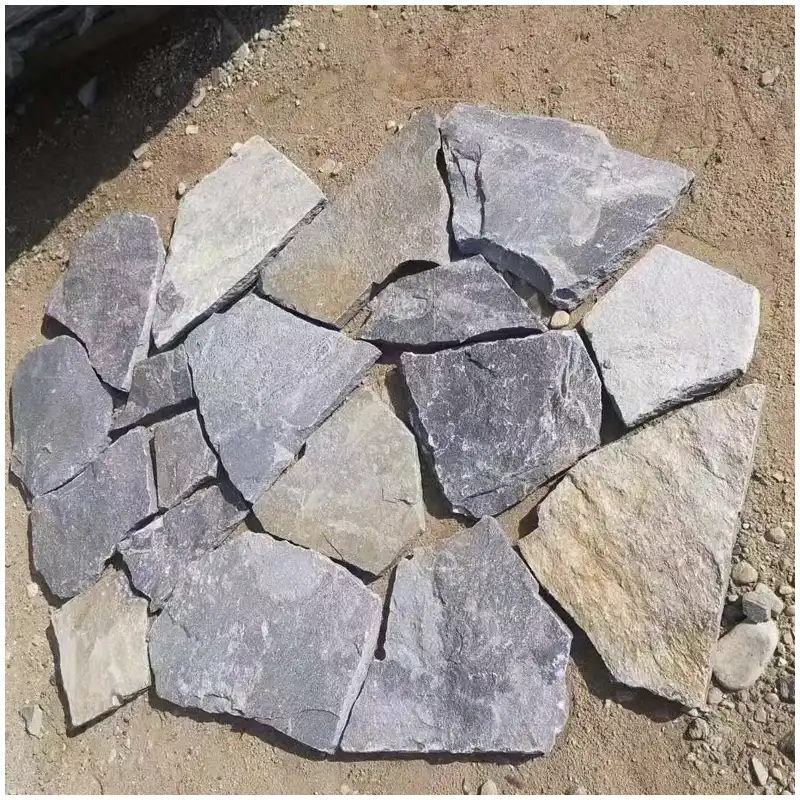
Grey Random Rubble Slate Tiles
Irregular natural slate pieces with rugged grey and brown coloration for architectural walls, garden enclosures and textured landscape stone cladding.
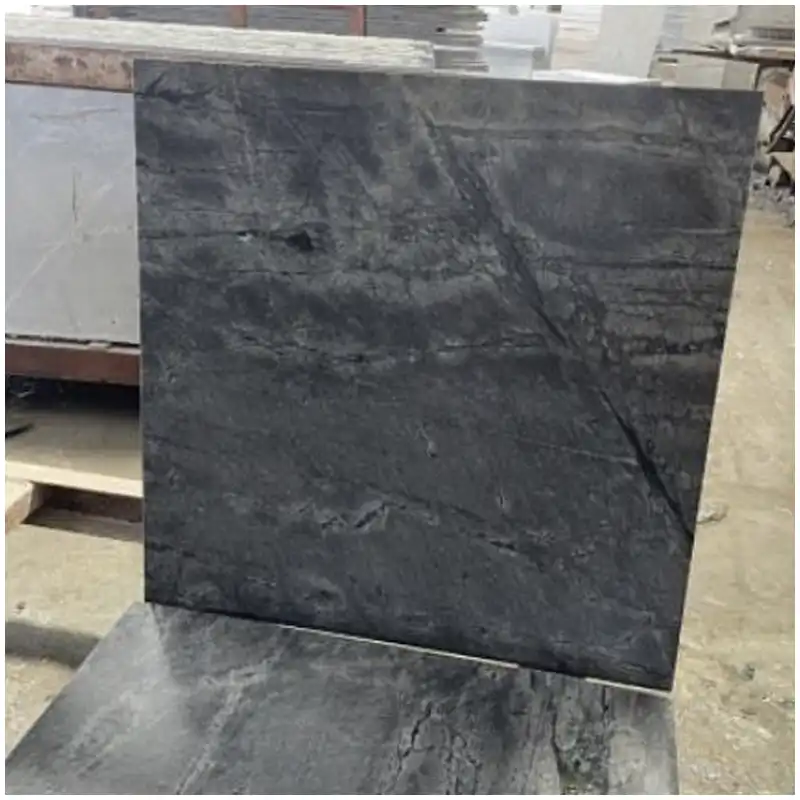
Dlaždice z atlantického sivého kvarcitu
Grey natural quartzite tiles for contemporary architectural surfaces where mineral movement, stone texture and a cooler material palette are preferred.

Andromeda White Granite Tiles
Light-colored natural granite tiles for architectural flooring and wall cladding where pale mineral coloration and coordinated stone surfaces are required.
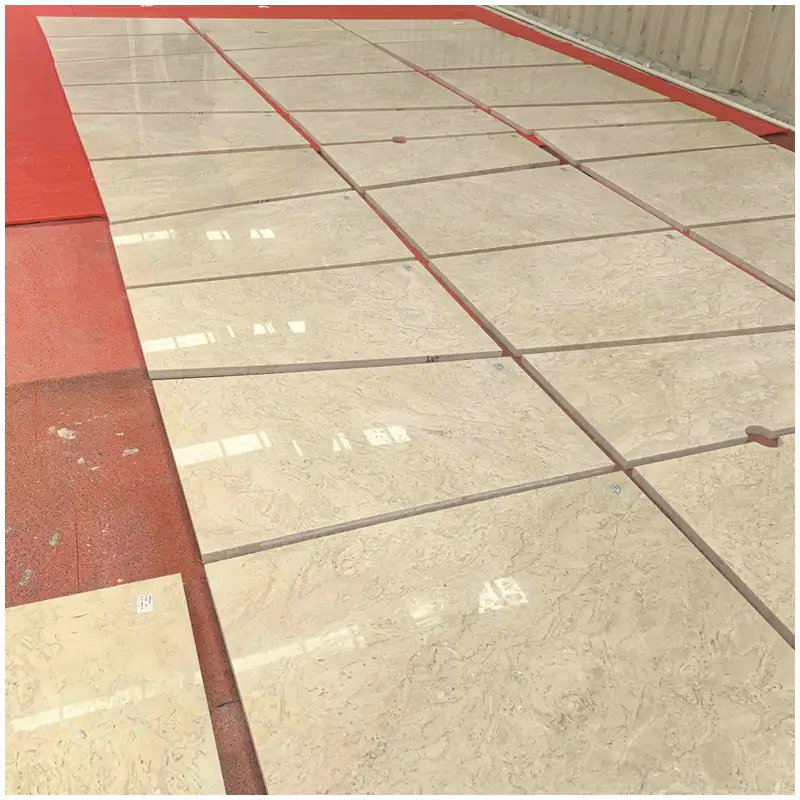
Oman béžové mramorové dlaždice
Warm beige marble tiles for coordinated hotel interiors, residential floors and decorative walls requiring a quieter natural stone background.
Request Rainbow Sandstone Tiles for Your Architectural Project
For a Rainbow Sandstone quotation, provide the required combination of 600×600mm, 600×300mm and 300×300mm tiles, preferred 20mm or 30mm thickness, surface finish, quantity and delivery destination. Include the intended paving, flooring or wall application, preferred mineral color distribution, laying pattern, joint dimensions and any required technical documentation. Esta Stone can review the selected stone format and processing requirements against the proposed architectural layout and commercial purchase specification.