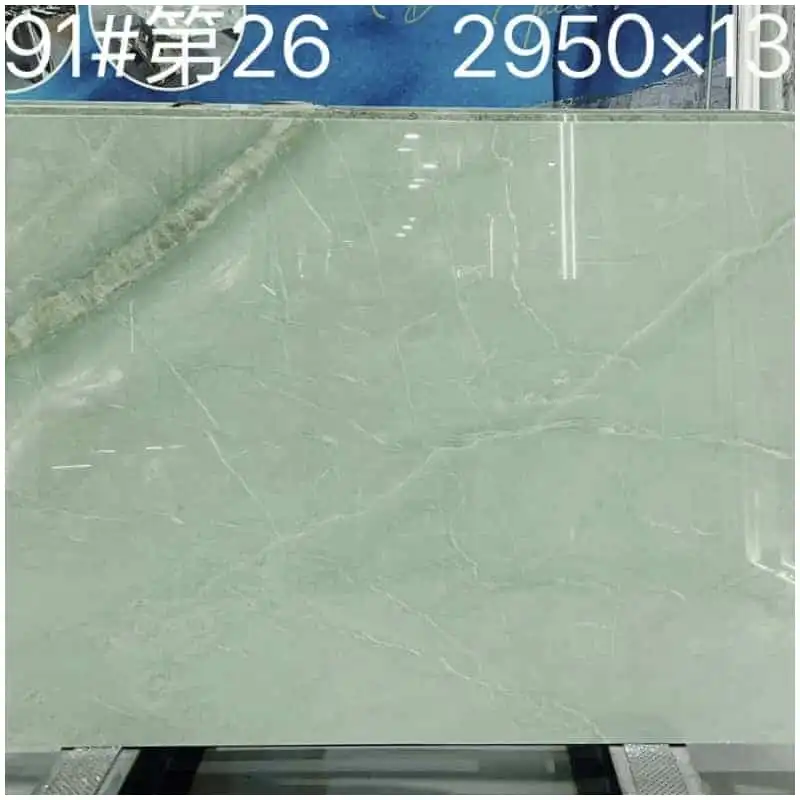
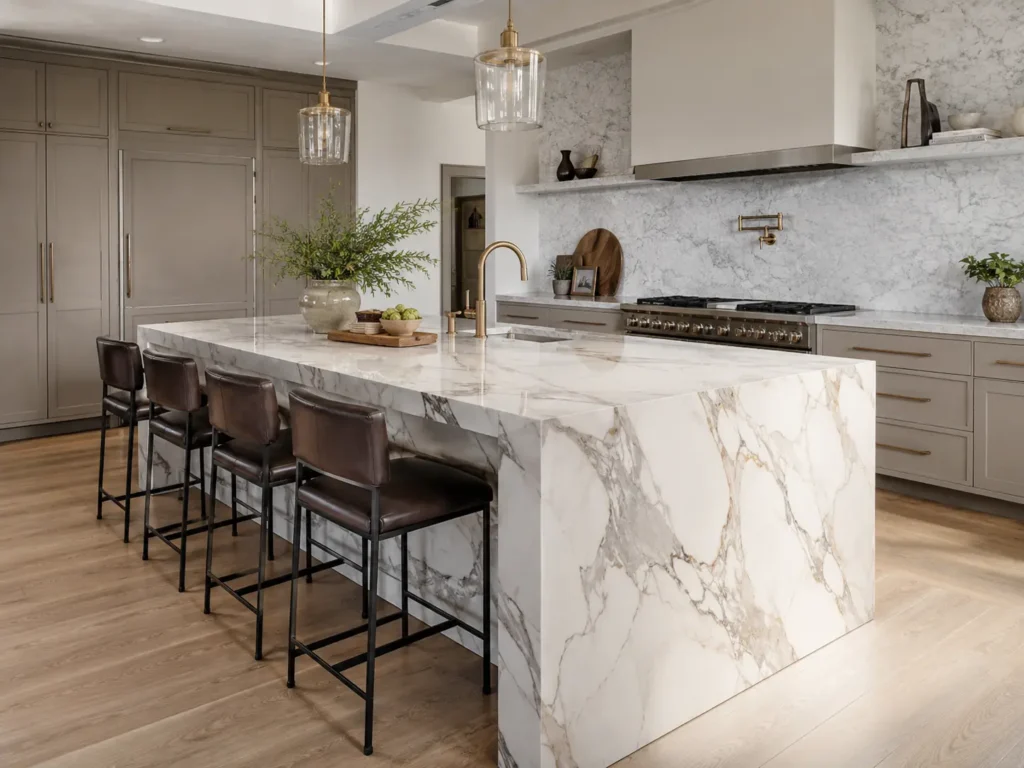
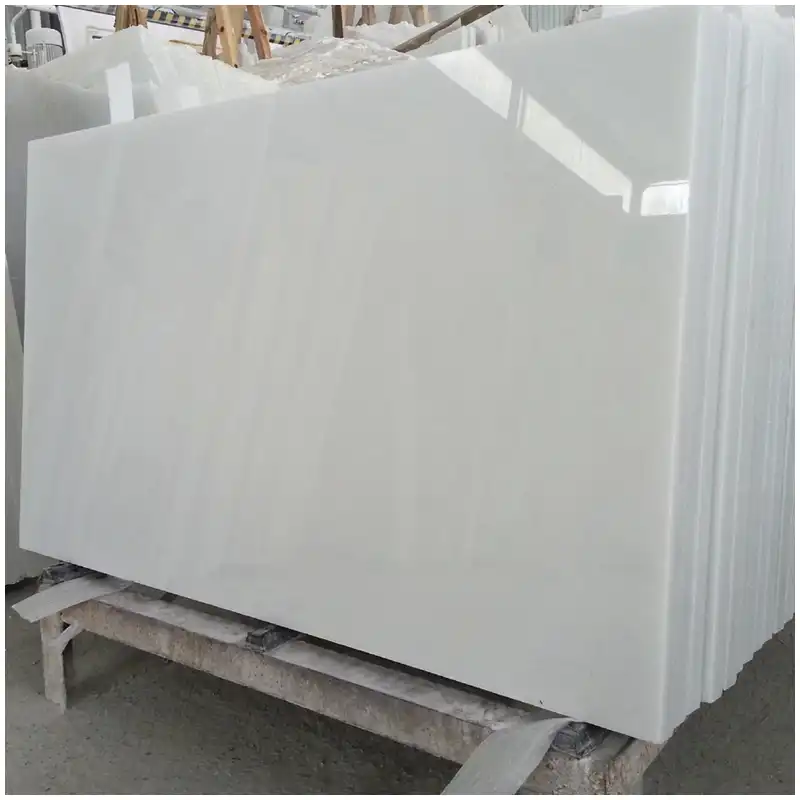

Volakas Marble vs Carrara under Real Bathroom Light
Volakas and Carrara both carry the word white, and both look near identical under a cool warehouse lamp. Move the same two pieces under a 3000K mirror light and the pair separates. One face shifts cream, the other holds blue-grey. The names did not change. The light exposed the range, and the range is the real subject of the decision.

The wider comparison, covering provenance and supply, sits in the Volakas and Carrara comparison guide; this page makes the installed-room colour call.
Volakas marble vs Carrara is not settled from a 100 millimeter sample. Pull full slabs, lock the camera exposure, note the finish, set the wall and cabinet colors beside them, damp one controlled patch, and decide which range the bathroom can live with. Photographs corrected one at a time mislead, so both stones stay in the same frame, under the same lamp, beside the same room materials.
Read the Background Before You Read the Veins
I look at veins like everyone else, but the ground color decides more, because the ground is what a whole wall reads as from the doorway. Volakas runs from a clean cool white to a soft cream depending on the quarry layer, and some faces carry a faint warmth visible only beside something colder. That faint warmth is the white marble undertone a small sample does not reveal. Carrara sits on a grey to blue-grey base, with a fine feathered movement that reads as a haze rather than a drawing at distance.
I check this at the distance a person actually stands. Stand square to the face, step back to where the mirror would put a viewer, and read the field before reading any single vein. When a Volakas face drifts warm against the accepted range, it goes back to the sorting rack as a group, not piece by piece. On Volakas marble vs Carrara, the ground color is the first thing that breaks the tie.
Volakas is a dolomitic marble out of Greece, and that is part of why its background behaves the way it does. The stone leans on dolomite, so its white carries a slightly different body than the calcite-heavy Carrara from Tuscany. The Carrara side of the comparison belongs with the Bianco Carrara Marble for Bathroom Projects approval notes, where the same white marble has to agree across slabs, wet areas, lighting, and joints.
Volakas Marble vs Carrara under 3000K and 4000K Light
Warm light does not flatter every white. A 3000K lamp pulls cream out of a warm Volakas face and leaves a cool Carrara looking flat. A 4000K lamp does the reverse, and it can make a blue-grey Carrara read almost clinical.
Auto white balance is what wrecks this test. When the camera corrects each slab on its own, a warm Volakas and a cool Carrara both land as neutral grey on screen, and the point of the comparison disappears. Fixed exposure plus a neutral grey card restores the reference; without it the two whites collapse into one picture and nothing measurable is learned.
I run this test on the actual faces that would ship, so the Volakas marble slab range is read against the Carrara sitting beside it in the yard, not against a photograph taken under an unknown lamp. A Volakas marble bathroom keeps its color only when the batch was judged under the light the room will use.
Finish, Water, and Grout Change Both Stones
Polish and hone are not the same stone. Polish bounces light back and can make a warm Volakas read brighter than it is. Hone soaks up light and can pull two ranges closer together while they are dry. Then water enters and the pair separates again, because a damp face darkens and can reveal a fill or a repair that a dry face hides.
Published absorption figures move between producers and lots, so this call is made on the reserved lot’s own report rather than a borrowed range, and sealing is treated as part of the color decision instead of a fix for a dry sample. A face that takes more water holds a wet patch longer, so the damp test runs at one exposure: wet and drying are photographed alike, and an uneven return to color is caught instead of argued about.
Grout is a second color source in every joint. A cool grey grout can pull a Carrara field together and make a warm passage in Volakas stick out. White grout brightens the field but shows residue and moisture trails differently. I approve the stone and the joint as one visible assembly, damp and dry, before anything is cut.
| Propiedad | What the choice needs from the lot record | Method or record |
|---|---|---|
| Water absorption | Compare the lot report at the finished condition supplied and the wet-patch reading on both faces at one exposure | ASTM C97/C97M within ASTM C503/C503M |
| Densidad | Use the declared density of the reserved lot for weight planning, never a catalogue average | ASTM C97/C97M |
| Flexural strength | Only where span, support or a thin built-up edge depends on it; the assembly still decides | ASTM C880/C880M |
| Compressive strength | Only where the fixing design asks for it | ASTM C170/C170M |
| Surface hardness | Both are soft carbonate marble; the practical test is what the approved cleaner does to the face | Scratch and cleaner test on the reserved face |
The figures move with the quarry layer, so the reserved lot’s own report carries the decision, alongside the wet patch on the actual face.
The Hard-Won Lesson: The camera can make two different whites look identical
When each slab is photographed with automatic white balance, a warmer Volakas face and a cooler Carrara face both turn neutral on screen. The comparison collapses, and an approval can be given for a difference that does not exist in the photo. Installed beneath one mirror lamp, the real gap returns across the whole wall, and the approval no longer matches what was shipped.
The Lesson: Photograph comparison samples together with fixed exposure and a neutral reference.
Sinks, Niches, and Joints on Real Faces
A strong vein through a sink cutout or across a niche shelf is where a Volakas marble bathroom goes wrong. Overlay every cutout and joint on the actual face before cutting, so a bold Volakas line does not land in a corner where it reads as a crack, and a Carrara feathered run is not chopped mid-flow into odd pieces.
Niches sit at eye level, where every repair, edge and joint is read closely. A shelf at that height shows every repair, edge, and joint, and a flattering crop of one clean corner says nothing about the face that gets dressed. Map the repairs on the face and place the cut layout over it at the wall.
The same rule holds on the Carrara side: Carrara white marble slabs stay beside an approved physical reference for the reserved batch. The cut layout has to respect the veins the batch carries.
Batch Sorting for Repeated Bathrooms
One bathroom can be judged on its own. Twenty bathrooms in one hotel cannot. When a job repeats a white marble across many rooms, the risk is not one ugly slab; it is two batches that were not meant to mix on the same floor, where every doorway shows the seam between a warm group and a cool group.
I sort by room group before anything leaves the yard. Each group gets a dry-lay of the visible faces in sequence, and companion pieces are reserved against the approved reference so a replacement three months later does not arrive from a different batch with a different ground. The batch record is tied to the room assignment so a later complaint can be checked against the original light and finish.
For Volakas marble vs Carrara on a repeated-room job, the sorting decision matters more than the name. The Greek Volakas marble grading and selection guide walks through block family, slab family, and the grade splits that decide how much range one order carries.
How Cleaning Sensitivity Differs on Pale and Grey Fields
Cleaning sensitivity is where the two fields genuinely part. Both are marble, so both etch when an acid sits on the face: a citrus cleaner or mouthwash left to dry marks either surface, while a neutral stone soap used at the recommended dilution leaves a film rather than an etch. The difference is visibility: on the pale Volakas field a dull etched patch or a dried cleaning film reads as a grey ghost against the white, while the same mark blends into the Carrara grey field and shows later. That gap is why stain and film diagnosis belongs with the white marble bathroom problems workflow rather than with the stone label.
Finish decides how fast that difference appears. Hone can make fine wear and etch marks less conspicuous than polish, which is why I lean hone on a bathroom floor or shower wall that sees soap and hard water. Polish looks brighter on day one and shows every water mark after. On cleaning sensitivity, Volakas marble vs Carrara sits close enough that the finish and the sealer schedule decide more than the name; sealer slows absorption without making either stone acid-proof.
Which White Marble Holds Its Color in the Installed Room
The answer to Volakas marble vs Carrara sits in the batch, the lamp, the finish, and the plan, each with a condition to check before anything is signed off.
Neither name guarantees one white
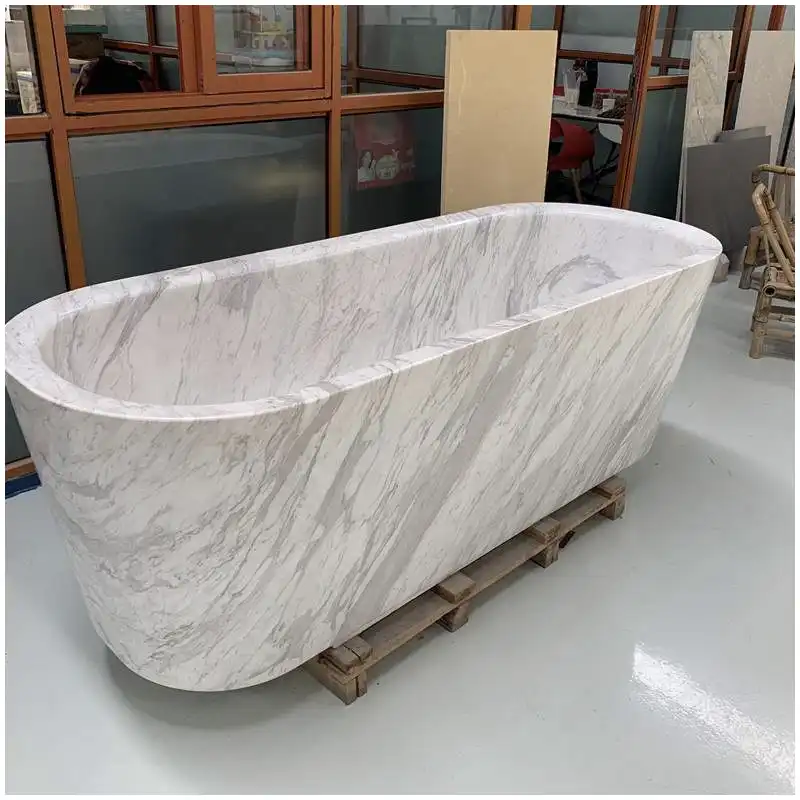
Both materials carry natural range, and the reserved batch carries more authority than a catalogue description. A Volakas face can read cooler or warmer than a Carrara face by layer and light, so the pair is judged on the reserved boards.
Light and finish change the comparison
The same pair can reverse under a different lamp, so the decision needs the lamp temperature, adjacent paint and cabinet colors, surface finish, wet state, and viewing distance written down together. Change one of them and the approved comparison no longer holds.
Sorting protects repeated bathrooms
Room grouping and reserved companions control variation more honestly than promising identical stone. Where one room is judged alone, a batch that drifts warm or cool can pass. Where twenty rooms share a floor, the sort is what stands between a deliberate range and a patchwork the owner did not agree to.
The maintenance plan is part of the color decision
A stone that etches from the owner’s cleaning routine will look different in a year, whatever it looked like on day one. The finish and the sealer schedule have to match the room’s actual use; if the owner will not live with honing and resealing, neither stone answers that bathroom.
When Volakas Marble vs Carrara Fails after Installation
A warm room beside a cool room is the usual complaint after installation; the response is a three-step record, not a patch.
- Document. Photograph every affected room under one lamp and exposure, and log room codes, slab IDs, finish, grout, and approval light temperature.
- Isolate. Stop mixing the suspect batch into new rooms, tag remaining slabs by lot, and hold rack faces so the accepted range stays available.
- Escalate or hold. Send the record to the supplier against the shipped reference, and hold cutting or installation until a disposition is agreed.
Frequently Asked Questions
1. Does Volakas marble vs Carrara have one clear winner for bathrooms?
No. Compare the actual batches for undertone, movement, finish, wet response, cut layout, maintenance, and repeated-room consistency. The winner is the range that held its color under the room’s own light.
2. Which marble looks whiter under warm bathroom light?
It depends on the slab range and the colors around it. A warm 3000K lamp can pull cream out of a warm Volakas and leave a cooler Carrara reading flat, or do the reverse on another batch. Test both together under fixed exposure.
3. Is Carrara usually greyer than Volakas?
Carrara commonly carries a grey to blue-grey ground with fine feathered movement, while Volakas often shows a pale to warm background with stronger diagonal grey veining. The ranges overlap, so inspect the actual slabs.
4. Should the comparison use polished or honed samples?
Use the finish the project will actually get. Polish and hone change reflection, contrast, color depth, feature visibility, and the maintenance the surface needs. Honed Volakas against polished Carrara tells you nothing about the installed result.
5. What should happen if installed rooms split into warm and cool groups?
Stop and photograph first. Shoot every affected room under the same lamp and exposure, then pause further mixing of batches. Send those photos with the slab IDs, room assignments, finish, grout, and approval records so the supplier can compare against the shipped reference.
Quick-Reference Checklist for Volakas marble vs Carrara
- Compare full slabs in one frame.
- Lock lamp temperature and camera exposure.
- View the intended finish dry and damp.
- Add grout and room palette samples to the same frame.
- Overlay sink, niche, and joint positions on real faces.
- Sort batches by room group and reserve replacement pieces.
Final Conclusion
Choose between the two materials from current full slabs under controlled room conditions. Background, movement, finish, water, grout, cut layout, sorting, and maintenance decide whether the installed white stays acceptable, and the approved Volakas marble vs Carrara stays tied to the records behind it.
Two honest slabs under one unkind lamp beat two flattering photographs, and that is the comparison the room record carries.
References
- Mármol de Carrara, Wikipedia.
- Dimension Stone Design Manual, Natural Stone Institute.
- Natural Stone Institute Technical Bulletins for Wet Areas, Natural Stone Institute.
- TCNA Handbook for Ceramic, Glass, and Stone Tile Installation, Tile Council of North America.
- Bathroom Planning Guidelines, National Kitchen and Bath Association.
- Stone Federation Great Britain Technical Guidance for Natural Stone.
- ASTM C97, C170, and C880 Standard Test Methods for Natural Stone, ASTM International.