


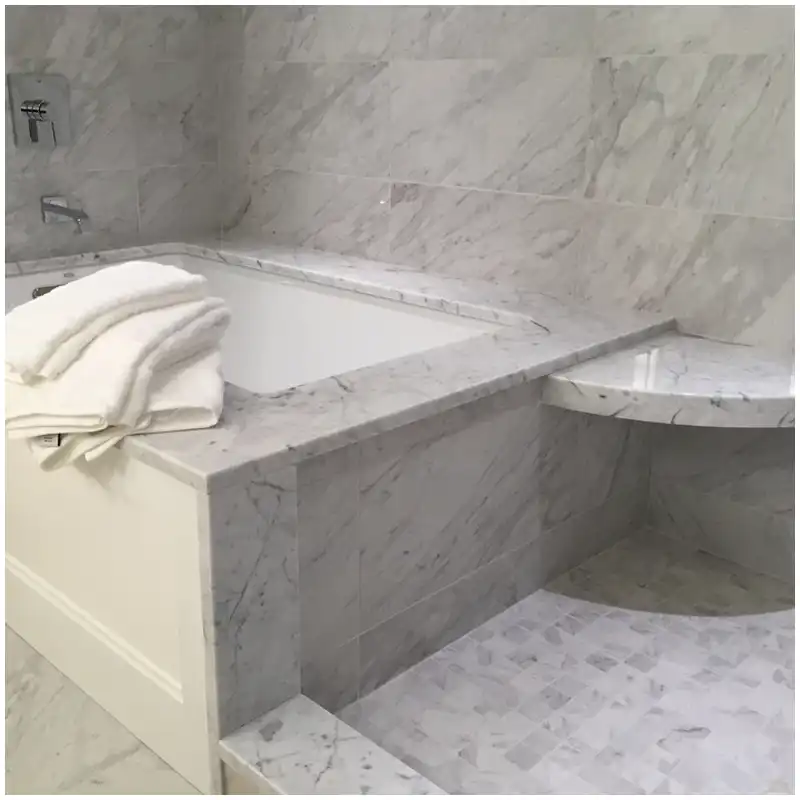

Volakas Marble Repair Acceptance: Fill Color, Polish, and Full-Slab Lighting
A pale fill at the back edge looked harmless under the warehouse lamps. After the piece was polished and placed under warm mirror lights, the fill became a soft beige comma in the middle of a cool white field. The repair had not moved. The light had simply stopped being kind.

Számára Volakas marble repair acceptance, the exact location, type, size, finish, and viewing conditions are recorded before deciding whether the repaired piece belongs in a visible area.
Do not just look at samples. A tiny repair sample is far less informative than the same condition spread across a full slab.
Map the Repair before the Surface Is Altered with Volakas Marble Repair Acceptance
Three Volakas slabs are laid out under the light specified for the project to inspect pale resin fills. Comparing full faces under fixed light reveals how a stable fill shifts tone against the surrounding white field. Dry-laying multiple pieces shows how a single repair behaves within a larger assembly. That whole-face view is weighed above any isolated close-up, because the close-up removes the surrounding white field that decides the call.
The range sheet and the lighting record are kept together, so a future review can compare installed work against the conditions the repair was approved under rather than against a corrected image.
Next, darker natural lines are examined. Both damp and dry views are preserved alongside the approved reference before any fabrication alters the surface. The goal is to detect if polishing causes the repair to reflect light differently than the surrounding stone. These features are assessed by stepping back for context and moving in for detail on edges and pores.
This detail is kept beside Volakas Marble for Bathrooms because the same white marble must agree across slabs, wet areas, lighting, joints, and maintenance.
Judge Fill Color against the White Field
The cool white background is evaluated from a standard viewing distance. This assessment occurs before polishing or cutting modifies the surface. The key question is whether a minor repair becomes conspicuous when the repaired piece is viewed within a larger wall field. This broad perspective is balanced with close inspection of specific defects and joint details.
The four outcomes are not interchangeable, and the difference turns on where the repair sits. A repair in a field that will be read at arm’s length, such as a backsplash or a vanity return, carries a different tolerance from one high on a wall that is seen from across the room. Moving the affected piece into a less exposed position, reassigning it to a smaller cut, or accepting it where it will be covered by joinery are all legitimate responses; remaking is the answer only when none of those placements work.
Volakas makes that judgement harder than a strongly veined marble does. Its ground is quiet and its veining is narrow and grey, so a filled area does not necessarily announce itself by breaking a bold pattern. What it does instead is sit slightly differently from the surrounding field under directional light, which is why the decision is made under the lighting of the room rather than in the warehouse. A repair that reads cleanly in diffuse daylight can still register as a dull patch under a warm downlight, and the reverse also happens.
At a bathroom threshold, darker natural lines are verified from the user’s eye level. Maintaining damp and dry references ensures consistent evaluation across the slab range. Ignoring this comparison risks discovering post-polish reflection mismatches too late. The final installation determines if the line stays within acceptable limits. If not, the batch returns to the sorting rack rather than proceeding.
With Volakas Marble Tile Sorting, full faces are compared under the project light before acceptance of tone, veins, finish, and wet-area placement.
Számára Volakas marble repair acceptance, the file begins with an exact full-face location, not a close-up without orientation, because a fill photographed without its slab position cannot be allocated or defended after the cut.
Compare Polish and Honed Reflections
Comparing damp shower details against dry references under varying light sources highlights tonal shifts. These changes are observed from a normal distance to gauge their impact on the overall field. Warm lighting can amplify the visibility of repeated repairs on large walls. Adjacent stones can accentuate a deviation in the white background, and that effect can read strongest at a joint rather than in the middle of a piece. The focus remains on the integrated appearance rather than isolated defects.
My inspection sheets link the dry-lay map directly to the repair record. This connection ensures that formal documentation supersedes casual phone photos. Honed wall panels must conform to the physical range established during this review.
The lights are kept fixed while a polished face is checked under mirror light. The affected piece is mapped while the full slab is still in front, because polishing, sealing, cutting, or cleaning will change what can be proved. The concern is whether wetness hides the difference until the project dries. For a polished face under mirror light, the whole piece is read from two paces back, then the fill edge, the pore line, and any polish residue dragged across the boundary are checked after moving in.
| Decision point | Evidence to inspect | Release condition |
|---|---|---|
| Repair identity | Type, size, orientation, and full-slab position | Condition can be found again after cutting |
| Color relation | Fill, natural lines, and surrounding white field | No distracting contrast in the assigned view |
| Finish relation | Polished or honed reflection around repair | Sheen change stays inside approved expectation |
| Light relation | the project light condition, wet and dry observations | Project viewing condition is recorded |
| Disposition | Accept, relocate, remake, or hold | Piece allocation matches the inspection decision |
The Hard-Won Lesson in Volakas marble repair acceptance: A repair can be invisible until the finish makes it speak
A small repair was approved while the slab was damp and unpolished. Later, the polished surface reflected a mirror light across its edge and produced a different gloss patch. The repair itself held. The acceptance did not account for the final finish and view.
The Lesson: Judge every visible repair after the surface reaches the finish and lighting it will keep.
Read the Repair under Project Lighting
On a honed panel the repair is read against the surrounding field at working distance. The batch stays on hold until it is known whether an adjacent cutout will move the repair into a more prominent position, since the decision changes once the panel is cut.

At a full-slab inspection rack, a polished face is put under mirror light into the dry-lay before a decision is made. The affected piece is mapped before any repair changes it while the full range is visible. Adjacent pieces quickly reveal that wetness hides the difference until the project dries. The complete setting reveals a polished face under mirror light without the mercy of a cropped photograph. Only the complete arrangement earns a release mark.
With Volakas marble repair acceptance, the buyer must compare fill color and reflection against the intended surface finish, since a fill that reads calm on a honed sample can read differently on the polished wall it was cut for.
Assign Repaired Zones to Suitable Locations
During a check of a polished edge below warm mirror lamps, a honed wall panel is compared across several pieces. The batch is held until the full relationship is clear while the full range is visible. If that is skipped, a cutout moves the repair into the most visible remaining area. Grout, water, light, and neighboring pieces make changes in a honed wall panel easier to see. The whole arrangement is trusted before a polished close-up is trusted.
Warehouse logs combine the batch register with the room allocation sheet. These documents define material identity and specify environmental conditions like light and finish. This data allows us to trace tonal shifts to specific locations rather than debating subjective perceptions.
Volakas Marble for Bathrooms is kept beside the approved physical reference so batch drift cannot hide behind a material name.
Keep Wet and Dry Evidence Together
While reviewing a replacement piece beside the accepted range, a repair close to a cutout is not judged from one flattering crop. The acceptance range is recorded on the dry-lay sheet while the full range is visible. The trouble appears when a repair is accepted without a record of its exact position. Once grout and water enter the picture, the effect of a repair close to a cutout becomes easier to judge. The larger field decides; the flattering detail shot does not.
Before the batch is accepted, the Volakas Marble Slab Approval is revisited to check whether this detail still belongs with the complete Volakas bathroom.
When the specification calls for Volakas marble repair acceptance, the approval file needs warm and neutral lighting records, because white marble can appear different under the project’s warm and neutral lighting conditions, and one light source will not show that shift to the next reviewer.
Set a Clear Accept Reject or Relocate Record
Returning to three Volakas slabs under the light specified for the project, a repair is placed at a concealed return beside the approved reference. The full faces are compared under fixed light while the full range is visible. A single image can hide the fact that a replacement conversation starts from memory instead of evidence. Project light gives the accepted result for a repair at a concealed return a more representative project-specific check than a corrected warehouse image. Approval follows the dry-lay, not the prettiest individual piece.
The dry-lay file records which pieces passed and under which light they passed. Patchiness across a repair becomes a question that can be tested against that record rather than argued from photographs.
A wet and dry reading is kept beside the approved reference, because a stable fill can change colour against the surrounding stone once the surface is wet, and the repair has to hold in both states.
Where a White Marble Repair Changes the Whole Face
The map matters more than the close-up
A repair is only acceptable in relation to the whole field, the crop, the joint, and the room’s main sight lines.
Finish can change visibility
Polish, honing, wetness, and raking light alter what the eye notices. Keep the final condition in the record.
A clear disposition protects the allocation
Accepted repairs may suit a concealed return and fail on an eye-level wall. Write the use condition down.
My rule for the record is simple: start from an exact full-face location, not a close-up without orientation, because the same fill can pass quietly at a slab edge and fail across an eye-level wall.
Most buyers go wrong right here: they must compare fill color and reflection against the intended surface finish, not the finish the sample arrived in, before the lot leaves the rack.
The point of pushback is this: the file needs warm and neutral lighting records because white marble can appear different under those lighting conditions, and memory will not settle a dispute once grout and water arrive.
At a damp shower detail beside a dry reference, one more comparison of a darker natural line is made, and the affected piece is mapped before any repair changes it. Dry-lay map is noted in the warehouse log because a small repair becomes obvious when repeated across a visible wall. The actual difference stays in dry-lay map rather than being corrected away.
Before applying the release mark, a honed wall panel is placed in the recorded view at a full-slab inspection rack, and the batch is held until the full relationship is clear. The full-slab range sheet is noted in the warehouse log because a stable fill changes color against the surrounding field. The condition that exposes the issue with full-slab range sheet is saved, not just the image that minimizes it.
Later in the approval record, the product route for Volakas marble slab is filed beside the repair map. That reference is kept with the signed record rather than reopening the decision from memory.
The related decision is documented in Volakas Marble Slab Approval. Keep that reference with the signed record rather than reopening the decision from memory.
For an operational comparison, keep Volakas Marble Batch Matching. Keep that reference with the signed record rather than reopening the decision from memory.
The next material or project question belongs with Volakas Marble Tile Sorting. Keep that reference with the signed record rather than reopening the decision from memory.
Számára Volakas marble repair acceptance, the signed evidence must describe the physical condition that the next team will actually receive.
A final check of Volakas marble repair acceptance belongs in the close-out record, because a good detail cannot survive a missing reference.
Frequently Asked Questions
1. Are filled repairs normal in Volakas marble?
Natural stone can contain natural features and treated areas. Acceptance depends on the actual slab, repair condition, intended use, finish, light, and project standard.
2. Why does a repair look different after polishing?
Polish can change reflection around the fill and make a boundary visible under direct or grazing light. Inspect after the intended finish is complete.
3. Should repairs be checked when the marble is wet?
Wet viewing can help identify some conditions, but it may also hide others. Record wet and dry observations rather than relying on one view.
4. Can a repaired slab be used in a bathroom?
The answer depends on the repair, location, intended application, fabrication, exposure, finish, and project acceptance standard. Map and assign the piece deliberately.
5. What should happen when a repair is disputed after installation?
Photograph the full installed face and close condition under documented light, stop further related cutting where practical, and compare the installed piece with the repair map and acceptance record.
Quick-Reference Checklist for Volakas marble repair acceptance
- Photograph the full slab with repair orientation and scale.
- Compare fill color with the dry white field.
- Inspect the final polish or hone under the lighting specified for the room.
- Assign the repaired zone to a stated visibility condition.
- Save an accept relocate remake or hold decision with the slab map.
Final Conclusion
A repair passes only when it belongs in the actual face, finish, light, and room where the stone will be judged. The final decision on Volakas marble repair acceptance must stay attached to the evidence that production and site teams can verify.
Lighting lies. Esta Stone would rather keep one questionable repair off a visible wall than explain a perfectly stable fill that nobody can stop seeing.
References
- Márvány, Wikipedia.
- Dimension Stone Design Manual, Natural Stone Institute.
- Natural Stone Institute Technical Bulletins for Wet Areas.
- TCNA Handbook for Ceramic, Glass, and Stone Tile Installation.
- Stone Federation Great Britain Technical Guidance for Natural Stone.
- Search Essentials, Google Search Central.