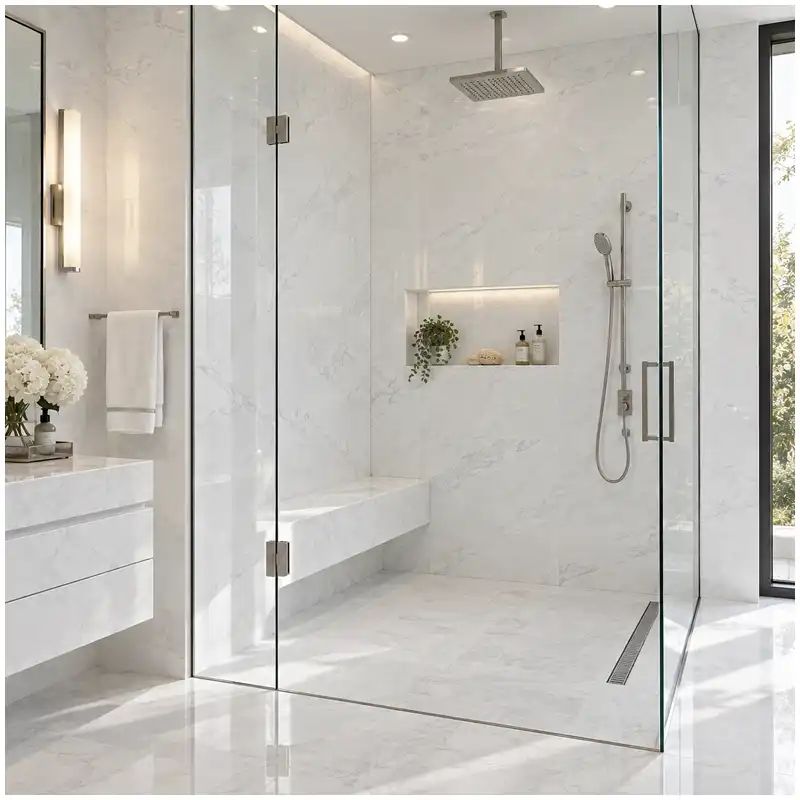
A shower niche is small, wet, and placed close to the eye. Volakas marble niche shelves can look refined or immediately expose a wrong vein, a flat shelf, or an awkward edge. Esta Stone uses full-piece review, a slope check, and the actual bathroom light to settle those details before a wall panel is cut.
The floor-to-wall line is where a white-marble bathroom can either look deliberate or look patched together. Volakas marble skirting needs the same slab, light, joint, and vein review as the floor and wall above it. Esta Stone uses full pieces and a dry-lay to settle that narrow but highly visible transition before cutting starts.
A sink cutout removes the center of a slab crop and can leave a strong grey vein pointing into a tap hole, breaking across the front edge, or disappearing behind the basin. Susan Zheng checks the full slab with a scaled template before any vanity piece is nested. Esta Stone fixes the basin, faucet, backsplash, edge, joint, repair, and spare-piece relationship under both warehouse and bathroom light so the finished top reads deliberately rather than
A box label cannot tell you how grey veins will repeat across a bathroom floor or climb a wall. The sort starts at the slab face, because a diagonal line divided by the saw is never described by a size. Group the pieces by undertone first, then by vein weight and cloudy zones; reserve the calmest group for panels read at eye level; send heavier movement to long floor runs; keep one face lot per box; and hold any piece outside the written span. Esta Stone keeps each accepted group tied to face numbers, wall and floor allocation and spare stock so installation does not create a patchwork field.
A small Volakas sample may contain one thin grey line and a clean white field, while the production slab carries warmer clouds, broader veins, open features, or repaired areas outside that crop. Susan Zheng builds approval from square full-slab photographs, controlled lighting, slab identity, finish, repair maps, cut overlays, and dry-lay transitions. Esta Stone treats the sample as a color reference only; the complete face decides where the stone can be cut and installed. My warehouse rule is simple: Approve the visible crop after cutouts are drawn, not before.
Volakas marble vs Carrara is a full-slab decision. Both stones look pale on a sample, but their movement and white marble undertone behave differently under warm mirror light, neutral ceiling light, water, grout, and adjacent finishes. I compare the production range rather than ideal pieces, then check vein scale, finish, wet appearance, cutouts, dry-lay, and replacement control before either name is approved for repeated bathrooms. Esta Stone uses the room and the warehouse evidence together, so the batch you approve is the batch your bathroom receives.
Volakas marble reads as a pale field with grey to grey-brown diagonal movement, and the same board behaves differently on a wall, a vanity top, a floor, and a shower elevation. Zone allocation decides the result: a large wall field spreads the movement and forgives it, while a floor field cuts it into a joint grid read from above. Tone spread between boards, the finish, and the absorption measured on the reserved lot decide how the stone behaves in wet use. The zone schedule, the tone group and the batch record belong in one project file so repeated rooms stay inside the approved range.
A thickness number means very little unless the project defines where it is measured, whether it is nominal or finished, and what the chosen assembly must support. Wall panels, vanity tops and built-up edges place different demands on Volakas marble. I inspect the actual production finish at several locations, relate those readings to the approved detail and keep weight calculations tied to a declared density. The designer and fabricator still decide the structural arrangement; the warehouse record prevents a broad 20 mm description from hiding an unusable range.
A bookmatch is not approved because two slab photographs look roughly symmetrical. The pair must come from the correct cutting sequence, open in the intended direction and survive the room's joints, fittings and light. I inspect the central transition first, then move outward to undertone, vein weight, repairs and usable dimensions. A calm Volakas pair can lose its balance when a vanity mirror, niche or wall return cuts through the wrong part of the drawing. The approval record needs one numbered layout with the viewing conditions and every proposed cut visible.
The white face is only part of a shower wall decision. Stone thickness, factory backing, adhesive, waterproofing and bathroom lighting all affect the result that a project team must approve. I would start with pieces from the reserved batch and build a representative assembly before releasing repeated bathrooms. A clean sample cannot prove how a bonded panel will look after moisture exposure. The approval record needs to connect the visible finish with the materials behind it, including the limitations that the installer and maintenance team will inherit after handover.
Carrara around a bathtub is seen close, touched wet, and divided by deck openings, wall returns, access panels, and warm lighting. A strong vein can disappear into a faucet cutout or land on a vulnerable narrow bridge. Esta Stone overlays the entire surround on full slabs, checks the selected finish at 3000K and 4000K, and records joints, wet edges, support, and batch relationships before fabrication. My warehouse rule is simple: Approve the crop only after every real opening is overlaid.
A bathroom threshold may be one narrow piece, yet it bridges waterproofing, drainage, floor levels, door clearance, wall finishes, movement joints, and foot traffic. Carrara can also expose wet edges and setting-bed moisture quickly. Esta Stone checks the section, not only the plan dimension, and approves the pale marble, finish, edge, slope, and joint arrangement together before fabrication. My warehouse rule is simple: Put orientation, levels, and slope on the fabrication drawing. Before release, draw both finished levels. Mark slope and wet-side orientation.