

Quick Summary: This guide explains why Taj Mahal Quartzite at Esta Stone has become the performance-first stone for ultra-luxury real estate in 2026. Covering market positioning, developer ROI, large-scale export logistics, advanced digital fabrication workflows (Slabsmith), sensory design practises (backlit engineering, color temperature ranges) and field-ready technical specs, the document equips architects, developers and procurement teams to specify, procure and install Taj Mahal Quartzite at project scale with minimal risk.
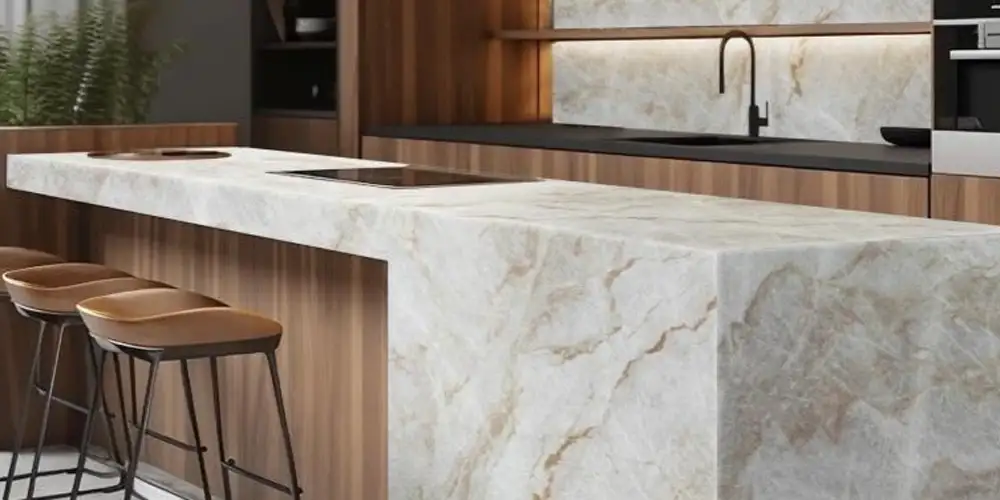
Taj Mahal Quartzite: The 2026 Strategic Specification Guide for Ultra-Luxury Real Estate
In the global luxury property market, materials are no longer decorative decisions—they are strategic investments. The Premium Quality Taj Mahal Quartzite Series from Esta Stone Factory has emerged as the material of choice for architects and developers designing landmark projects in Dubai, Doha, Miami, and Toronto. As the 2026 design cycle shifts toward Warm Minimalism—favoring tactile surfaces, neutral palettes, and enduring natural materials—Taj Mahal Quartzite delivers both visual serenity and technical strength.

Taj Mahal Quartzite has moved beyond decorative use to become the primary high-performance alternative to marble. It delivers marble’s warm, soft white aesthetic and delicate gold veining while offering markedly superior mechanical properties—most notably Mohs hardness around 7.0 (versus marble ~3.0). That combination of photogenic elegance and durability is why many design teams now prefer it for ultra-luxury applications where appearance cannot compromise longevity.
In 2026 the dominant “Warm Minimalism” trend—especially across the Middle East and North America—prioritizes neutral palettes with tactile warmth and natural materials that photograph well. Taj Mahal Quartzite answers that brief: it reads as timeless luxury on camera and in physical space, and it scales effectively from private penthouses to 5A office towers and five-star hotels.
| Performance Metric | Taj Mahal Quartzite | Premium White Marble | Benefit for Project |
|---|---|---|---|
| Mohs Hardness 💎 | ≈ 7.0 (High) | ≈ 3.0 (Soft) | Scratch resistant in high-traffic areas |
| Acid Resistance 🍋 | Excellent (Inert) | Poor (Etching risk) | Low maintenance for bars & kitchens |
| Porosity Rate 💧 | < 0.2% (Very Low) | 0.5% – 2.0% (Medium) | High stain resistance; less sealing needed |
| Compressive Strength 💪 | 180 – 220 MPa | 60 – 100 MPa | Supports heavy loads & structural features |
Unlike marble, which offers beauty but limited durability, Taj Mahal Quartzite combines refined elegance with exceptional structural resilience. Its Mohs hardness of approximately 7.0 makes it suitable for demanding applications including luxury hotel lobbies, high-traffic casino floors, executive office interiors, and penthouse kitchens. At the same time, its champagne undertones and subtle veining create the luminous calm that today’s affluent buyers expect.
1 — Commercial Value & Global Logistics (The Developer’s Perspective)
Investment Appreciation
Specifying Taj Mahal Quartzite raises perceived unit value. High-end buyers and institutional operators consistently interpret natural stone as a durable, high-quality finish that supports resale premiums and shorter time-on-market. For developers, the incremental specification cost is often recouped through uplift in net selling price and stronger long-term asset valuation.
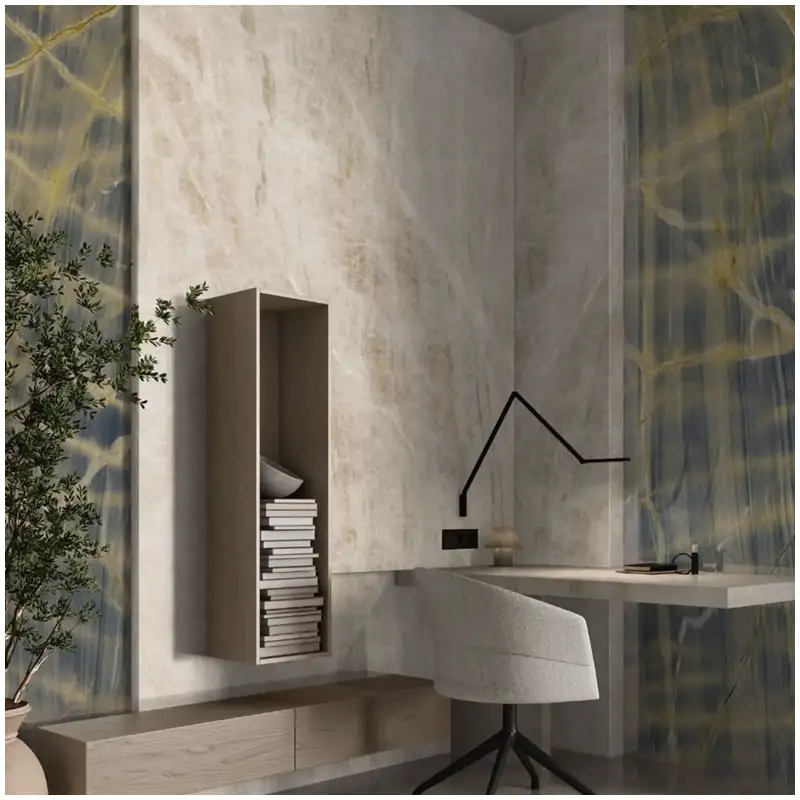
Scalable Delivery — 2025 Case Study
In 2025 Esta Stone executed a landmark export: 70 full 20-ft container equivalents of Taj Mahal Quartzite to deliver materials for a cluster of 5A office and luxury hotel projects across Dubai and Qatar. The project demonstrated three operational imperatives for large deployments: early block reservation, rigorous pre-shipment QA, and coordinated on-site acceptance protocols to prevent delays.
For developers managing large-scale projects, the stone also supports supply chain stability, digital slab mapping, and precision fabrication planning. It is not simply a finish—it is a performance-grade architectural asset engineered for prestige and longevity.
Supply Chain Security: Single-Block Procurement
For massive projects, “single-block procurement” (reserving multiple slabs from the same quarried block) is fundamental. It ensures color and vein consistency across expansive bookmatched runs and reduces visual discontinuity—critical for long corridors, lobby elevations and multi-apartment developments where consistency drives perceived luxury.
| Project Phase | Key Action Item | Strategic Importance |
|---|---|---|
| Procurement 🏗️ | Single-Block Reservation | Ensures 100% color & vein consistency across large areas |
| Digital Phase 💻 | 1:1 Slabsmith Twinning | Virtual dry-lay saves up to 15% on material waste |
| Quality Control 🔍 | Pre-shipment Light Test | Guarantees optimal performance for backlit architectural features |
| Logistics 🚢 | Sequential Crating | Matches site installation sequence to reduce labor handling |
| Protection 🛡️ | Nano-Sealing Protocol | Essential for salt-spray resistance in coastal or desert climates |
2 — Digital Craftsmanship (The Engineering Core)
Slabsmith Technology — 1:1 Digital Twinning
Slabsmith creates a 1:1 digital twin of each jumbo slab: high-resolution imaging, laser flatness scans and a metadata record (thickness, resin fill, light transmission). These digital assets enable offsite approvals and precision cutting plans that translate virtually—eliminating many on-site surprises.
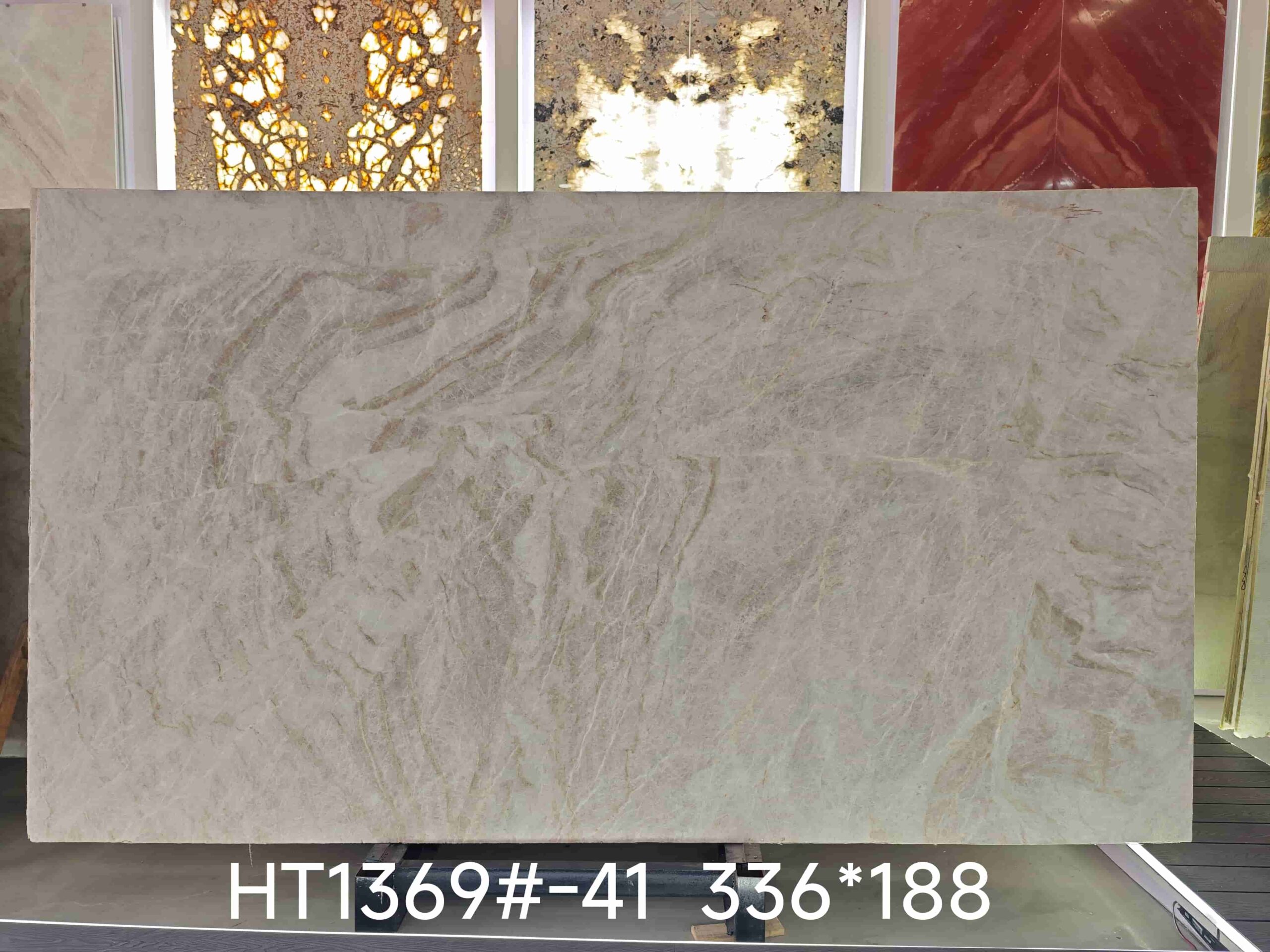
Eliminating On-Site Surprises with 3D Pre-Alignment
Using the slab twin, project teams run 3D dry-lays to simulate seams, supports and threshold transitions. This pre-alignment prevents last-minute site design changes and reduces slab waste and rework.
The Art of the Seam — Bookmatching & Diamond Matching
Bookmatching and diamond matching allow designers to create mirrored vein vistas—an effect commonly used in casino lobbies and feature walls. Slabsmith outputs exact cutting maps so fabricators execute mirrored panels with precision and predictable seams.
Vein Continuity & Long Runs
For 20-meter penthouse corridors or multi-elevator banks, continuity is non-negotiable. Digital planning maps slab sequences to corridor runs and identifies the minimum number of matched slabs needed to preserve flow.
Waste Optimization — 45° Mitered Joints
To reduce waste and create seamless waterfall edges, fabricators use 45° mitered joints. That technique preserves continuous veining while reducing material loss—important when working with premium slabs and large quantities.
4 — Sensory Design & Technical Specs (The Architect’s Toolkit) 💡
Translucency & Lighting Engineering
Taj Mahal Quartzite performs exceptionally in layered lighting strategies. For high-end bars, master suites and spa features, engineers typically specify warm LED ranges between 2700K and 3500K to preserve the stone’s champagne/gold undertones and avoid color shift. Key practices:
- Use dimmable LED drivers with CRI ≥ 90 for natural rendering.
- Include non-yellowing diffusers and ventilation channels behind backlit panels.
- Request slab light-transmission tests before thinning for illumination.

Durability & Performance Specs
Technical highlights that justify Taj Mahal Quartzite in heavy programs:
- Mohs hardness: ≈ 7.0 — significantly more scratch resistant than marble (≈3.0).
- Heat resistance: Stable under typical kitchen and commercial thermal loads.
- Low deformation: High compressive strength suitable for large tables and continuous flows.
Climate Resilience & Sealing Protocols
In high-temperature Middle East climates and coastal, high-salinity zones, the following are essential:
- Use solvent-based penetrating sealers with documented UV and salt-spray resistance.
- Specify expansion joints and flexible adhesives to accommodate thermal movement.
- Implement scheduled resealing (annually in high-use commercial contexts) and periodic professional maintenance.
5 — Conclusion & Strategic Partnership 🤝
Future-Proofing Your Asset
Architects and developers who specify Taj Mahal Quartzite buy a material that sustains visual prestige and resists functional depreciation. Its photo-ready palette and robust performance reduce lifecycle interventions, positioning finishes as long-lasting value drivers rather than short-term cost items.

6 –Top FAQs of Taj Mahal Quartzite
1: Is Taj Mahal Quartzite suitable for high-traffic commercial floors?
Yes. With a Mohs hardness around 7.0, it significantly outperforms marble in scratch resistance and structural strength, making it suitable for casino floors, hotel corridors, and office lobbies when properly installed and sealed.
2: Does Taj Mahal Quartzite require sealing?
Yes. Although denser than marble, it is still a natural stone. A professional penetrating sealer is recommended during installation and periodically thereafter, particularly in hospitality and kitchen environments.
3: Can Taj Mahal Quartzite be used outdoors in hot climates?
Yes, when specified correctly. It performs well in high-temperature environments such as the Middle East, provided expansion allowances, UV-stable sealers, and proper substrate engineering are implemented.
4: Is Taj Mahal Quartzite more expensive than marble?
Material cost may be comparable or slightly higher, but lifecycle value is superior. Reduced maintenance, longer durability, and higher perceived luxury often generate stronger ROI for developers.
5: What thickness options are recommended for luxury projects?
Standard slab thicknesses include 2cm and 3cm. For high-end countertops and commercial installations, 3cm slabs are typically preferred for structural stability.

6: Can Taj Mahal Quartzite be backlit?
Yes. Select slabs with appropriate translucency can be engineered for backlit features, typically using 2700K–3500K LED systems to enhance the stone’s warm undertones.
7: How do developers ensure color consistency across large projects?
Through single-block procurement and digital slab mapping technologies such as Slabsmith, ensuring vein continuity and uniform tonality across multiple installations.
Call to Action — Expert Consultancy & Digital Layout Services
For procurement teams seeking consultancy, digital slab twinning and turnkey layout services, contact our specialist team to arrange slab selection, 3D dry-lays and export coordination. View our specification insights and case studies to inform your strategy: specialist resources and technical guides are available via our editorial and product pages such as the 2026 Middle East overview and technical FAQ documentation (see linked resources below).
Taj Mahal Quartzite is not merely a decorative material—it is a strategic specification choice for ultra-luxury real estate. Its combination of timeless aesthetics, structural resilience, and scalable logistics makes it uniquely positioned for landmark developments in 2026 and beyond. For architects and developers seeking finishes that enhance brand prestige, protect asset value, and reduce long-term maintenance risk, Taj Mahal Quartzite stands as a future-proof investment. Selecting the right stone today defines the architectural legacy of tomorrow.

Further reading & resources: strategy briefs and technical pages
2026 Why Taj Mahal Quartzite Dominates Luxury Middle East Projects
Why Taj Mahal Quartzite is the High-Yield Architectural Asset of 2026: A Strategic Analysis
Taj Mahal Quartzite is a strategic material: aesthetically aligned with 2026’s Warm Minimalism while delivering the performance necessary for high-use luxury environments. Combining digital craftsmanship (Slabsmith), single-block procurement, and engineered installation protocols forms a defensible specification strategy that minimizes risk and maximizes asset value.
To deploy Taj Mahal Quartzite at scale: reserve single blocks early, require 1:1 slab digital twins, use bookmatching for feature runs, design for thermal and expansion control in harsh climates, and plan scheduled maintenance into operating budgets. Together, these measures turn exquisite stone into a durable, non-depreciating asset for the next decade.