



Volakas Marble Grout Color: Joint Tone Across the Batch
The generic grout workflow (building the sample board, viewing it under the specified lamps, setting joint width, recording the approval) belongs to the White Marble Grout Color approval guide and is not repeated here. This page answers the narrower question a Volakas order raises: what does the joint do when the stone itself changes character from panel to panel inside one batch?
Scope: This article covers joint-tone selection across the vein-density and undertone range of one reserved Volakas batch. For grout sample-board construction, lighting methodology, joint-width mechanics, cementitious versus epoxy product selection, and post-installation troubleshooting of the generic kind, the White Marble Grout Color approval guide owns the workflow.
The Batch Question a Single Swatch Cannot Answer
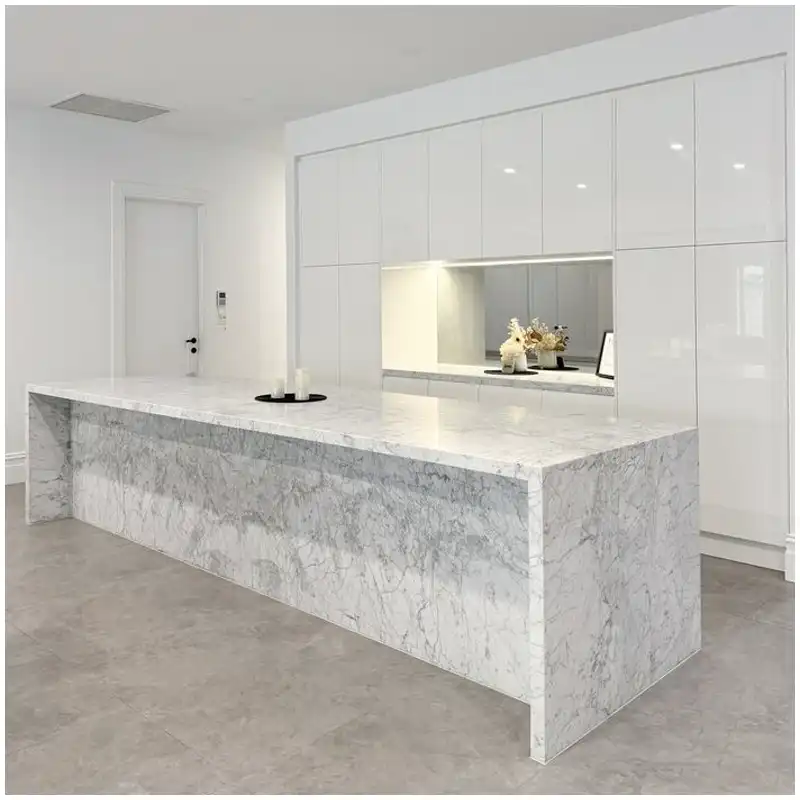
Volakas blocks range from near-silent white fields with faint grey cloud to panels carrying diagonal movement across the whole face. A single order can mix both, because the catalogue sells the batch by range, not by uniformity. Grout decisions made against one flattering panel therefore fail quietly on the others: the joint passes its approval test and then reads wrong on the wall that actually got installed.

Undertone adds the second axis. Volakas panels drift between cool grey-white, faint lavender, and warmer creamy passages, and the same grout candidate pulls each undertone a different way: a cool joint can flatten a warm panel, while a warm joint can make a cool panel look grey beside it. Neither result is a defect in the stone or the grout; both are the interaction this page exists to place under the batch record before ordering.
The decision rule that survives the range: the joint is calibrated to the quietest field and checked against the most active one. If one joint tone cannot serve both ends of the crate, the answer is not a compromise colour; it is re-grouping which panels go to which rooms, which is the sorting decision covered in the Volakas tile sorting guide.
One Joint Tone, Two Different Reads
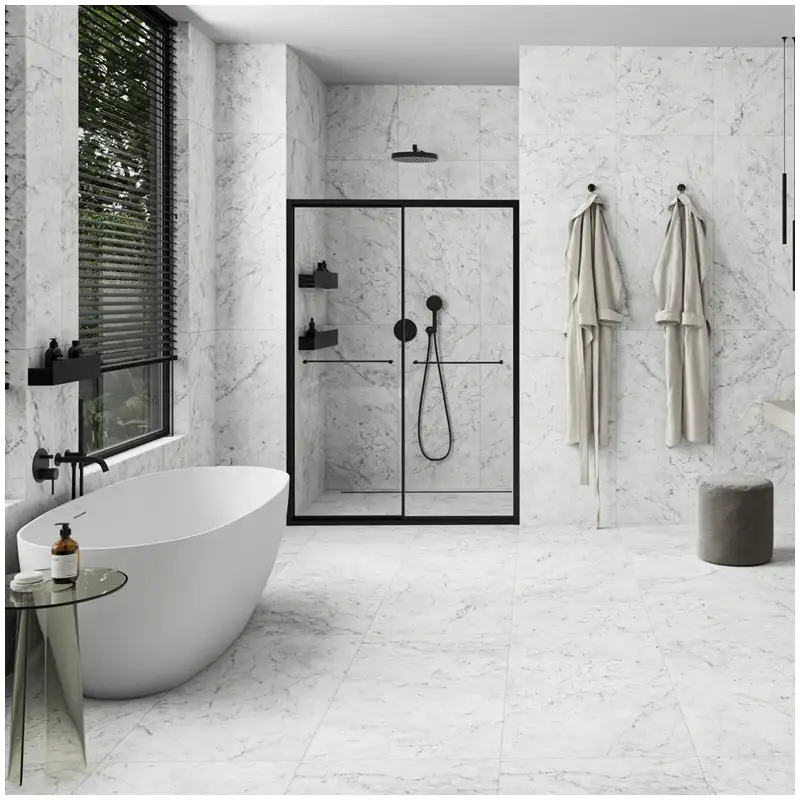
On a quiet Volakas panel the eye has little else to follow, so the joint becomes the pattern. A body-colour joint keeps the field reading as continuous stone; anything darker turns every tile edge into a graphic outline and a calm bathroom into a grid. On an active panel the reverse holds: the grey movement already carries the visual weight, and a slightly stronger joint can absorb into the veins rather than competing with them. The Volakas marble grout color that disappears on one wall can dominate another wall in the same room.
This is why the parent guide’s board method matters differently here: the board must carry tiles from both ends of the reserved batch, not one convenient sample. A single-panel test does not fail noisily; it approves a joint tone that only works on that panel, and the batch keeps the difference for the installer to discover.
| Field type (same batch) | What the joint does there | Batch-level action |
|---|---|---|
| Quiet white field, faint cloud | Eye tracks the joint before the stone; contrast reads as a grid | Pair with a body-tone joint matched to this panel’s undertone |
| Active grey diagonal movement | Joint can absorb into vein weight or cut across it, depending on direction and tone | Test the same joint on this panel before accepting the quiet-panel result |
| Warm creamy passage panels | Cool joints flatten the warmth; the panel looks grey beside its neighbours | Either a warmer joint for this group or a separate room allocation |
| Cool grey-white panels | Warm joints push them visibly greyer; mismatch shows at the first shared wall | Keep cool-group panels out of rooms set with warm joint tone |
Group the Batch Before Fixing the Joint
Order of operations matters more than the colour choice itself. Sorting the panels into tone and vein groups happens on the dry-lay table, and the grout decision should come after the groups exist. The parent workflow starts from one stone reference and picks one joint; a Volakas order starts from three or four groups inside one batch and must check the joint against each of them.
For each group, place the joint candidate across full tiles of that group (quiet set, active set, warm set) under the room’s specified lamp, and keep the photographs with the group they came from. A joint that passes on the quiet set and fails on the active set is not rejected outright; the groups move to different rooms, and the record names which joint was approved against which group.
Where the project insists on one joint tone through every bathroom, the quietest panel in the crate is the strictest visibility test: a pale field has no veining to absorb the joint line, so grid effects that busier panels can hide show there first. Passing that panel does not prove the active end passes too. An active field interacts with the joint by its own logic, since vein direction can either absorb a joint line or cut across it, so a single-tone approval must be photographed against both ends of the range before it is signed.
When the Joint Looks Wrong, Check the Batch First
A joint that disappoints after installation splits into two different problems, and only one of them is grout. Compare the installed field against the group photographs from approval first: if the quiet-panel rooms read as grids while the active-panel rooms look intentional, the pattern points first to panel allocation rather than the grout batch, though the record has to confirm it. The correction is then a sorting question for the remaining rooms, moving quieter panels to fewer sightlines, rather than a re-grout.
If the same joint tone looks wrong in the same way across every room type, the pattern points away from panel allocation and toward a shared grout, application, or environmental factor (batch, water ratio, curing, or a substitution), and the generic diagnosis and treatment workflow applies, again owned by the parent Grout Color approval guide and, for residue cases, the Grout Haze identification guide. A few isolated darker patches inside one joint line should not be assumed to be a colour failure: localized shade shifts can come from moisture still leaving the joint, from uneven cleanup, from sealer migration at the perimeter, or from substrate suction differences behind the tiles, and the cause has to be identified before anything corrective touches the field.
Three Steps When the Joint Disagrees With the Batch
- Document: photograph each room type under the room light, square to the field, with the group-approval photographs of the same panels beside them.
- Isolate: pause grouting on any room whose panel group has not yet been joint-tested, so the remaining crate can still be allocated to what passed.
- Escalate: send the supplier the room photographs, the group records, and the grout batch data, and agree whether the answer is reallocation, joint change, or product correction before further fixing.
Sıkça Sorulan Sorular
1. Does one Volakas batch really need more than one grout decision?
Where the reserved batch actually spans quiet and cloudy panels, yes: the Volakas marble grout color that disappears on one end of the range can frame every edge at the other. Group the panels first, then test the joint against each group; a single flattering-panel test approves only that panel.
2. Is the quietest panel the test that matters?
It is the strictest visibility test, because a pale field has no veining to absorb the joint line, so grid effects show there first. Passing it does not prove the active end passes; approve a single joint tone against photographs of both ends of the batch.
3. Can undertone change the joint decision across one order?
Yes. Volakas panels drift between cool grey-white and warm creamy passages, and a cool joint flattens warm panels while a warm joint greys cool ones. Keep the joint record tied to the undertone group it was approved against, not just to a colour name.
4. Why does the same grout look like a grid in some rooms and fine in others?
The pattern points first to panel allocation rather than the grout batch, but confirm it against the records. Compare each room against the group photographs from approval before blaming the grout; if quiet-panel rooms show the grid and active-panel rooms do not, the joint may be sound and the remaining batch may need re-sorting.
5. Some joint patches dried darker, is that a colour problem?
Not automatically. Isolated shade shifts can come from moisture still leaving the joint, uneven cleanup, perimeter sealer migration, or substrate suction, and each needs a different response. Identify the cause before applying any corrective product, and hand generic residue or cleaning cases to the grout haze identification guide.
Final Conclusion
A Volakas batch is not one stone wearing one face. The joint that keeps a quiet panel reading as continuous stone and the joint that disappears into an active panel are different decisions taken from the same grout bag, and the honest approval is the one that names which group it was tested against. Esta Stone fixes the Volakas marble grout color against photographs of both ends of the crate under the room lamp, and files it with the group records, so the joint follows the batch instead of arguing with it.
Kaynaklar
- Mermer, Wikipedia.
- Dimension Stone Design Manual, Natural Stone Institute.
- ANSI A118.3 (Chemical-Resisting Grouts) and ANSI A118.6/118.7 (Unsanded and Powered Cementitious Grouts), Tile Council of North America.
- TCNA Handbook for Ceramic, Glass, and Stone Tile Installation, Tile Council of North America.